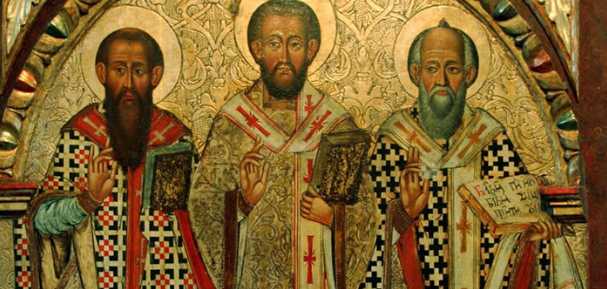
Cappadocian Fathers
22
MENTIONS
8
EPISODES
8
PODCASTS
Search complete. 22 mentions across 8 episodes found for "Cappadocian Fathers".
Sep 9, 2026

Brian ThomasonGUEST
So the divide that is now standard in Trinitarian thought, that doesn't come until later.
Brian ThomasonGUEST
And it comes by some guys called the Cappadocian fathers, who are going to be writing in the 370s, which is going to directly inform the second ecumenical council, which is going to lock in the modeling that is now standard of the three hypostasis in one usia.
Brian ThomasonGUEST
It didn't exist originally.
Hayden PaulHOST
Man, like our Christian brothers and sisters like to remind us, if understanding the Trinity is the only way to heaven, I think we're all screwed.
Jackson PaulHOST
In a Pew Research study, they found that only 17% of Christians that they asked the questions to properly identify the Trinity, only 17% of them were able to do so.
Brian ThomasonGUEST
Yeah, it's a tough road.
Brian ThomasonGUEST
So how did it develop? The reason it developed is because the Cappadocian fathers that I'm mentioning, they take a Neoplatonic cosmology and then they use it for their own purposes.
Brian ThomasonGUEST
So what I've brought up here is the Neoplatonic three hypostases the one, intellect and soul, tohen, nus, suke, those are all from Neoplatonism.

speaker_0HOST
And this doctrine is called the monarchia to patros, the monarchy of the father.
speaker_0HOST
It's often associated with the Eastern patristic tradition with the Cappadocian fathers, Basil the Great, Gregory Nazianzus, Gregory of Nyssa, and all that sort of Trinitarian theology that comes in that tradition.
speaker_0HOST
But it's not actually an Eastern peculiarity.
speaker_0HOST
It is the universal faith of Christianity.
28 MINS LATER
speaker_0HOST
The Trinitarian correction is gentler and deeper and has the possibility of repentance and restoration.
speaker_0HOST
It's the call of a father to his son to remember who he is.
speaker_0HOST
I want to add a word here about the Cappadocian fathers because I owe them a great deal personally.
speaker_0HOST
And I think the modern English speaking Christian has often missed how foundational they are.

Chris DotsonUNKNOWN
No, I did what any normal parent of a seven-year-old would do.
Chris DotsonUNKNOWN
I sat her down and walked her through an in-depth theological, historical conversation around the Trinity, right? We started in Genesis, worked our way through the Jewish Shema, talked about the divine name, the Council of Nicaea, the Cappadocian Fathers, like just basic normal bedtime stuff that you would probably do, right? No, I'm kidding.
Chris DotsonUNKNOWN
I didn't do that.
Chris DotsonUNKNOWN
I said, babe, sort of, I'm kidding.

Tim HowardGUEST
That's actually a later development.
Tim HowardGUEST
When you read the Patristics and specifically the Cappadocian Fathers, Central to that would be Gregory of Nanzianzus.
Tim HowardGUEST
They never understood the Trinity in terms of God.
Tim HowardGUEST
Rather, God is the father.
29 MINS LATER
ZachHOST
But anyways, who are some of the Christians that kind of peddled this that you have – that have helped you to understand this doctrine or this idea?
Tim HowardGUEST
Well, what I would recommend people do is to look into John Bear's two-volume work on – I think it's called Searching for the Nicene Doctrine of the Trinity.
Tim HowardGUEST
And he does a very good job of outlining the early church history of the – Debates and formulations of the Trinity And the most earliest understanding Of the Trinity Specifically Amongst the Cappadocian fathers Is this view I'm talking about Gregory of Nanzianzus formulated the Trinity in the exact same way that I'm talking about.
Tim HowardGUEST
This is before Augusta, right? So we already had church fathers and Christian thinkers understanding the Trinity within and situated within the monarchy.

Andrew M. HenryHOST
We've already met one of them, Gregory of Nyssa, but there was also his brother, Basil of Caesarea, and his friend Gregory of Nazianzus.
Andrew M. HenryHOST
Together they're known as the Cappadocian Fathers, and they're some of the most important theologians in Christian history, and they all have a deep apophatic streak.
Andrew M. HenryHOST
Basil of Caesarea drew a distinction between God's essence and his energies.
Andrew M. HenryHOST
He argued that God's essence, what he actually is, is unknowable.
Andrew M. HenryHOST
This brings us finally to the most famous apophatic theologian, who ironically, and in true apophatic fashion, is anonymous to us.
Andrew M. HenryHOST
Though he wrote under the pseudonym Dionysius the Areopagite, an obscure figure from the New Testament, and scholars today call him Pseudo-Dionysius.
Andrew M. HenryHOST
Writing around the year 500, the apophatic tradition was already old and well-established because of the Cappadocian fathers.
Andrew M. HenryHOST
But Pseudo-Dionysius is the first to deploy the technical vocabulary apophatic versus cataphatic for Christian theology, borrowing the vocabulary from the Athenian Neoplatonist Proclus.

Jay DyerHOST
But you will get the same line of argumentation in Basil and Gregory Notzianzus in a shorter format for the Cappadocian model of the Trinity, which is Constantinople I's official dogmatic stance.
Jay DyerHOST
Now, the issues, though, are not just, well, what do the Cappadocians mean and can we harmonize that with Christianity? Roman Catholicism, because Roman Catholicism will state that it believes all kinds of stuff.
Jay DyerHOST
So it will affirm, yeah, we believe, uh, Cappadocians and we believe Aquinas and we believe Augustine and we believe, so they'll sort of have this umbrella approach.
Jay DyerHOST
But the problem with the umbrella approach is that the Cappadocians are very specific.
Jay DyerHOST
And by the time you get to Aquinas, you're going to have things like the, uh, uh, equating of nature in person, which is a fundamental denial of, uh, what is it? Basil it's called basil letter 38, right? It's actually believed to be Nyssa's letter 38.
Jay DyerHOST
And the premise of the letter, of course, is the fundamental distinction between nature and person in the Trinity.
10 MINS LATER
Jay DyerHOST
I don't even know who that would be.
Jay DyerHOST
But I mean, Dr.

Michael HortonHOST
So there are the...
Michael HortonHOST
These three theologians are called the Cappadocian Fathers.
Michael HortonHOST
Gregory of Nyssa, Basil were brothers, and then their friend, Gregory of Nazianzus.
Michael HortonHOST
Well, Macrina, the older sister of the first two, was actually, should be mentioned, you know, should be the Cappadocian parents-
speaker_0NARRATOR
Mm-hmm.
Michael HortonHOST
And but she did it in such a a, a, a gracious way that anybody who is in that situation where their philosophy is kind of, uh, making it difficult for them to accept the Christian faith can find, uh, s- a, a good resource there.
Michael HortonHOST
If the Cappadocian fathers are important as everybody says they are, which they are, uh, Macrina certainly deserves her place and her, her role in, in all of that.
Michael HortonHOST
And then I guess I would also mention, um, you know, someone more recently.

Dustin SmithHOST
Today we're going to be tracing one of the most consequential developments in the history of Christian thought.
Dustin SmithHOST
How the understanding of Jesus moved from the New Testament's picture of a subordinate human Messiah who was exalted by the one God, who by the way is the Father alone, to the full Trinitarian language of one divine essence in three co-equal, co-eternal persons that was articulated by the Cappadocian fathers in the middle of the 4th century.
Dustin SmithHOST
We're going to follow some of the best critical historical scholarship, drawing on figures like James Dunn, R.P.C. Hansen, Larry Hurtado, and others, while remaining attentive to the primary texts themselves.
Dustin SmithHOST
Along the way, we will note the decisive moment when Christian thinkers began deliberately adopting and adapting Platonic philosophy.
14 MINS LATER
Dustin SmithHOST
Athanasius spent much of his career defending the full deity of the sun, arguing that only if the sun is truly God can he deify humanity.
Dustin SmithHOST
The decisive clarification came in the middle of the 4th century, long after the Council of Nicaea.
Dustin SmithHOST
And this took place with three Cappadocian fathers.
Dustin SmithHOST
Their names were Basil, his friend Gregory of Nazianzus, and Basil's brother Gregory of Nyssa.