Cantillon Effect
12
MENTIONS
5
EPISODES
5
PODCASTS
Search complete. 12 mentions across 5 episodes found for "Cantillon Effect".
Oct 14, 2026

Ryan McMakenNARRATOR
It enters the economy at particular points, altering relative prices and redistributing resources toward the source.
Ryan McMakenNARRATOR
By reducing these complex processes to an aggregate inflation rate and an output gap, new Keynesian models neglect the market processes that are essential to understanding Cantillon effects and business cycles.
Ryan McMakenNARRATOR
The third equation completes the picture by putting central bankers in charge of setting interest rates to stabilize the economy.
Ryan McMakenNARRATOR
But why should the economy have these goals in the first place, that is, stable prices and maximum employment? The economy is not a person with its own goals.

Neal McSpaddenGUEST
You know, it was a French guy a long time ago.
Joe WithrowHOST
Yeah, but the Cantillon effect, which I love this.
Joe WithrowHOST
I've used this in some essays that I've written.
Joe WithrowHOST
I think it's just a really neat thing.
Neal McSpaddenGUEST
It's just there's more money to go around, which means that as we trade back and forth for all the things that we want, then the average price has to go up because we have more supply to buy things with.
Neal McSpaddenGUEST
So That's just what inflation is.
Neal McSpaddenGUEST
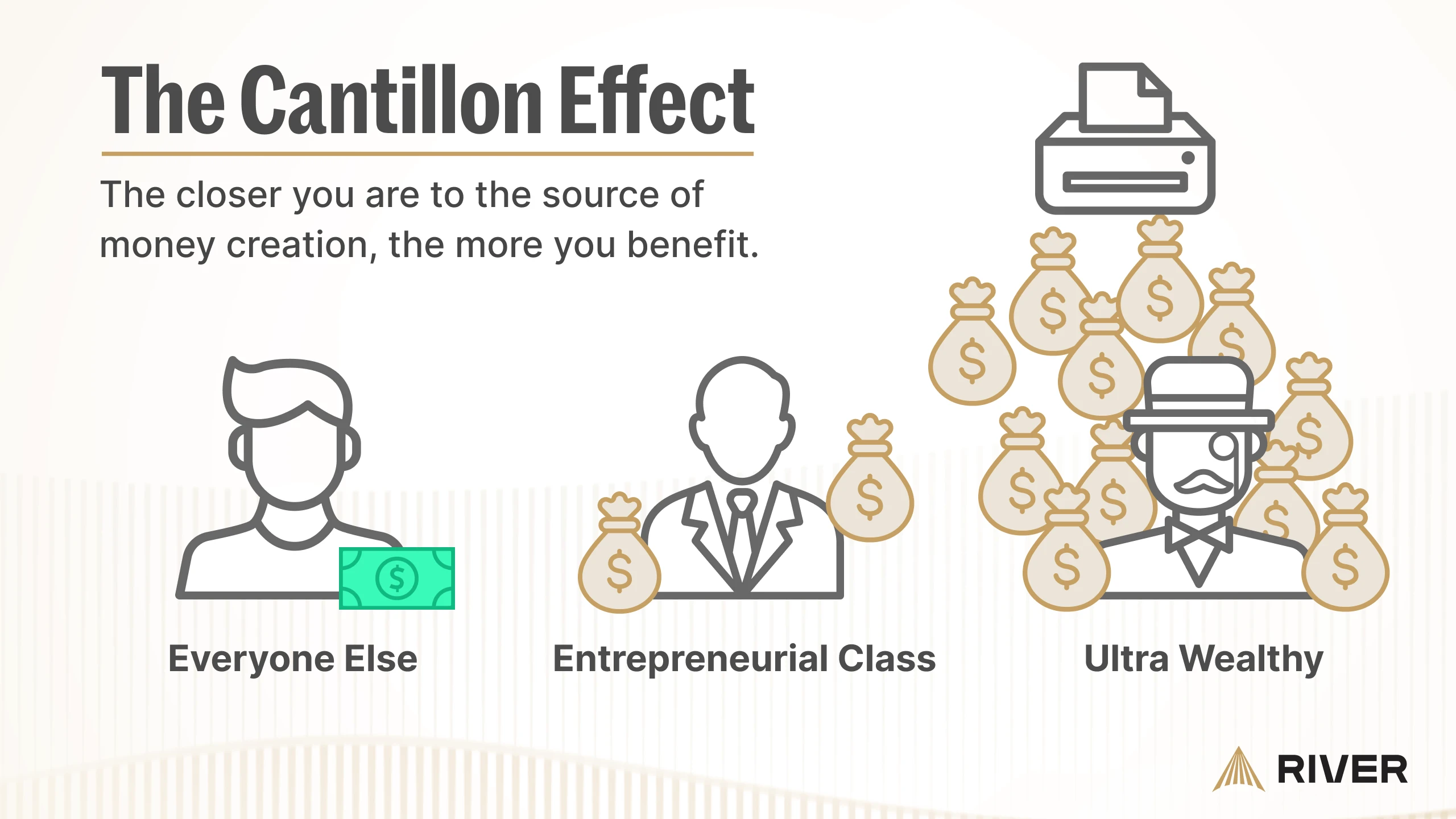
The Cantillon effect is a description of how that actually percolates through the economy, because we don't all get that $5 evenly, right? And the way the monetary system is set up, is there's what's called the Primary Dealers Network, which effectively is big banks.
Neal McSpaddenGUEST
They get the money first, and then they loan it into further existence by the whole fractional reserve thing, which is a little bit beyond the scope of...

John Lee DumasHOST
I started going deeper.
John Lee DumasHOST
Inflation, supply cap, issuance schedule, thermodynamic security model, game theory, monetary history, the Cantillon Effect, fiat endgame, deflation as the natural state of a free economy.
John Lee DumasHOST
And somewhere in between interesting technology and holy shite, every dollar I hold is melting, you cross a threshold.
John Lee DumasHOST
Then I found myself pouring my savings into Bitcoin because I understood the math.

Jack MallersHOST
One is called seigniorage.
Jack MallersHOST
Who profits from issuing the money? Right? Who profits from issuing dollars? Well, we all know, uh, the Federal Reserve and the US government and the politicians and people close to the money printer, which is what's called the Cantillon Effect.
Jack MallersHOST
Who gets the new money first? When it is issued and when it is printed, who has an advantage? Who has a bias? Who sits on the hierarchical level above you? And then the third issue is counterparty risk.
Jack MallersHOST
Who do you have to trust? Okay.
32 MINS LATER
Jack MallersHOST
It was a startup that was raising money.
Jack MallersHOST
So calling back to the earlier slides, Bitcoin removed profits from issuing it, getting new coins first.
Jack MallersHOST
So seniorage, Cantillon effect, counterparty risk.
Jack MallersHOST
You don't have to trust anyone with Bitcoin.

Mike CarterHOST
Yeah.
Kevin FreemanHOST
A- and that's the Cantillon Effect.
Mike CarterHOST
A- a- and we talked a little bit about that in the Social Security segment a week or two ago.
Mike CarterHOST
You know, if you're, that money becomes worth less and less, 'cause they gotta pay off the debt.