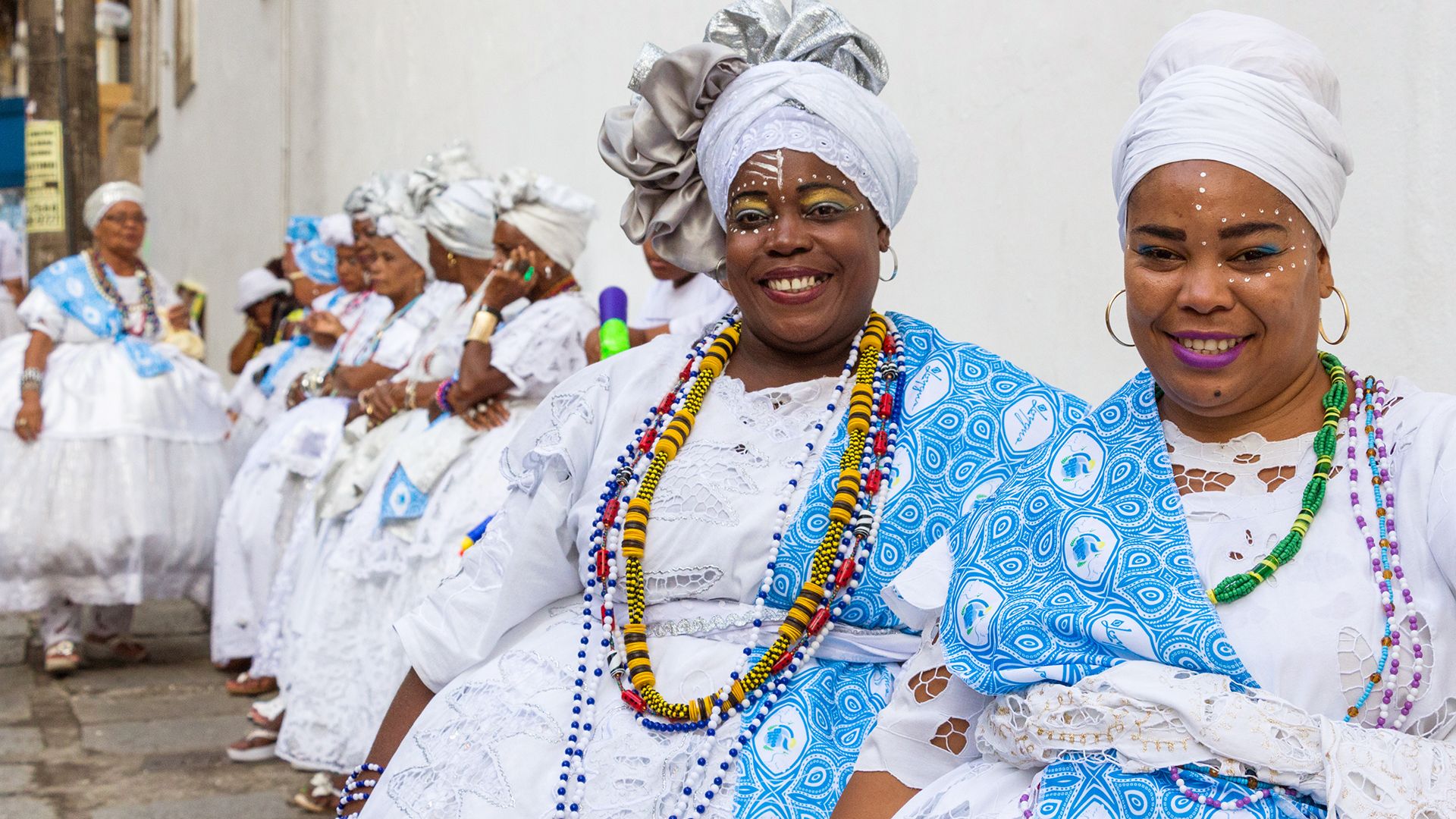
Candomblé
ReligionWikipedia
25
MENTIONS
22
EPISODES
21
PODCASTS
Search complete. 25 mentions across 22 episodes found for "Candomblé".
Sep 17, 2026

Kimberly Ann JohnsonGUEST
So I've given up for now My husband moved here a year ago.
Kimberly Ann JohnsonGUEST
He is very in tune with plants, and so he's caring for some herbs and plants that are on our balconies because they're part of his offerings to hi- the deities that he bows to and lives with in his religion, which is Candomblé.
Kimberly Ann JohnsonGUEST
So I live with an actual animist.
Kimberly Ann JohnsonGUEST
It's not convenient.

Jordan StephensGUEST
This is Ogun and Oya.
Jordan StephensGUEST
So they're like, it's from Candomblé.
Jordan StephensGUEST
It's like a Brazilian, Afro-Brazilian.
Manny BrownHOST
Now I need to know more.

John GreenHOST
This type of global scattering of populations is known as a diaspora, and many of these people took their religions with them, which spread a variety of indigenous African traditions to North America, Latin America, and the Caribbean, where they evolved and blended with other cultural traditions.
John GreenHOST
Many of these are still practiced, such as Santeria in Cuba, Candomblé in Brazil, Vodou in Haiti, and Orisha-Vodun in South Carolina? Let's go to the Thought Bubble.
John GreenHOST
As a 15-year-old growing up in Detroit during the 1930s, Walter King asked his mom, "Who is the African god?" And she wasn't sure how to answer, so King set out on what would become a lifelong mission to bring African religion to African Americans.
John GreenHOST
He read everything he could about African traditions and eventually changed his name to Ofuntola Oseijeman Adeghbu Adefumi I.

Yveline AlexisGUEST
And Brazil, just to go way, way backward, in 1896 doesn't make sense either.
Yveline AlexisGUEST
And so the spaces where I think we should expand—and this is me coming out of Oberlin now, college and conservatory— is that I think we need to do a better job about examining the multiplicity of religions, like Lukumi, like Condomble, like Ife, like Vodun.
Yveline AlexisGUEST
And honestly, with Black studies in general, and this is a critique from across institutions, is how we prioritize looking at sexuality studies.
Yveline AlexisGUEST
What does it mean to be a Black trans woman? What does it mean to be bisexual, bi-curious? What's the historicity around that? And funny enough, There's an Oberlin alum.

Catherine A. JohnGUEST
So displacement means that we were cut off from the roots and the sources of our power.
Catherine A. JohnGUEST
In some instances, there were certain spiritual practices that survived, right? Hoodoo in Louisiana, Obeah throughout the Caribbean, Santeria and Lucumi in Cuba, um, Voodoo in Haiti, Kumina, Zion Revival in Jamaica, um, what's referred to as Orisha and Shango Baptist practice in Trinidad, um, Candomble in Brazil.
Catherine A. JohnGUEST
A lot of those all have sort of Yoruba, Yoruba sort of diasporic foundations.
Catherine A. JohnGUEST
The Sanctified Church in the US, right? So the forms that have survived in the diaspora are displaced Africanized forms, right? Much of formal academia and everyday culture has disconnected our diaspora realities from the continental African realities, and often demonized these diaspora forms as country, savage, deviant, devilish, right? And they're not that thing.

Maya Annik BedwardGUEST
Like, when I found out the zombie originally came from Haitian Vodou, I was just, like, shocked that I didn't know this.
Maya Annik BedwardGUEST
And I've always been really interested in a lot of African, um, uh, traditional religions like Vodou and Candomblé and Santería.
Maya Annik BedwardGUEST
Um, being part of the Black diaspora here in the Americas, like, I think a l- lot of these, uh, these religions actually house history and traditions that have been kind of, um, uh, erased from, um, a lot of our, like, mainstream culture, traditions that, you know, predate slavery and colonialism, and it's kind of preserved a lot of, um, history and, um, info about my ancestors that I wanted to know, traditional knowledge.
Maya Annik BedwardGUEST
You know, you find them in these religions.

Maya Annik BedwardGUEST
And in school, often I was told you know, there's no record of these cultures and traditions in this history.
Maya Annik BedwardGUEST
But as I got older, I realized actually the record is very much housed in like a lot of the spiritual traditional practices that continue to exist today, like Vodou, Santeria, Obeah, Candomblé.
Maya Annik BedwardGUEST
They really house a lot of the traditional knowledge and stories of the the ancestors who came, you know, who came from West Africa.
Maya Annik BedwardGUEST
So I've always been learning more, wanting to learn more and research.

GinaHOST
And that's the Dikenga Diakongo, Cosmogram, or Yawa, and that represents the cycle of existence, the circle of life.
GinaHOST
So this is a knowledge system, and it traveled directly to the Americas through the enslaved people of Congo, with a K, and then later with a C. Scholars trace its presence in African-American spiritual practices, Haitian voodoo, Cuban Palo Monte, Brazilian Candomblé.
GinaHOST
I'm going to attach some links in the show notes so you can learn more about the Dikenga.
GinaHOST
Oral tradition among the Teke, the Congo, and the Sangha people also transmits knowledge and governance, how we treat each other.

speaker_1HOST
He replaced American slang with the incredibly specific localized slang of Rio.
speaker_1HOST
He also began layering in local Afro-Brazilian percussion styles, like the rhythms of Macumba and Candomblé, playing them on electronic drum machines.
speaker_0HOST
So it's already mutating sonically, but then the physical geography of where the music is played shifts dramatically.
speaker_1HOST
This is the critical friction point.

Maya Anik-BedwardGUEST
Mm-hmm.
Maya Anik-BedwardGUEST
yeah I mean I wanted you know when I when I first found out where the zombie came from I was shocked that I did not know this like I was always very interested in learning more about um African traditional religious practices especially in the Black diaspora I think that so much of our history and culture is really preserved in those spaces and so like For a long time, I've been, you know, learning about Candomblé, about Vodou, about Santeria.
Maya Anik-BedwardGUEST
So I was surprised.
Maya Anik-BedwardGUEST
I didn't know the zombie came from Haitian Vodou.
12 more episodes mention Candomblé.
Create an account to see the whole feed, search across every transcript, and follow the entities you care about.