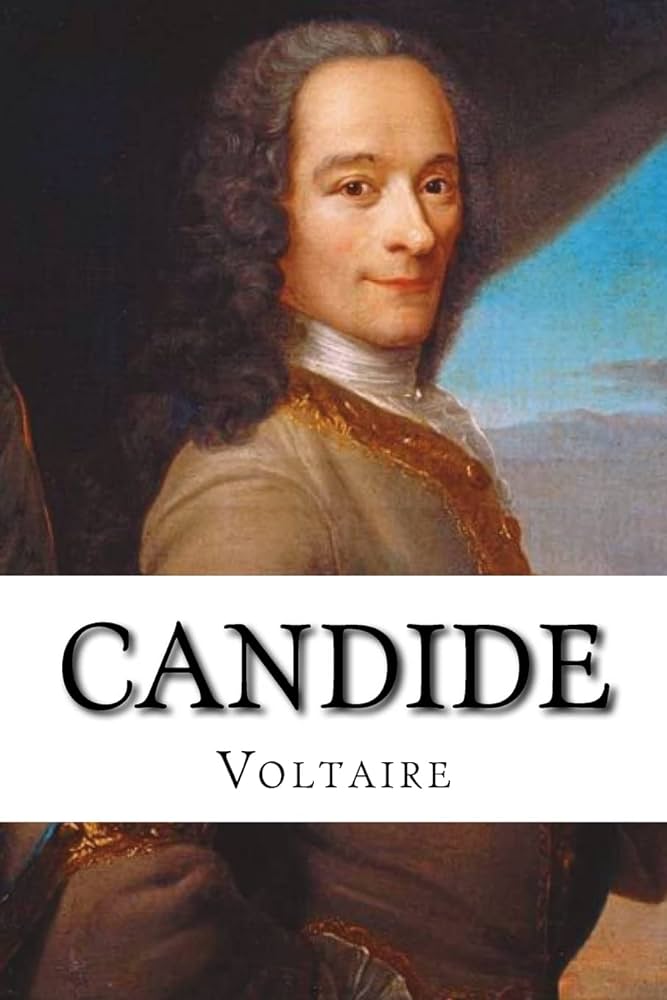
Candide
Book by VoltaireWikipedia
40
MENTIONS
15
EPISODES
15
PODCASTS
Search complete. 40 mentions across 15 episodes found for "Candide".
Sep 15, 2026

Alain de BottonNARRATOR
[upbeat music] One of the world's most famous phrases is: one must cultivate one's own garden.
Alain de BottonNARRATOR
But where does it come from, and what exactly does it mean? It is the work of the French 18th century writer and philosopher Voltaire, and it appears at the end of his legendary novel Candide, written in just three very inspired days in 1759.
Alain de BottonNARRATOR
The clue to its meaning lies in the subtitle of Voltaire's novel, Candide or Optimism.
Alain de BottonNARRATOR
Voltaire's goal in writing his book was to destroy the optimism of his times, an optimism that centered around science, love, technical progress, and a faith in reason.
Alain de BottonNARRATOR
This made Voltaire furious.
Alain de BottonNARRATOR
Of all this, Voltaire's readers were to be left in no doubt.
Alain de BottonNARRATOR
Hope was, he felt, a disease, and it was Voltaire's generous goal to try to cure us of it.
Alain de BottonNARRATOR
Nevertheless, Voltaire's novel is not simply a tragic tale designed to inspire nihilism.

RaghunathHOST
Hmm.
Kaustubha DasHOST
Author of, you know, uh, Candide and Phil-
RaghunathHOST
You know, I'd be interested why they call it the Time of Enlightenment.
RaghunathHOST
Can you look that up on ChatGPT? Bec- you know what I mean? Uh, like, were they-

Chuffy GaliazziNARRATOR
Politely, and in all innocence, Manon presented her volume for inspection.
Chuffy GaliazziNARRATOR
It was Voltaire's Candide, that delicious satire, which is crammed with the frankest allusions to all sorts of matters about which little girls are supposed to be quite ignorant.
Chuffy GaliazziNARRATOR
As the visitor looked and gasped, Madame Philippon re-entered the room.
Chuffy GaliazziNARRATOR
My dear friend, exclaimed the woman, surely you are not permitting your little girl to read a book like this.

Derek CaldwellHOST
well as we bring this to a close this has been a great uh conversation really appreciate the the insights of my two i'll call you friends and um and uh you know it's been it's been great having you guys on here but i also want to just for for the last question i want to you know if there's a way to equip anyone I think about 9-11 in a way of like, you know, the Lisbon earthquake of 1755 and how it greatly changed.
Derek CaldwellHOST
I mean, the way that people talk about the problem of evil and you even have Voltaire writing Candide, making fun of the idea that this is the best of all possible worlds.
Derek CaldwellHOST
And so that that really impacted theology.
Derek CaldwellHOST
And what could even be what was even allowable sort of discourse, theologically or even apologetically at the time.
Derek CaldwellHOST
You've got World War I and how it changed some eschatological views that people once held onto.
Derek CaldwellHOST
They got a little less optimistic.
Derek CaldwellHOST
It does seem like each time, because actually Voltaire's character in Candide was named Pangloss, and he was making fun of him, which Pangloss is just someone who's overly optimistic.
Derek CaldwellHOST
So it seems like we're moving towards pessimism, and that becomes the attack on Christianity.

Bob MurphyHOST
So that's kind of my framework.
Bob MurphyHOST
And so just to take a step back again, if God, ahead of time, before he chooses to create an actual universe, considers every possible possibility potential universe and all the different possible sets of creatures and when they come on the scene and how they interact with each other and what they do and it's all voluntary right in the sense that we've described then and then he what does he do presumably he picks the best one according to his value scale so i think voltaire was being very cheeky and unjust and you know, when he was mocking the best of all possible worlds, you know, the Pangloss and his Candide, that was apparently, you know, zinging Leibniz, but I think that's entirely accurate.
Bob MurphyHOST
That there is a sense in which God created the best of all possible worlds.
Bob MurphyHOST
And yeah, when you say, well, geez, why did that happen? And it's not a cop-out or just dodging it to say, you know, God has a plan and he works in mysterious ways.

Chris WilliamsonHOST
wrote
Douglas MurrayGUEST
in Candide one of the great, great attacks on slavery.
Douglas MurrayGUEST
But Voltaire says in his own day, he says, well, the only thing worse than what the Europeans have done to the Africans is what Africans have done to their fellow Africans, is what Africans have done to their brothers and sisters.
Douglas MurrayGUEST
We know from the few memoirs we have of people who were slaves in this period, people like Equiano, Olaudah Equiano, the most amazing man who ended up British and was baptized in Westminster, became a free man, had a most extraordinary life.

Paul E. CooleyHOST
Now, when I saw this, I immediately jumped to literature.
Paul E. CooleyHOST
I immediately thought of Candide by Voltaire, which I've, I've mentioned more than once on this podcast.
Paul E. CooleyHOST
Um, yep.
Paul E. CooleyHOST
Thanks for catching up.
Paul E. CooleyHOST
What is Terry writing now? You don't want to know.
Paul E. CooleyHOST
Um, if you haven't read Candide, it's basically a, a satire about Victorian, not Victorian, um, The Age of Enlightenment's Ridiculous Optimism.
Paul E. CooleyHOST
And one philosopher in particular, Leibniz? Leibniz? I can't remember his name.
Paul E. CooleyHOST
Voltaire.

Stuart FiresteinGUEST
Natural science, social science, political science? I don't know.
Stuart FiresteinGUEST
What, what do you want me to follow? You know, I point out in the book that I think many people don't know this, I didn't know it, I came across it, that the word optimism didn't even exist until 1759 when it was invented, honestly invented by Voltaire for his novel Candide or Optimism.
Stuart FiresteinGUEST
So we didn't even have a word for it.
Stuart FiresteinGUEST
We had an idea of it.
21 MINS LATER
Michael ShermerHOST
Mm-hmm
Stuart FiresteinGUEST
...
Stuart FiresteinGUEST
when it was invented, honestly invented by Voltaire for his novel Candide, or Optimism.
Stuart FiresteinGUEST
So we didn't even have a word for it.

Pamela NagamiNARRATOR
For perspicuous clearness of language and excellence of arrangement, Voltaire cannot be surpassed.
Pamela NagamiNARRATOR
Amongst the best of Voltaire's writings, which are distinguished by their extraordinary variety, the palm must be given to the tales of Zadig and Candide.
Pamela NagamiNARRATOR
The former is an Eastern tale.
Pamela NagamiNARRATOR
Zadig, the hero, is a sort of Eastern Voltaire, who at first suffers many persecutions on account of his desire to do good to his fellow creatures, but lives through them, and having just escaped hanging, is promoted to be Grand Vizier of Babylon.
Pamela NagamiNARRATOR
The story is full of satirical allusions to France, and Voltaire's enemies are introduced into it under disguised names.
Pamela NagamiNARRATOR
The book is very wittily and gracefully written.
Pamela NagamiNARRATOR
The tale of Candide was the fruit of the earthquake of Lisbon of 1755, a frightful calamity which suddenly overwhelmed more than 50,000 people, and set men everywhere a-thinking.
Pamela NagamiNARRATOR
The popular philosophy of the day was what is known as optimism, shortly expressed in the phrase of Pope, Whatever is, is right.

Jeremy MorrisGUEST
in which local action, the salt of the earth principle, was particularly important.
Jeremy MorrisGUEST
And I'm reminded, of course, inevitably, of the end of Voltaire's Candide, where he says, we must cultivate the garden, the face of the fake collapse of all his ideals.
Jeremy MorrisGUEST
Or Luther's famous dictum, if the world were ending tomorrow, I would still plant my apple tree today.
Jeremy MorrisGUEST
So then, just a number of questions And inevitably here, and I know this is the easy thing to do, I'm picking up difficulties.
5 more episodes mention Candide.
Create an account to see the whole feed, search across every transcript, and follow the entities you care about.