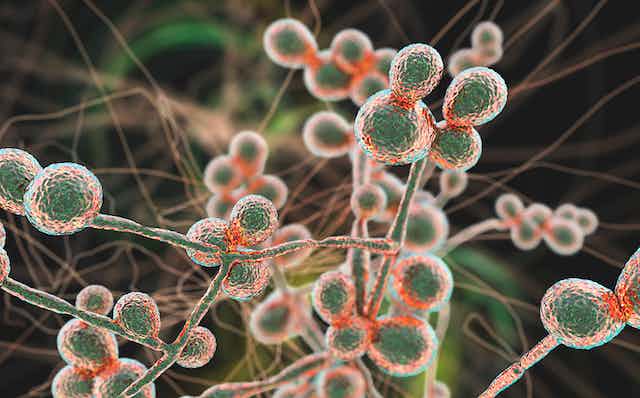
Candida
FungiWikipedia
278
MENTIONS
62
EPISODES
59
PODCASTS
Search complete. 278 mentions across 62 episodes found for "Candida".
Sep 11, 2026

Nathan WalzGUEST
So it turned out I tested positive for Lyme.
Nathan WalzGUEST
I had Candida.
Nathan WalzGUEST
I had mercury toxicity.
JustinHOST
My

Jim ApplegateHOST
and it encourages healthy fauna.
Jim ApplegateHOST
Sometimes people ask what to do for candida, and Fection is the answer because it will not...
Jim ApplegateHOST
Candida is just an overgrowth of a certain kind of bacteria in the digestive tract, and Fection doesn't kill off all of the good bacteria.
Jim ApplegateHOST
It It only kills off the excess and the bad bacteria.
Lynn ApplegateHOST
Yeah, and a candida overgrowth, it's not that you have to completely annihilate candida.

NicholasGUEST
formulation binds to microbes it's cold it doesn't produce any scent or smell it is not painful and then we activate it with red light that goes into the nose for a total of four minutes it's produced by a laser and what you see in the graphic is the disposable component which is used a single time And that red light produces a cascade of photo reactions with immediate broad spectrum effect.
NicholasGUEST
You can see we take care of MRSA, Aspergillus, which is a dangerous fungus, and even Candida auris, which is one of the new most dangerous microorganisms in hospitals, which has borrowed genes from multiple of its cohort to try to avoid the use of common antifungals.
NicholasGUEST
That's a really dangerous one.
NicholasGUEST
This technology is simple to speak about, complex in its development, and it's taken us a number of years to get to our crowning achievement to date, which is the conclusion of Lantern, a large-scale pivotal phase three study, which we disclosed a short while ago.

Keith BeaversHOST
Banana, pear, apple, berry notes.
Keith BeaversHOST
Then you have candida.
Keith BeaversHOST
Candida is the yeast that produces the glycerol, the viscosity, the... silky nature of wine.
Keith BeaversHOST
It also produces what's called pyruvic acid, which apparently it emits from its cell wall, binding to oak and binding to the red color of wine.
Keith BeaversHOST
So it's a stabilization yeast, if you will.

Heather McSherryHOST
In 2009, researchers in Japan described a yeast that had been isolated a few years earlier from the external ear canal of a 70-year-old Japanese woman at the Tokyo Metropolitan Geriatric Hospital.
Heather McSherryHOST
It was something they hadn't seen before, a new species of Candida.
Heather McSherryHOST
They named it Candida auris.
Heather McSherryHOST
Auris means ear.
Heather McSherryHOST
At the time, there wasn't much reason to think this obscure little yeast would become a global public health problem, but then it started turning up in other places, different hospitals, different patients, different continents, and some of those patients were seriously ill.
Heather McSherryHOST
The obvious explanation was that Candida auris had emerged somewhere, found its way into healthcare systems, and started spreading around the world, but that's not what they found.
Heather McSherryHOST
And beyond that strange provenance, Candida auris turned out to have an unusual collection of traits that make it especially well-suited to the modern healthcare system.
Heather McSherryHOST
It can colonize patients without making them sick.

Richard HorowitzGUEST
And finally, even fungal infections, they find fungus in the brains of people with Alzheimer's, not just in the gut.
Richard HorowitzGUEST
And it's interesting, most people know about Candida syndrome, right? If you're in the functional medicine space.
Richard HorowitzGUEST
They may not realize though, that when you get leaky gut and intestinal hyperpermeability, and you've got Candida oak growth in the gut, it's actually affecting your brain at the same point.
Richard HorowitzGUEST
And they found fungus there.
Richard HorowitzGUEST
You combine these infections with toxins like mold.
19 MINS LATER
Richard HorowitzGUEST
These biofilm infections, by the way, they've been around forever.
Richard HorowitzGUEST
Endocarditis of the heart.
Richard HorowitzGUEST
Candida infections of the gut is a biofilm infection.

Johannes PlatteHOST
There's some gram negative rods once in a while.
Johannes PlatteHOST
But when you get that phone call from the microbiology lab that something funky has shown up, something like yeast Canada, right? You get really worried.
Johannes PlatteHOST
So today, this is what we're talking about.
Jessica SeidelmanHOST
Absolutely.
Jessica SeidelmanHOST
When you see yeast on some gram stain that is coming back from an OR culture, your heart just kind of sinks, right? But to help us unpack the epidemiology, diagnosis, and treatment of cangenital PJIs, both medical and surgical, we are truly thrilled to welcome two leaders in this field that have recently published a wonderful article in clinical infectious diseases.
Johannes PlatteHOST
And joining us today, both from Europe, Aurélien Dean, an infectious disease physician at the Raymond Poincaré University Hospital of Paris, and Professor Martin McNally, orthopedic surgeon at Oxford University in the UK.
Johannes PlatteHOST
They are, as Jessica said, both co-authors on a comprehensive paper in the Clinical Infectious Disease Journal on Canada PJI.
Johannes PlatteHOST
And we'll be talking about that paper throughout this episode.

Natalie JensenGUEST
That's a great remedy.
Natalie JensenGUEST
Candida combination, cystitis combination.
Natalie JensenGUEST
My favorite one from this little book here is the jet lag combo.
Natalie JensenGUEST
So that's what I use when I travel.

AlyssaHOST
So if you've been experiencing symptoms like that and you've had a breath test before and you don't know what's wrong still, absolutely, this is a time where you've gotta dig deeper into the actual stool in your stomach and your digestive enzymes as well and figure out, A, if you have an infection of H. pylori, B, if you even have enough enzymes to begin with to digest properly.
AlyssaHOST
All right, now we're moving on to another pathogenic yeast called Candida.
AlyssaHOST
Candida is another one that comes up a lot in gut health conversations and a lot in testing.
AlyssaHOST
So many people are infected with Candida.
AlyssaHOST
And this is an area where context is especially important.
AlyssaHOST
Candida species can be part of the normal microbial community in humans, very natural.
AlyssaHOST
So finding candida or another yeast organism on a stool test doesn't automatically mean it is causing someone's symptoms.
AlyssaHOST
But again, it's one piece of information that needs to be interpreted alongside everything else.

Kim RogersGUEST
You should eat this way.
Kim RogersGUEST
Candida is a parasite and it tells you all day every day to eat sugar so it thrives more.
Kim RogersGUEST
You give them energy then.
Kim RogersGUEST
And I realized this when I was doing my first cleanse.
52 more episodes mention Candida.
Create an account to see the whole feed, search across every transcript, and follow the entities you care about.