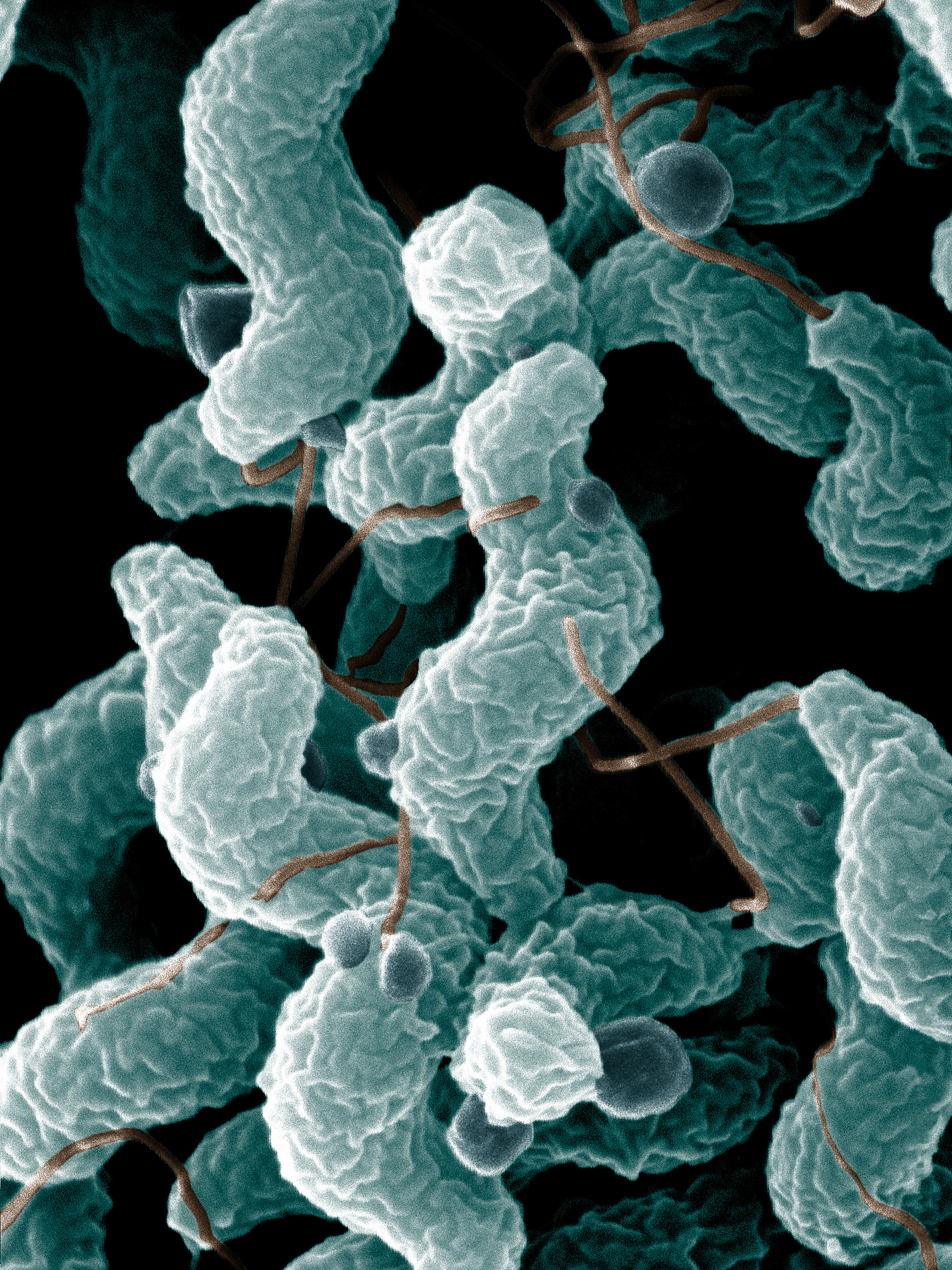
Campylobacter
BacteriaWikipedia
38
MENTIONS
23
EPISODES
21
PODCASTS
Search complete. 38 mentions across 23 episodes found for "Campylobacter".
Sep 16, 2026

Bryan ArdisHOST
All right, so now I'm going to ask you to remember post-infections and remember respiratory infection a week to six weeks before Guillain-Barre syndrome starts.
Bryan ArdisHOST
Infection with the bacteria Campylobacter jejuni, which causes diarrhea, is one of the most common triggers for GBS, they say.
Bryan ArdisHOST
Then they say viral infections can cause Guillain-Barre syndrome.
Bryan ArdisHOST
Some people with GBS have had the flu or infections with cytomegalovirus, Epstein-Barr virus, Zika virus, or other viruses.

Keith HnilicaHOST
Uh, the raw diets, uh, that I mentioned earlier, are much more risky because, uh, typically those are gonna be uncooked, and you don't really know how long they've been, uh, at what temperature and how they've been handled.
Keith HnilicaHOST
And so that would be more like the Salmonella and Campylobacter.
Keith HnilicaHOST
Definitely like with all of the produce, like with Cyclospora and any of the pathogens, uh, look for recalls, and if there is a recall, kind of look at your brand of dog food that you're feeding.
Keith HnilicaHOST
And then, uh, there's a recent study that I'm, have mentioned earlier, uh, with a really large number of dogs that showed that actually a, a very, uh, large variety of ingredients that are home-cooked is actually one of the best things that you can do.

Brad YoungHOST
Those crowded, waste-soaked, ammonia-filled conditions are a perfect incubator for bacteria.
Brad YoungHOST
When you cram tens of thousands of stressed, immune-compromised birds into a filthy shed, you create ideal breeding grounds for pathogens like salmonella and Campylobacter.
Brad YoungHOST
This is not speculation.
Brad YoungHOST
Testing by the United States Department of Agriculture and independent researchers has repeatedly found significant contamination on raw chicken.

Mark WebsterHOST
Waterborne diseases already cause about 1.5 million human deaths every year.
Mark WebsterHOST
The commonly found Campylobacter, Botulism, Salmonella and E. coli can all spread through tainted water, as can devastating cholera and typhoid fever, both are still epidemic in some developing countries.
Mark WebsterHOST
Stagnant water and wet ground is also a breeding ground for pests, including mosquitoes and midges, or sandflies.
Mark WebsterHOST
Still water is open to all manner of possible tainting from birds, animals or from any traces of general bacteria which replicate dramatically in warm weather.

Elizabeth DeleryGUEST
You also have bacteria, which can cause it too.
Elizabeth DeleryGUEST
Campylobacter is a big one.
Elizabeth DeleryGUEST
C. diff, Clostridium giardia is a cute little protozoa that can actually make you sick too.
Elizabeth DeleryGUEST
You have E. coli.

Lin WalkerGUEST
In this country, there are a lot of food safety problems are caused by foodborne pathogens.
Lin WalkerGUEST
Um, you know, in poultry, mainly, uh, from Salmonella, Campylobacter, right? Those kind of foodborne pathogens.
Lin WalkerGUEST
So they are bacteria.
Lin WalkerGUEST
Um, but from the other angle when you're looking to safety, it's also chemical, right? Is there any drug residues? Uh, and when we say in chicken, in poultry, could be, you know, the antibiotics that we gave to the birds, right, wh- while we raise them.
Lin WalkerGUEST
It's not just Salmonella or it's not just the antibiotics.
Lin WalkerGUEST
So, um, so now since we have dissect this into two portions, and then we'll dive into this, um, bacteria first or foodborne pathogens.
Lin WalkerGUEST
As we mentioned, you know, the top foodborne pathogens in poultry, they are Salmonella and Campylobacter.
Lin WalkerGUEST
Salmonella is regulated by USDA, um, so the poultry industry is obligated to reduce Salmonella.

Annie WaldmanGUEST
So unlike, you know, many of the smaller farms across the country, Raw Farm screens each batch of milk for four different types of bacteria.
Annie WaldmanGUEST
Salmonella, E. coli, Campylobacter, and E. Campylobacter and Listeria, all of which thrive in the intestines of cattle and can contaminate milk through flecks of feces.
Annie WaldmanGUEST
So McAfee told me that when they catch these things, they divert the milk immediately.
Annie WaldmanGUEST
I assumed that after diverting the batches, the farm discarded them.

Oriol ManuelGUEST
I show you here a result of a meta-analysis.
Oriol ManuelGUEST
I think all know that most of the causes of travel or diarrhea is bacteria, mostly it's E. coli and teratoptogenic or others, but with a number of Campylobacter, Salmonella and Shigella, that is also important.
Cameron WolfeMODERATOR
So again, I show you before
Oriol ManuelGUEST
that actually diarrhea in solid organ transplant recipients may be more harmful than in the general population.
Oriol ManuelGUEST
Here is again data from the Swiss Transplant Core Study.
Oriol ManuelGUEST
We saw that actually Campylobacter in Switzerland is the most common pathogen that causes gastroenteritis with up to 5% of our transplant population.
Oriol ManuelGUEST
And what I wanted to show here is that actually the risk for invasive infection in this patient is much, much higher than in the general population.
Oriol ManuelGUEST
You can see that up to almost 8% of patients had invasive infection with bacteremia.

speaker_1UNKNOWN
Right.
speaker_1UNKNOWN
And the sources state these practices drastically cut down the transmission cycles of common zoonotic bacteria like Salmonella and Campylobacter.
speaker_1UNKNOWN
But how does a mundane task like washing hands actually defeat a global pathogen like Campylobacter?
speaker_2UNKNOWN
If we connect this to the bigger picture, it is all about structural destruction.
speaker_2UNKNOWN
Pathogens like Salmonella and Campylobacter rely on specific unbroken chains of transmission, usually from an animal's waist to your hands to your mouth or your food.
speaker_1UNKNOWN
Gross, but true.
speaker_2UNKNOWN
But these bacteria are structurally vulnerable.

Tim ChambersGUEST
And so we're trying to update those using all of the data that we've pulled about every single drinking water supply in New Zealand, and then linking that with enteric disease rates to work out what number of people are likely getting sick from drinking water each year.
Gary PayindaHOST
And of course, not just getting sick, but sometimes dying, right? So there was the Campylobacter outbreak that killed several people a few years ago.
Tim ChambersGUEST
Yeah, and made a whole town sick, so 8,000 people sick before people died.
Tim ChambersGUEST
Tragically, and that's what sparked a lot of the water reforms that you see today, the three waters and also the establishment of Tomataraway.
13 more episodes mention Campylobacter.
Create an account to see the whole feed, search across every transcript, and follow the entities you care about.