Cambrian
Geologic periodWikipedia
52
MENTIONS
10
EPISODES
10
PODCASTS
Search complete. 52 mentions across 10 episodes found for "Cambrian".
Sep 28, 2026

Kelsey MillsHOST
The next group within the time scale is our periods.
Kelsey MillsHOST
And so the oldest one is the Cambrian, and that one is about 542 million years to 488 million years.
Kelsey MillsHOST
Then we have the Ordovician, the Silurian, Devonian, the Mississippian and Pennsylvanian, which sometimes you'll see as the Carboniferous, the Permian, Triassic, Jurassic, Cretaceous, Paleogene, Neogene, and the Quaternary.
Kaylee JohnsonHOST
Yes.

Aviv ShaharHOST
That is part of a continual discovery in the facilitative and behavioral sciences of doing work with collectives.
Aviv ShaharHOST
And finally, a bit cryptical, but I'll add it here, dwell with the Cambrian epoch connection and further explore its revelatory releasing potential.
Aviv ShaharHOST
What that number 16 is, Jeff, It was a week last year where for a few days I became completely immersed in writing something that was coming through.
Aviv ShaharHOST
I say coming through because I don't treat it as a channeling at all.
Aviv ShaharHOST
I treat it as the human faculty in surrender in receipt of new intelligence.
Aviv ShaharHOST
And the kernel that it was stimulated by was a state of knowing and a state of perception that I described as the Cambrian epoch release rather than the Cambrian explosion.
Aviv ShaharHOST
And what it referred to was, and so the book was written in just one week, and then it stopped because I needed to turn my attention to other projects.
Aviv ShaharHOST
And it's kind of now on the back burner for whenever I'll come back to it.

Damon DavisHOST
But then they come to this age.
Damon DavisHOST
It's called the Cambrian Age.
Damon DavisHOST
And when they get to the Cambrian Age, it's called the Cambrian Explosion.
Damon DavisHOST
Every fossil comes to be in one era.
Damon DavisHOST
And they're like, hmm, I wonder when that could be.

speaker_0NARRATOR
It sits in the same darkness it has sat in since the ocean formed.
speaker_0NARRATOR
It receives the same slow rain of particles it has received since the first organisms with mineral shells evolved and began sinking when they died, a process that began roughly 500 million years ago during the Cambrian period, when the first shelled organisms appeared in the fossil record and the nature of the abyssal sediment changed forever.
speaker_0NARRATOR
from purely mineral clay to a mixture of clay and biological remains.
speaker_0NARRATOR
Before the Cambrian, the abyssal sediment was all inorganic, just clay and ash and dust.
speaker_0NARRATOR
After the Cambrian, it began to include the remains of living things.
speaker_0NARRATOR
The rain of biological material from the surface to the deep ocean floor is, in a sense, a consequence of the evolution of hard parts, of shells and skeletons and tests.
speaker_0NARRATOR
Life changed the deep ocean not by living there, but by dying in the surface waters and sinking.
speaker_0NARRATOR
The rain is continuous.

Ben ShapiroSOUNDBITE_SPEAKER
... intelligent design is the idea that it's not a scientific theory.
Ben ShapiroSOUNDBITE_SPEAKER
So is intelligent design th- the idea that there was somebody, you don't actually say God, but, but something, there was some intelligent force that moved the universe, that, that created life on Earth, that was responsible, in your book, for the Cambrian explosion.
Ben ShapiroSOUNDBITE_SPEAKER
How is this a, a scientific theory as opposed to just as maybe Richard Dawkins would say, a god of the gaps argument?
Stephen MeyerSOUNDBITE_SPEAKER
Well, one of the things I did when I first set off to grad school, I, I ...
7 MINS LATER
Stephen MeyerSOUNDBITE_SPEAKER
Obviously, uh, and, and that, that can mean a couple different things itself.
Stephen MeyerSOUNDBITE_SPEAKER
It can refer to the small scale variation that we see with things like the Galapagos finches, where their beaks get a little bigger or a little smaller in response to varying weather conditions.
Stephen MeyerSOUNDBITE_SPEAKER
It can also refer to the fact that life on the planet today is differen-... than it was in the period of the Jurassic when you had the dinosaurs roaming the earth, or in the Cambrian when you had trilobites.
Stephen MeyerSOUNDBITE_SPEAKER
We've had change in the representation of life forms over time in the fossil record.

speaker_3NARRATOR
What a life! But ever so slowly, they began to change and grow more complex.
speaker_3NARRATOR
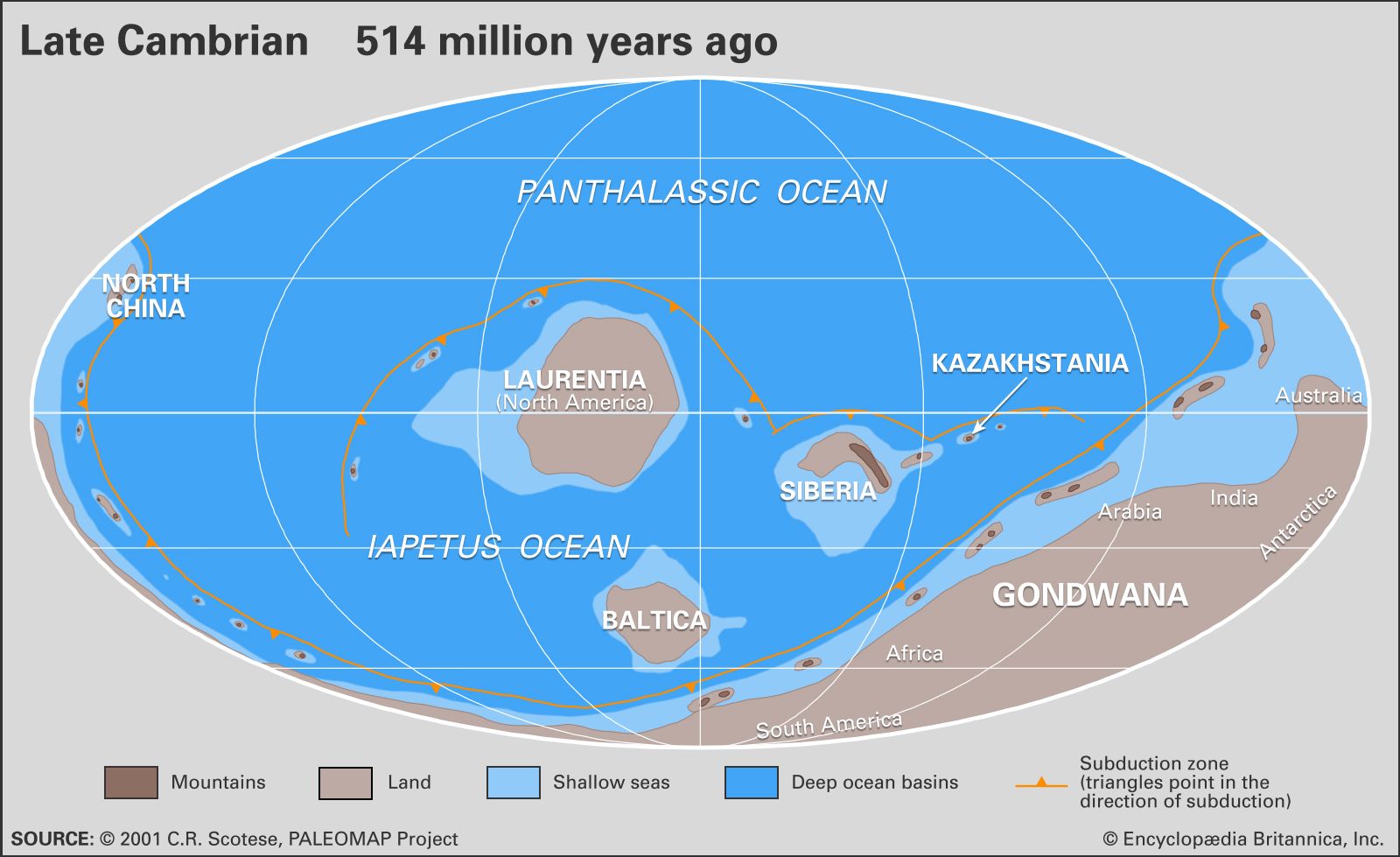
This would finally come to a head at the start of the Cambrian period, some 538 million years ago.
speaker_3NARRATOR
Before the Cambrian, the Earth's landmass had formed one supercontinent called Rodinia.
speaker_3NARRATOR
As the Cambrian began, however, this would split into several smaller landmasses, the biggest of which was Gondwana in the southeast.
speaker_3NARRATOR
But that's not the exciting part.
speaker_3NARRATOR
Allow me to introduce you to the Cambrian Explosion, the most incredible biodiversification event in the history of our blue planet.
speaker_3NARRATOR
Now when I say explosion, I don't mean a big fiery bang.
speaker_3NARRATOR
No, this explosion was more metaphorical to describe the sheer number of new creatures that burst onto the scene.

65TucksNARRATOR
but there are indirect traces of life in the shape of limestone probably derived from shells and of black lead probably derived from plants all these early deposits have been terribly twisted and contorted by subsequent convulsions of the earth and most of them have been melted down by volcanic action so that we can tell very little about their original state thus the history of life opens for us like most other histories with a period of uncertainty its origin is lost in the distant vistas of time Still, we know that there was such an early period, and from the thickness of the rocks which represent it, we may conjecture that it spread over three out of the ten great aeons into which I have roughly divided geological time.
65TucksNARRATOR
Next comes the period known as the Cambrian, and to it we may similarly assign about two and a half aeons on like grounds.
65TucksNARRATOR
The Cambrian epoch begins with a fair sprinkling of the lower animals and plants, presumably developed during the preceding age, but it shows no remains of fish or any other vertebrates.
65TucksNARRATOR
To the Silurian, Devonian, and Carboniferous periods, we may roughly allow an aeon and a fraction each, while to the whole group of secondary and tertiary strata, comprising almost all the best-known English formations, Red Marl, Lias, Oolite, Greensand, Chalk, Eocene, Miocene, Pliocene, and Drift, we can only give a single aeon to be divided between them.
65TucksNARRATOR
Such facts will sufficiently suggest how comparatively modern are all these rocks when viewed by the light of an absolute chronology.
65TucksNARRATOR
This will show that there was plenty of time for their development in the earlier ages.
65TucksNARRATOR
True, we must reckon the interval between ourselves and the date of this blue mud at many millions of years.
65TucksNARRATOR
But then we must reckon the interval between the Elias and the earliest Cambrian strata at some six times as much, and between Elias and the lowest Laurentian beds at nearly ten times as much.

Emily GraslieGUEST
Then there's the simple fact that extinct species are always found in the same rock layers you'd expect to find them.
Emily GraslieGUEST
Which is why you don't see a bunny skeleton in Cambrian rock layers from half a billion years ago.
Emily GraslieGUEST
That's also how we know that Dimetrodon is not a dinosaur.
Emily GraslieGUEST
Closely related species are often geographically distributed near one another.
John GreenHOST
So after Snowball Earth, the Ediacaran era gives us the first extensive fossil evidence for multicellular organisms.
John GreenHOST
There were various ancient forms that resemble today's worms, corals, mollusks, various underwater plants.
John GreenHOST
But then in the Cambrian era, adaptive radiation really got underway and multicellular life filled thousands upon thousands of niches, unlocked by their new traits.
John GreenHOST
A lot more is just possible for multicelled organisms than for single-celled ones.

Deboki ChakravartiHOST
Forums are one of the most ancient groups of organisms on planet Earth that are still around today.
Sam JonesHOST
They first evolved during the Cambrian period, over 500 million years ago.
Seth SuttonSOUNDBITE_SPEAKER
The Cambrian is where life started to diversify.
Seth SuttonSOUNDBITE_SPEAKER
It's not when life began.
Seth SuttonSOUNDBITE_SPEAKER
Life began on Earth billions of years ago.
Sam JonesHOST
So if you find a bunch of fossils for different species in a particular area, you can figure out what the environment was probably like when they were alive based on what you know about the environmental conditions those species prefer.
Deboki ChakravartiHOST
So let's turn back the clock to around 540 to 485 million years ago.
Deboki ChakravartiHOST
This is the Cambrian period, which you've maybe heard of called the Cambrian Explosion.