Cambrian explosion
PeriodWikipedia
71
MENTIONS
35
EPISODES
29
PODCASTS
Search complete. 71 mentions across 35 episodes found for "Cambrian explosion".
Sep 22, 2026

Daniel HintonGUEST
Uh, so, so we hold, uh, positions in about a dozen global markets.
Daniel HintonGUEST
Um, and, and each one of those have particular regulatory profiles, and liquidity profiles, and, and just local stock market happening, you know, comings and goings that, that, that really have a, an effect on the, the composition of our portfolio and the relative performance, uh, of those assets, right? So, so it's nice from a discretionary allocator perspective to be able to, y- you know, skate where we think the puck is gonna go, but also just have such a wide variety of things, um, as this, this Cambrian explosion of, of Bitcoin activity happens across the globe, to where we can focus in, you know, Southeastern Asian markets, or North America, or South America, or, or Europe.
Daniel HintonGUEST
Which is, you know, we, we hold positions in all of those locations.
Grace RemingtonHOST
UTXO has talked before about how institutions aren't blocked by not liking Bitcoin.

Alex Zaharov-ReuttCORRESPONDENT
He says the findings could also help explain the dramatic environmental changes which paved the way for complex life to develop on Earth.
Stuart GaryHOST
Earth.You see, Gondwana's formation triggered profound global changes, including shifts in climate, in atmospheric chemistry, and in geological processes that ultimately helped create the conditions for what we call the Cambrian explosion of life, and that changed everything.
Bill CollinsGUEST
The Earth is divided up into these tectonic plates, so rigid blocks of crust.
Bill CollinsGUEST
And there's maybe just over half a dozen of those plates.
Bill CollinsGUEST
Pangea was the one that formed about 300 to 200 million years ago, and the one that formed before that was Gondwana.
Bill CollinsGUEST
And Gondwana formed as a supercontinent between about 550 and 500 million years ago.
Stuart GaryHOST
That's interesting because that's about the same time as the Cambrian explosion in life, isn't it?
Bill CollinsGUEST
Oh, bang on.

Stuart GaryHOST
He says the findings could also help explain the dramatic environmental changes which paved the way for complex life to develop on Earth.
Stuart GaryHOST
You see, Gondwana's formation triggered profound global changes, including shifts in climate, in atmospheric chemistry, and in geological processes that ultimately helped create the conditions for what we call the Cambrian explosion of life, and that changed everything.
Bill CollinsGUEST
The Earth is divided up into these tectonic plates, so rigid blocks of crust, and there's maybe just over half a dozen of those plates.
Bill CollinsGUEST
And the reason why they move around the Earth, and because of them we have earthquakes and volcanoes, which everyone knows about, but the reason why they move around is because the mantle underneath, and the plates are these...
Bill CollinsGUEST
Pangea was the one that formed about 300 to 200 million years ago, and the one that formed before that was Gondwana.
Bill CollinsGUEST
And Gondwana formed as a supercontinent between about 550 and 500 million years ago.
Stuart GaryHOST
That's interesting because that's about the same time as the Cambrian explosion in life, isn't it?
Bill CollinsGUEST
Oh, bang on.

James TourGUEST
And we're nowhere close.
James TourGUEST
That's just one problem of a thousand problems that have to be solved in order to get life.
James TourGUEST
So we're very far from understanding where life comes from.
James TourGUEST
And so there's other questions about why they would keep suggesting that we're close when we're not.
James TourGUEST
Every one of these molecules, I mean, the amino acids make proteins.
James TourGUEST
DNA is an oligonucleotide.
James TourGUEST
And so you need to solve the sugar problem, and you need to solve...
James TourGUEST
If we were to

Jack KruseGUEST
magically happens, the Earth restarts its dynamo.
Jack KruseGUEST
And that's when the Cambrian explosion starts.
Jack KruseGUEST
See, what we're taught in biology is that the Cambrian explosion was tied to oxygenation of the planet.
Jack KruseGUEST
It turns out the story is even more interesting than that because it goes back to these old papers that the Russians had.
Jack KruseGUEST
The Russians linked silver, the magnetic dynamo, and oxygen together.

speaker_3NARRATOR
It shows how behavior can become geology when enough organisms repeat it across enough time.
speaker_3NARRATOR
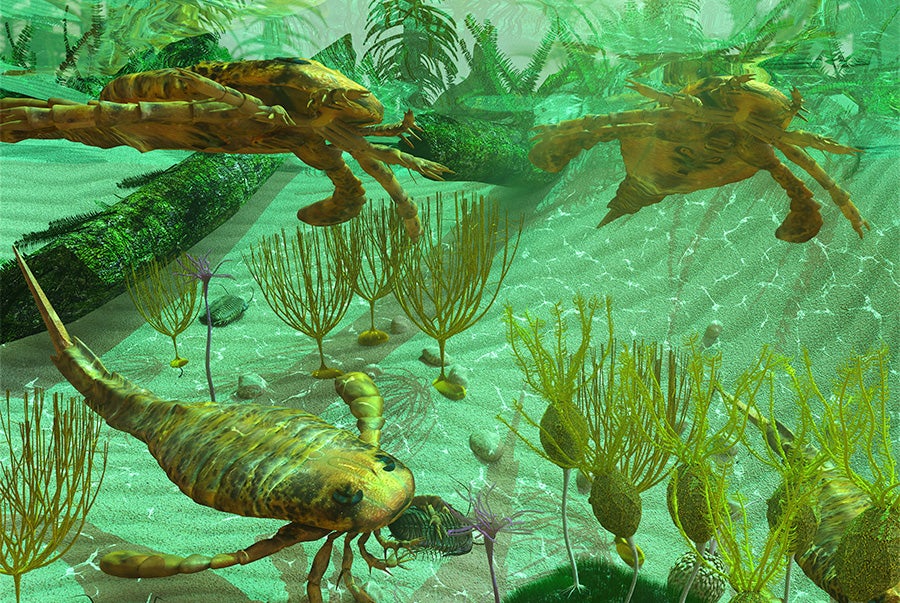
The Cambrian explosion filled oceans with eyes, shells, and predators.
speaker_3NARRATOR
Around this time, animal life diversified with astonishing speed by geological standards.
speaker_3NARRATOR
Fossils show many new body plans, including creatures with hard parts, jointed limbs, sensory organs, and active feeding strategies.

Hank GreenHOST
But it wasn't until around 535 million years ago that the eukaryotes went berserk.
Hank GreenHOST
And that's known as the Cambrian Explosion, a super major biological
speaker_4ADVERTISER
golden age when the diversity of all animal life on Earth exploded.
Hank GreenHOST
Nobody's entirely sure what started it, but suddenly life created innovations that the planet had never seen.

speaker_0NARRATOR
The phylum Cnidaria, to which all jellyfish belong, first appeared in the fossil record approximately 600 million years ago, possibly earlier.
speaker_0NARRATOR
This predates the Cambrian explosion, that extraordinary moment roughly 540 million years ago when complex animal life diversified in a geological eye-blink.
speaker_0NARRATOR
In other words, cnidarians were already established on Earth, before most of the body plans we associate with animals today had even appeared.
speaker_0NARRATOR
They survived the great extinction events that reshaped life on this planet.

Judith DadaGUEST
First, that we've massively underestimated the magnitude of AI, that kind of European policymakers particularly, but also to some extent, the broader public or kind of the, you know, call them elected leaders of any sort could be in the economy or could be in the political realm.
Judith DadaGUEST
You know, they thought that this was going to be a little bit more like a tool, you know, maybe like, you know, kind of like the desktop computer or maybe like, you know, kind of the mobile phone, when actually it was much more similar to the Industrial Revolution in its kind of, you know, kind of Cumbrian explosion and force that it would bring to the economy or also not bring to the economies that are not actually adapting in the right way.
Judith DadaGUEST
The second piece is that we underestimated the speed at which this technology was going to progress.
Judith DadaGUEST
And I have to say, in 2026, it's now...

Brendan Graham DempseyGUEST
But when certain kinds of cellularity, let's say, sync up, in a way that generates neuronal information processing as sort of sensory inputs into a given entity, that's where you get basically the emergence of minded animals.
Brendan Graham DempseyGUEST
So this happens, it's thought, probably around 530 million years ago with the Cambrian explosion.
Brendan Graham DempseyGUEST
And you've got this sort of moving out of the kind of single-celled or kind of, let's just say, yeah, kind of the... biological colony kind of configuration there.
Brendan Graham DempseyGUEST
You start to see the emergence of complex active bodies that are able to navigate 3D space and move around.
Brendan Graham DempseyGUEST
And these actually, as you know, it's called the Cambrian explosion because we just see this wild proliferation of all these diverse forms around this period.
Brendan Graham DempseyGUEST
Some people, I think the best idea out there is that this happened because of predator-prey relationships that basically we move from photosynthesis to some uppity cell gets the idea, hey, I can eat my neighbor.
Brendan Graham DempseyGUEST
And then I can just sort of munch off of all the photosynthesis he's done and take it easy.
25 more episodes mention Cambrian explosion.
Create an account to see the whole feed, search across every transcript, and follow the entities you care about.