Calvin cycle
Chemical processWikipedia
7
MENTIONS
2
EPISODES
2
PODCASTS
Search complete. 7 mentions across 2 episodes found for "Calvin cycle".
Oct 10, 2026

Dave FarinaHOST
Photosynthesis consists of two stages.
Dave FarinaHOST
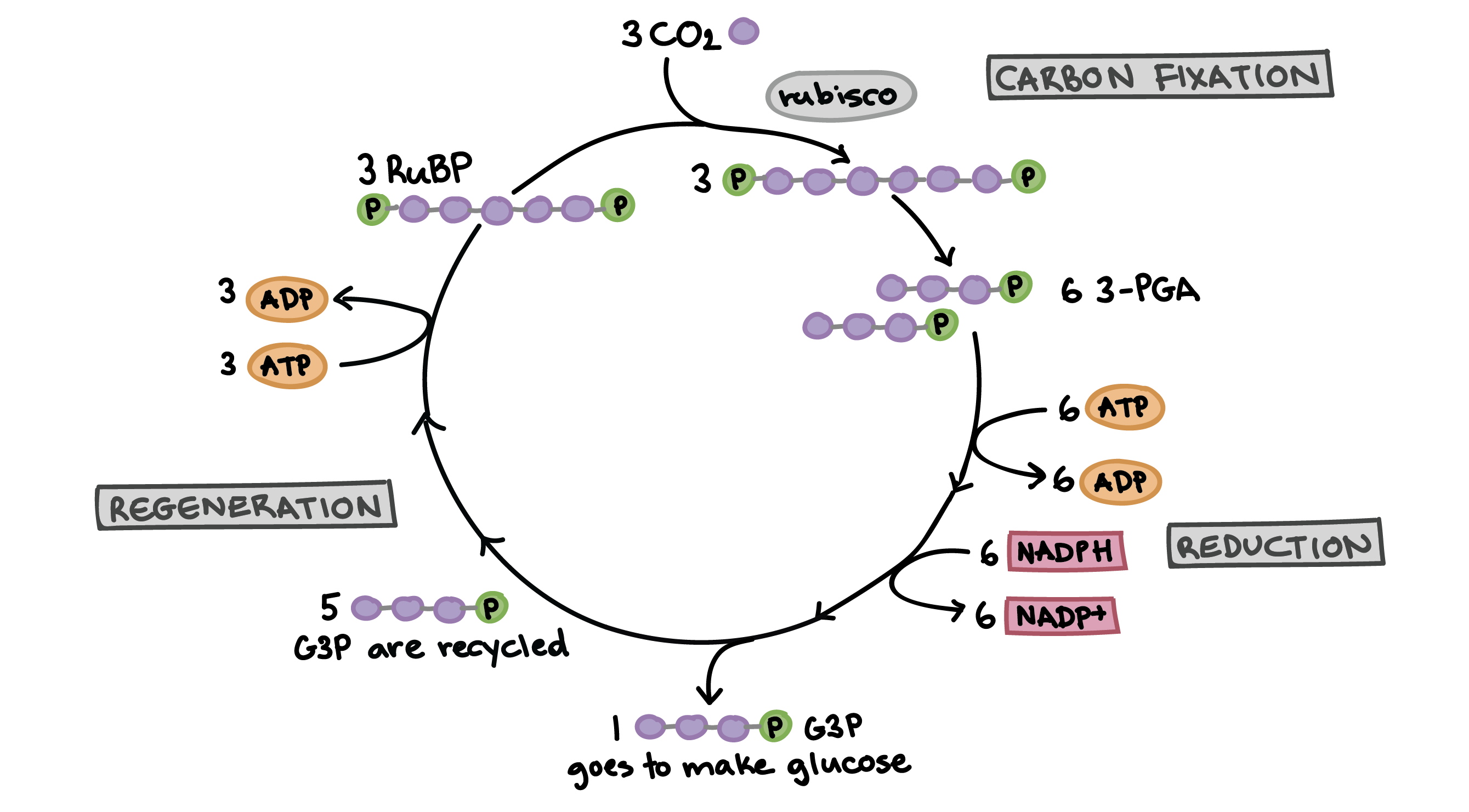
There are the so-called light reactions, in which solar energy is converted into chemical energy, and then there's the Calvin cycle, which uses that chemical energy to build G3P, the precursor to glucose and other molecules.
Dave FarinaHOST
Both of these stages occur inside one of the organelles found in plant cells, which are called chloroplasts, and there are around 30 to 40 of them per cell.
Dave FarinaHOST
A chloroplast has two membranes that surround a fluid called stroma, within which sacs called thylakoids are suspended.
Dave FarinaHOST
But instead of producing ATP, photosystem I will result in the conversion of nicotinamide adenine dinucleotide phosphate, or NADP+, into NADPH.
Dave FarinaHOST
So the light reactions in the thylakoid, which are summarized by the following equations, require sunlight and water among the reactants and generate oxygen, ATP, and NADPH as products.
Dave FarinaHOST
ATP and NADPH are then used in the Calvin cycle, which occurs in the stroma.
Dave FarinaHOST
This is where all the synthesis occurs.

KellyHOST
The oxygen is released as a byproduct, which is why photosynthesis is the primary source of oxygen in the Earth's atmosphere.
KellyHOST
The ATP and electron carriers produced in the light-dependent reactions are then used in the second stage, the light-independent reactions, also known as the Calvin cycle.
KellyHOST
Now, the Calvin cycle depends on the products of the light reactions.
KellyHOST
So in this cycle, carbon dioxide is fixed, meaning inorganic carbon dioxide gas is used to build the backbones of organic molecules.
KellyHOST
An enzyme called Rubisco, this is probably my favorite enzyme name, helps combine carbon dioxide with a 5-carbon molecule, eventually leading to the production of glucose and other carbohydrates.