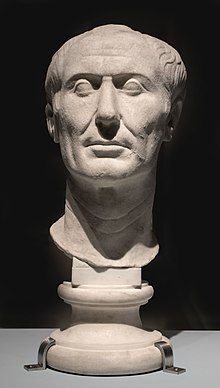
Caesar
Noble titleWikipedia
651
MENTIONS
30
EPISODES
30
PODCASTS
Search complete. 651 mentions across 30 episodes found for "Caesar".
Oct 16, 2026

JakeHOST
Yeah.
JakeHOST
Like Caesar.
JakeHOST
He looked like, I thought you were showing me a statue of Caesar or something for a second there.
JakeHOST
I was like, okay.
JakeHOST
That is crazy.

Kasia Van SchaikGUEST
And partly it's because I think partly it's because she, he hears the register of a voice change from this kind of dominant, more booming masculine mode to something that is vulnerable and tender.
Kasia Van SchaikGUEST
And that is, that seems to be the thing that really frightens him about Gertrude Stein is that she's not, that she is, that she contains multitudes and, And she's not just the Roman Caesar, as he likes to call her, but is someone who is, you know, is also a queer woman in a relationship with another, in a loving relationship with another woman.
Kasia Van SchaikGUEST
And so he renders her monstrous.
Kasia Van SchaikGUEST
And for sure.

Aubrey HershGUEST
Because who came up with mathematics, architecture, literature? Not the Romans.
Aubrey HershGUEST
And in fact, the Gemara in Bacharas tells us that when Rabbi Shimon Hanania is challenged to a debate by the Roman Caesar, he debates the Savade Beatuna.
Aubrey HershGUEST
The sages are Athenian, not Roman, and these are the people that Caesar puts forward.
Aubrey HershGUEST
And classically, all the Roman gods are Greek gods with Latin name.
36 MINS LATER
Aubrey HershGUEST
In fact, it gets better for the Jews.
Aubrey HershGUEST
From the second to fourth century, it's a time of political freedom.
Aubrey HershGUEST
The Roman Caesars allowed Jews to have official office, to have civic rules.
Aubrey HershGUEST
They even created legal exemptions that allowed Jews to perform public duties without going against their own Jewish, uh, Halakhic, uh, rules against, uh, obviously offering pagan sacrifices, Avodah Zarah, as long as they paid their financial duties.

Edem Julius-CudjoeHOST
And at this time, Domitian had begun what we call the deification of the emperors.
Edem Julius-CudjoeHOST
So they have something called the divine Caligula, divine Caesar.
Edem Julius-CudjoeHOST
You'll be surprised that the word Augustus is from the English-- is fr- is where we get the English word August.
Edem Julius-CudjoeHOST
So Augustus was not necessarily a name.
Edem Julius-CudjoeHOST
That's why most of the Caesars had it.
Edem Julius-CudjoeHOST
Augustus was a title, the most August, the highest supreme one.
Edem Julius-CudjoeHOST
So Augustus is from the word August.
1 HR 58 MINS LATER
speaker_2UNKNOWN
Oh

Dave FarinaHOST
After arriving at a peace agreement with the Persians, who were the empire's greatest military threat, he created in 293 CE a more elaborate system of government in which the empire was ruled as separate Eastern and Western halves under two senior and two junior emperors, who were called Augustus and Caesar respectively, after the titles given to the first emperors.
Dave FarinaHOST
Though these men were largely free to make their own decisions, they were closely bound to one another by their personal ties.
Dave FarinaHOST
Diocletian and Maximian, who was the other Augustus, married their daughters to the men who became their Caesars and adopted them as their sons.
Dave FarinaHOST
This was meant to guarantee that they would in turn become Augusti and make their own sons Caesars in their place.
Dave FarinaHOST
These four rulers and their administrations were based in cities in Turkey, Serbia, Northern Italy, and Germany, which were close to the empire's problematic border regions, while the city of Rome, which was the home of the Senate, became more of a ceremonial capital than an administrative one.
Dave FarinaHOST
In fact, as the imperial court of the fourth century became increasingly autocratic, the capital was wherever the emperor was, often at the front with Persia or the Germanic territories.

David GrayHOST
Hmm.
David GrayHOST
Verse 17, "Tell us then, what is your opinion? Is it right to pay the imperial tax to Caesar or not?" Hmm.
David GrayHOST
So they're saying to him, "What do you think? What is your opinion? Is it right to pay the imperial tax?" The, that's the tax for the empire, a special tax on, on, uh, subject peoples.
David GrayHOST
That means, um, Roman citizens didn't have to pay this tax, but other people did.
David GrayHOST
So is it right to pay this tax to Caesar or no? Okay, so what did they do? They're trying to trap him.
David GrayHOST
They're trying to catch him in his words, right? So first they say very nice things to him.
David GrayHOST
Why? They want him to relax, to put down his guard.
David GrayHOST
There's words written on the coin.

Jonah GoldbergHOST
And they would say, and they would sort of do a kind of almost a biblical exegesis kind of approach and say, well, Christianity has separation of church and state.
Jonah GoldbergHOST
It has render unto Caesar what is Caesar's.
Jonah GoldbergHOST
And Islam is totalitarian and does not see this space between, you know, the secular and whatever.
Jonah GoldbergHOST
And I think the theological arguments are all very interesting.
8 MINS LATER
Simon Sebag MontefioreGUEST
And in this way, you do see this all the way through Islam.
Simon Sebag MontefioreGUEST
You know, there's Muawiyah and the Umayyad dynasty.
Simon Sebag MontefioreGUEST
They were like, they were the first dynasty of caliphs that ruled from Damascus, they were like Roman Caesars.
Simon Sebag MontefioreGUEST
In fact, one of their opponents, Caliph Omar, said Mawir was like a Roman Caesar.

Matthew James ChristoffHOST
And they sent their disciples to him, along with the Herodians, saying, Teacher, we know that you are true and teach the way of God truthfully and care for no man, for you do not regard the position of men.
Matthew James ChristoffHOST
Tell us then, what do you think? Is it lawful to pay taxes to Caesar or not? But Jesus, aware of their malice, said, Why do you put me to the test, you hypocrites? Show me the money for the tax.
Matthew James ChristoffHOST
And they brought to him a coin.
Matthew James ChristoffHOST
And Jesus said to them, Whose likeness and inscription is this? They said, Caesar's.
Matthew James ChristoffHOST
Then he said to them, Render therefore to Caesar the things that are Caesar's, and to God the things that are God's.
Matthew James ChristoffHOST
When they heard it, they marveled, and they left him and went away.
Matthew James ChristoffHOST
The gospel of the Lord.
Matthew James ChristoffHOST
foolish.

Winn CollierGUEST
Tell us, then, what you think.
Winn CollierGUEST
Is it lawful to pay taxes to Caesar or not?' But Jesus, aware of their malice, said, 'Why are you putting me to the test, you hypocrites? Show me the coin used for the tax.' And they brought him a denarius.
Winn CollierGUEST
Then he said to them, 'Whose head is this, and whose title?' They answered, 'Caesar's.' Then he said to them, 'Give therefore to Caesar the things that are Caesar's, and to God the things that are God's.' When they heard this, they were amazed.
Winn CollierGUEST
And they left him and went away." The Word of the Lord.
Nathan HoffHOST
Thanks be to God.
Nathan HoffHOST
Yeah.
Winn CollierGUEST
Because he's gonna say something, just like he did in the last chapter against us.
Winn CollierGUEST
Now he's gonna say something against Caesar, and we're really gonna get him, you know?

GarfinkelHOST
Now, Onkelos is someone that everyone should know.
GarfinkelHOST
Onkelos was actually a relative, some say even a nephew of the Roman Caesar at the time when the Romans were controlling Israel.
GarfinkelHOST
And he was so blown away by Judaism that he converted.
GarfinkelHOST
Not only did he convert, he wrote the translation.
20 more episodes mention Caesar.
Create an account to see the whole feed, search across every transcript, and follow the entities you care about.