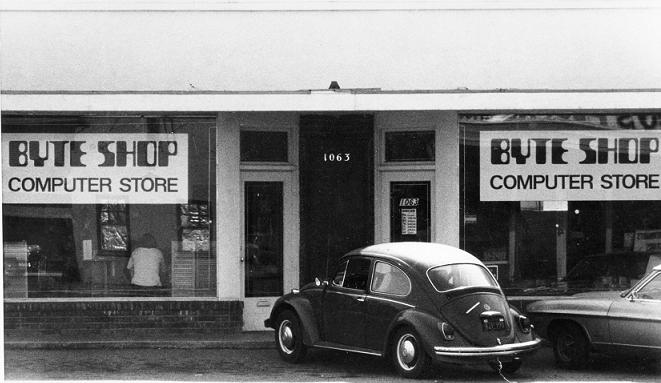
Byte Shop

Byte Shop

Retail companyWikipedia

Search complete. 20 mentions across 8 episodes found for "Byte Shop".

Aug 25, 2026

Myke HurleyHOST
71:01
Mm-hmm.
Jason SnellHOST
71:02
He owns a store called the Byte Shop, which is possibly the first computer store.
Jason SnellHOST
71:08
His business at this time was to buy Altair computer kits and assemble them, and then sell those ready-to-use computers at a profit.
Jason SnellHOST
71:19
This is...
Jason SnellHOST
71:37
... is the mechanical keyboard scene.
Myke HurleyHOST
71:39
Yeah.
Jason SnellHOST
71:39
So that's, that's the Byte Shop's business model is...
Jason SnellHOST
71:42
And perfect synergy with Steve Jobs, I would say, and I wonder how much Steve Jobs kind of like vibed with this guy or got some of his thoughts by watching Paul Terrell because the whole idea here is your addressable market for a board, th- a, a circuit board...
Jason SnellHOST
2:54
Now, when we last left you, Apple had registered as a partnership.
Jason SnellHOST
2:58
It had gotten some help in doing Net 30 accounting from their suppliers because they didn't have the money otherwise to buy the supplies to assemble the computers to fulfill that first set of Apple Is to their first customer, which was a computer store called the Byte Shop.
Jason SnellHOST
3:13
Once they did that, they had money left over from their profits to make some more Apple Is and start to sell those.
Jason SnellHOST
3:21
That's where we left it.
Jason SnellHOST
4:11
The truth is that even though the Apple I was a major step forward in terms of the hobbyist computer world, you didn't have to buy the chips and install them yourselves, right? That was part of what they were doing.
Jason SnellHOST
4:24
It was still a do-it-yourselfer's device.
Jason SnellHOST
4:28
What Steve Jobs delivered in our last go around with this to the Byte Shop and what Apple advertised in some computer magazines and took to the Homebrew Computer Club, you still needed to attach a keyboard and a display and, talking about screwing it into a block of wood, you had to put it in a case.
Jason SnellHOST
4:48
It was not a consumer product.
Jason SnellHOST
24:09
So the Apple I lesson, it was supposed to make it easier for hobbyists to build their own computer.
Jason SnellHOST
24:13
Then Paul Terrell at the Byte Shop funds to make it a project to assemble motherboards.
Jason SnellHOST
24:19
But even then, it doesn't have a case, it doesn't have a keyboard, doesn't have a display.
Jason SnellHOST
24:23
And he understood, Jobs did, what Terrell was saying when he was like, "I, I really want a complete package.

Unknown podcast

How Jeff Bezos’s Parents Bet on an Early Online Bookstore

Aug 25 · 1 Mention

speaker_1UNKNOWN
19:12
It was missing an operating system, no power supply, just a board that made a connection.
speaker_1UNKNOWN
19:18
But it mattered because it proved you could build a computer cheaply enough to sell fifty units through Byte Shop orders.
speaker_1UNKNOWN
19:25
That initial success gave them capital and confidence to start the Apple II project.
speaker_1UNKNOWN
19:31
Wozniak engineered the Apple II with a plastic case, keyboard, built-in screen interface, and a power supply, an all-in-one package that could plug straight into a TV.
Jason SnellHOST
70:59
Paul Terrell, we'll say.
Jason SnellHOST
71:02
He owns a store called The Byte Shop, which is possibly the first computer store.
Jason SnellHOST
71:08
His business at this time was to buy Altair computer kits and assemble them.
Jason SnellHOST
71:15
and then sell those ready-to-use computers at a profit.

Unknown podcast

The Trust Advantage of Berkshire Hathaway's Acquisitions

Aug 23 · 1 Mention

speaker_1UNKNOWN
15:53
That vision would become the core problem Apple tried to solve How to make computing personal and intuitive.
speaker_1UNKNOWN
16:01
Wozniak built the first Apple I with a MOS Sixty Five O Two processor, but it was Jobs who secured the initial orders from a local electronics retailer Byte Shop and arranged for production.
speaker_1UNKNOWN
16:13
The result was an MVP that delivered video output via a TV which was novel at the time Giving hobbyists a ready made platform It tested two assumptions First There were people willing to buy a computer preassembled Second they cared Enough about ease of use With those learnings apple shifted to the Apple II in nineteen Seventy Seven Mass Production Color Graphics and a user interface that didn't require programming knowledge Sales surged As schools and homes adopted the machine Confirming the Customer Problem of computers that actually work out of the box The Business Model moved From a niche Hobbyist Kit to a commodity Computer Backed By a network of resellers Fast forward to Nineteen Eighty Four and youll See another Leap with the Macintosh A device jobs pushed Forward Despite Higher Price Points and limited software The Mac introduced the graphical User Interface For a general Consumer But early customers baulked Over Cost and scarcity of applications forcing Apple to rethink pricing and ecosystem building The product Market Fit here Was incremental It required Proving That Customers Valued the experience Enough to pay When internal conflict Hit Jobs was forced out in ninteen Eighty Five an event that Might Have destroyed Apple but Instead became a learning Platform He founded NeXT a computer aimed at higher education and business markets and purchased Pixar turning it into a groundbreaking animation studio Both ventures Delivered New Technologies while Keeping Him engaged With Product Quality and User Experience Returning in ninteen Ninety seven Via the Acquisition of Next Jobs Revitalized Apple By Narrowing Its lineup Integrating Hardware Software Retail and Services under One Vision The company moved from a struggling niche vendor to a cultural icon, thanks in large part to the same DNA that guided his earlier experiments: relentless focus, control over every touchpoint, and an unwavering belief in making technology delight consumers.
speaker_1UNKNOWN
18:21
We've seen the definition of an entrepreneurial idea.

Unknown podcast

Ryan Reynolds' Marketing‑Led Entrepreneurship: From Celebrity to Profitable Brands

Aug 23 · 1 Mention

speaker_1UNKNOWN
22:00
Wozniak’s Apple I in 1976 was nothing more than a board mounted microprocessor with a video interface.
speaker_1UNKNOWN
22:07
The first order from Byte Shop came because hobbyists were already buying kits and soldering parts, but nobody had an all-in-one box that plugged into a TV.
speaker_1UNKNOWN
22:17
Jobs saw that opportunity.
speaker_1UNKNOWN
22:19
People love the idea of a plug-and play machine to experiment at home, not just as a tool for engineers.
Gavin KnightGUEST
3:34
It was owned by a guy called Paul Terrell.
Gavin KnightGUEST
3:37
It was called the Byte Shop.
Gavin KnightGUEST
3:39
And he agreed to purchase 50 of these devices, but they had to be complete.
Gavin KnightGUEST
3:44
They had to be soldered together.

We value your privacy

We use cookies to understand how you use our platform and to improve your experience. Click “Accept All” to consent, or “Decline non-essential” to opt out of non-essential cookies. Read our Privacy Policy.