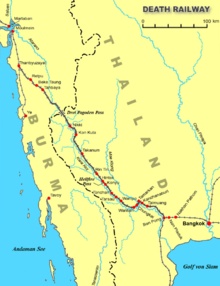
Burma Railway
Transit lineWikipedia
27
MENTIONS
9
EPISODES
8
PODCASTS
Search complete. 27 mentions across 9 episodes found for "Burma Railway".
Oct 9, 2026

Andy AitchesonHOST
[laughs] I mean, and this is the difference.
Andy AitchesonHOST
The minute this, I m- and we'll, this is called the Featherston incident, we'll talk about it in a second, but the, the minute something happened, New Zealanders reported it immediately, opened up to inspection from the, the Red Cr- Red Cross and say, "This is what's happened." At exactly the same time, thousands and thousands of people are being worked to death in the Thai-Burma Railway.
Andy AitchesonHOST
Thousands of people are being held with no food in Changi Prison.
Andy AitchesonHOST
So, the cheek of the Japanese, I mean, it's just, it's, it's, like, I can feel my skin crawling.
Merryn WaltersHOST
But, but what's interesting here from the newspaper's perspective is that the conditions in the prisoner of war camps, um, as we now know in the Far East-
Andy AitchesonHOST
Yeah, yeah
Merryn WaltersHOST
... and you mentioned the Thai-Burma Railway there, those weren't necess- we've covered this before.
Andy AitchesonHOST
Mm.

Lindsay GrahamHOST
Pilot Carl Fritsch screams away from the smoldering bridge with a sense of satisfaction, but he does not know that it was not only enemy soldiers on the ground beneath his bomber.
Lindsay GrahamHOST
The Burma Railway was constructed with forced labor.
Lindsay GrahamHOST
Tens of thousands of Allied prisoners of war and Southeast Asian civilians were used to construct the two-hundred-and-fifty-mile-long railroad.
Lindsay GrahamHOST
And whenever the Allies bomb the bridges, those prisoners are forced to repair them.
Lindsay GrahamHOST
In the years after the war, these prisoners' story will be made famous, but not in a way that many POWs will like.
Lindsay GrahamHOST
A popular novel will romanticize events along the infamous Burma Railway, and many of those who were actually there will feel their story has been twisted even more when the Hollywood adaptation of The Bridge Over the River Kwai premieres on October second, nineteen fifty-seven.
Lindsay GrahamHOST
Hello, History Daily listeners.
Lindsay GrahamHOST
The live show I've been telling you about for a few weeks has a new date, October twenty-third at the Plaza Theater in Garland, Texas.

Steve PriceHOST
Those Australians who have trekked Kokoda, they get it.
Steve PriceHOST
Those Australians who have visited the Burma Railway and read of Weary Dunlop, they get it.
Steve PriceHOST
Or those who have crawled through those Viet Cong tunnels in Vietnam, they get it too.
Steve PriceHOST
Now, these vandals in Canberra, including the passive bureaucrats in defence, should be ashamed of themselves.

Lucy Betteridge DysonGUEST
We tend to focus on the Chindit operations, which there is an argument that however brave those men were, they didn't have a huge strategic impact on things.
Lucy Betteridge DysonGUEST
Or we might focus on, obviously, the horrors that the Japanese inflicted on prisoners of war, might focus on the Burma-Thai Railway.
Lucy Betteridge DysonGUEST
But how are we looking at how victory actually occurred? Because let's not forget that the Japanese were defeated in Burma, and if we aren't remembering how that occurred, then we're doing a disservice to all the men that fought there.
Lucy Betteridge DysonGUEST
And the Southeast Asian Command, so the overall kind of operational command in Burma, there were something like 1.6 million men involved.

Matthew CollinsHOST
The brothers were first held in the bicycle camp, a former Dutch military base that Norman said was almost luxurious compared to the horrors that followed.
Matthew CollinsHOST
The horrors came during their time as slave labourers on the Thai-Burma railway.
Matthew CollinsHOST
Doing back-breaking work in tropical conditions and witnessing violence, starvation, disease, malnutrition, death and despair, the brothers survived by sharing rations, by supporting each other emotionally and physically and by sustaining throughout their captivity a powerful will to survive.
Matthew CollinsHOST
They were also fortunate to be under the command of legendary Australian Dr Weary Dunlop.
39 MINS LATER
Matthew CollinsHOST
Probably quite a nice, subtle way of putting it, is it? It was
John RouseGUEST
very, about the, uh, the management of the, of the war and their defences and so on.
John RouseGUEST
There's a great story actually in the, um, it's an ABC book, um, where in, they identified the 73 odd camps that the Australians had occupied on the Thai-Burma railway at some stage.
John RouseGUEST
And they got a, um, I suppose an oral, it was really an oral history which they published.
Matthew CollinsHOST
John has pieced together his understanding of his father's war from various sources, from things his father and his relatives told him, from what he's read, particularly the war diaries of his dad's CO, legendary Dr Weary Dunlop, the Booker Prize-winning novel The Narrow Road to the Deep North by Richard Flanagan, and the biography of Weary Dunlop by best-selling historian Peter Fitzsimons, as well as from John's personal visits to camps where his father and uncle were held.
Matthew CollinsHOST
Their time as POWs took them from the bicycle camp, the former Dutch barracks of a bicycle infantry unit, which was filled with a huge stockpile of left-behind bicycles, to Bandung, to transit through Singapore's Changi Jail and then Bangkok, and to Konyu, the start of the Thai-Burma railway.
Matthew CollinsHOST
From there, his dad and uncle lived in camps that the prisoners built themselves as the railway progressed north-west towards Burma.
Matthew CollinsHOST
After the railway was completed, Norman and his brother were shipped to Japan to work in a Nihama copper mine.
7 MINS LATER
Matthew CollinsHOST
And they were taken there, they were transported up towards Thailand by train, were they? Yes.
John RouseGUEST
Yes, from Singapore up to Bangkok by train.
John RouseGUEST
And then by train, they went west of Bangkok to the start of the Thai-Burma railway, which is in a town called Konyu, K-O-N-Y-U.
Matthew CollinsHOST
So that was one of the camps that the prisoners made themselves when they were being forced to help construct this Thailand to Burma railway.

Harry MountHOST
And you talk also in the book, which covers so many areas, about your embroidery.
Harry MountHOST
There's a particularly interesting passage on trying to embroider something in memory of the victims of the death railway.
Teresa KeswickGUEST
Yes, that
Harry MountHOST
was the
Teresa KeswickGUEST
local church in Wyndham.
Teresa KeswickGUEST
The parish priest, I think just after the war, had been on death railway.
Teresa KeswickGUEST
and to turn the little parish church into a sort of shrine for everybody, and I think it was everybody, not just the Allies, who were killed in the Southeast Asia during the Second World War.
Teresa KeswickGUEST
And they have a role of honour.

Vineet NairHOST
He was captured when Singapore fell to the Japanese, didn't die.
Vineet NairHOST
He was sent to the Burma-Thailand Railway, the infamous Death Railway, and subjected to starvation, disease, and brutal forced labor.
Vineet NairHOST
He didn't die.
Vineet NairHOST
He was packed onto the Japanese hell ship, Dodji Maru, which was torpedoed and sank in the South China Sea.
5 MINS LATER
Vineet NairHOST
He was conscripted into the British Army in 1939, aged 19, and served with, very aptly, the Gordon Highlanders.
Vineet NairHOST
He was stationed in Singapore when the Japanese captured the city in February 1942.
Vineet NairHOST
He became a prisoner of war, was sent to work on the notorious Burma-Thailand Railway, often called the Death Railway.
Vineet NairHOST
He spent around 750 days in brutal conditions involving forced labor, starvation, disease, and mistreatment.

Juan NaulaNARRATOR
One of the most notable incidents of the mistreatment and even murder of prisoners of war by the Japanese was the Bataan Death March of April 1942, during which American and Filipino prisoners were marched for almost 70 miles in searing heat across Bataan in the Philippines, resulting in between 5,000 and 18,000 men dying of exhaustion, lack of water, and by execution.
Juan NaulaNARRATOR
Another example of the Japanese Army's mistreatment of prisoners comes from the infamous building of the Burma Railway that involved as many as 250,000 local civilians and allied prisoners constructing over 250 miles of narrow gauge railway in tropical heat across Japanese-occupied Burma in little over a year between 1942 and 1943 that resulted in the deaths of nearly 100,000 men from dysentery, beatings, beheading, exhaustion, and starvation.
Juan NaulaNARRATOR
A stark statistic regarding the death toll of Allied prisoners is that 27% of all prisoners of war died under Japanese care, whilst in Europe the figure was around 6%.
Juan NaulaNARRATOR
However, Tojo himself claimed during his trial that the mistreatment and murder of prisoners of war was the responsibility of commanders in the field and not himself, although once again he and his government could have stopped the abuse and killings had they so wished.