Burgess Shale
Rock in British ColumbiaWikipedia
17
MENTIONS
7
EPISODES
7
PODCASTS
Search complete. 17 mentions across 7 episodes found for "Burgess Shale".
Oct 15, 2026

Dave FarinaHOST
Extant forms are small, only three to seven centimeters in length, slender, laterally compressed, translucent, and found in sandy sediments of coastal waters around the world.
Dave FarinaHOST
Modern lancelets closely resemble 530 million year old Pikaia, likely one of the first chordates, fossils of which are known from the Burgess Shale.
Dave FarinaHOST
As such, they are often studied because they hold clues within their genomes about the evolution of early vertebrates.
Dave FarinaHOST
Let's go over their anatomy and physiology, ecology, and phylogeny.

Jackie MullinsHOST
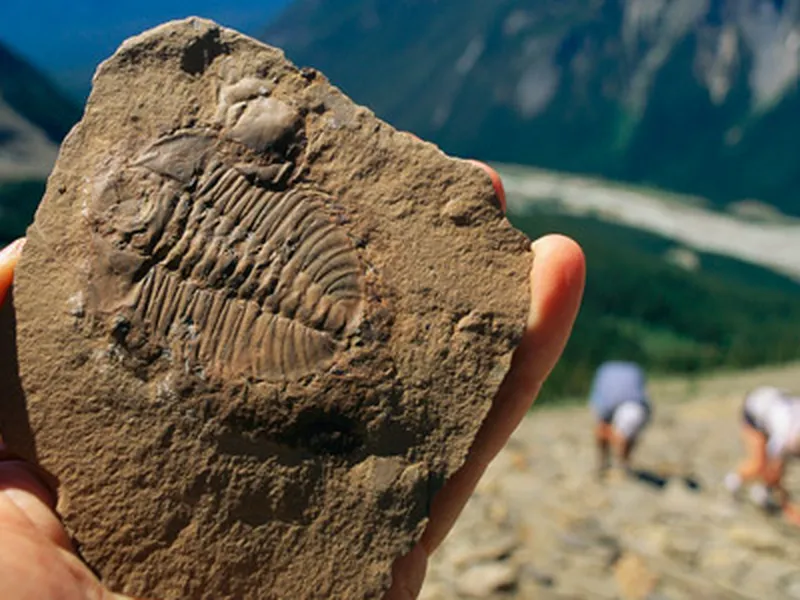
Soft tissue, internal organs, eyes, guts, things that almost never fossilized, preserved in stunning detail half a billion years after they died.
Jackie MullinsHOST
The Burgess Shale.
Jackie MullinsHOST
The leading theory for how preservation happened is similar to what we talked about with the Ediacaran.
Jackie MullinsHOST
The organisms were buried rapidly in underwater mudslides and sealed away from oxygen before they could decay.
Jackie MullinsHOST
And unlike the Ediacaran organisms, which left impressions, some Burgess Shale fossils preserved actual body structures.
Jackie MullinsHOST
You can see what these things look like in three dimensions.
Jackie MullinsHOST
You can see what was inside them.
Jackie MullinsHOST
He was running one of the largest scientific institutions in America while simultaneously trying to describe tens of thousands of fossils unlike anything anyone had ever seen.

speaker_4NARRATOR
Its back was covered with threatening thorns, while its belly had tubular legs similar to tentacles.
speaker_4NARRATOR
The fossils discovered initially in Burgess Shale disconcerted scientists for decades, who could not determine which of their ends corresponded to the head.
speaker_4NARRATOR
Recent studies have shed light on its orientation and diet, but its evolutionary lineage remains unclear.
speaker_4NARRATOR
Scientists still debate whether it was a worm, a mollusk, or something else.
28 MINS LATER
speaker_4NARRATOR
However, even these partial records show us that evolution experimented with designs in completely unknown ways for modern biology.
speaker_4NARRATOR
Marella was a tiny cambric arthropod with an unusual body plan that had ramified antennas and what seem to be legs used to swim.
speaker_4NARRATOR
This creature was so common in Burgess Shale that paleontologists assumed that it must have had great success.
speaker_4NARRATOR
However, in a relatively short period, Marella completely disappeared from the fossil record.

speaker_2NARRATOR
Its back was covered with wicked spines, and its belly featured tubular feet like tentacles.
speaker_2NARRATOR
Fossils first discovered in the Burgess Shale confounded scientists for decades who could not identify which end was the head.
speaker_2NARRATOR
Recent studies shed light on its orientation and feeding, but its evolutionary lineage remains obscure.
speaker_2NARRATOR
Scientists still debate whether it was a worm, mollusk, or something else.
22 MINS LATER
speaker_2NARRATOR
Yet even these partial records tell us that evolution was experimenting with designs in ways completely unfamiliar to modern biology.
speaker_2NARRATOR
Marrella was a tiny Cambrian arthropod with an unusual body plan featuring branched antennae and what appear to be swimming legs.
speaker_2NARRATOR
This creature was so common in the Burgess Shale that paleontologists assumed it must have been highly successful.
speaker_2NARRATOR
Yet within a relatively short time, Marrella disappeared from the fossil record completely.

Ray TrollHOST
bits, that's tough, all
David StrassmanHOST
right? Yeah, but if you think about it, the epoch before the Cambrian, we have the Burgess Shale and all that soft body preservation.
David StrassmanHOST
So it's not like a new thing, and it's not the oldest.
David StrassmanHOST
A crinoid is like a sea lily.

speaker_2NARRATOR
Some of the most important fossil sites in the world are valley floor deposits, the Olduvai Gorge in the East African Rift, where Lewis and Mary Leakey discovered hominin remains that reshape the understanding of human evolution.
speaker_2NARRATOR
The Burgess Shale in British Columbia, where a valley floor mudslide 500 million years ago entombed a community of soft-bodied marine organisms.
speaker_2NARRATOR
so perfectly that their internal organs are still visible.
speaker_2NARRATOR
The La Brea Tar Pits in Los Angeles, where a valley floor seep of natural asphalt has been trapping and preserving animals for 40,000 years, from sabre-toothed cats and dire wolves to ground sloths the size of automobiles, each one walking into the sticky surface and sinking.

Elle KeymerHOST
And this is a place of glittering skyscrapers, diverse neighbourhoods and excellent food.
Elle KeymerHOST
One of its greatest treasures is the Royal Ontario Museum, whose world-famous collection of Burgess Shale fossils reveal an astonishing snapshot of life more than 500 million years ago during the Cambrian Explosion.
Elle KeymerHOST
That's the moment when complex life rapidly diversified in Earth's oceans.
Elle KeymerHOST
It was originally discovered high in the Rockies of British Columbia.