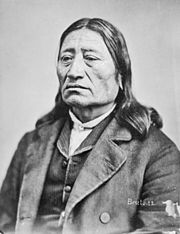
Sicangu
PeopleWikipedia
18
MENTIONS
4
EPISODES
4
PODCASTS
Search complete. 18 mentions across 4 episodes found for "Sicangu".
Sep 16, 2026

speaker_1NARRATOR
Yet this event ushered in a new period for their race.
speaker_1NARRATOR
The surveyors of the Union Pacific were laying out the proposed road through the heart of the Southern Buffalo country, the rendezvous of Ogalalas, Brules, Arapahos, Comanches, and Pawnees, who followed the buffalo as a means of livelihood.
speaker_1NARRATOR
To be sure, most of these tribes were at war with one another, yet during the summer months, they met often to proclaim a truce and hold joint councils and festivities, which were now largely turned into discussions of the common enemy.
speaker_1NARRATOR
It became evident, however, that some of the smaller and weaker tribes were inclined to welcome the new order of things, recognizing that it was the policy of the government to put an end to tribal warfare.
13 MINS LATER
speaker_1NARRATOR
When a council was held, and the other young men stood at a distance with their robes over their faces so as to avoid recognition, Spotted Tail always put himself in a position to hear all that was said on either side and weighed all the arguments in his mind.
speaker_1NARRATOR
When he first went on the warpath, it appears that he was, if anything, overzealous to establish himself in the eye of his people.
speaker_1NARRATOR
And as a matter of fact, it was especially hard for him to gain an assured position among the Brules with whom he lived, both because he was an orphan and because his father had been of another band.
speaker_1NARRATOR
Yet it was not long before he had achieved his ambition, though in doing so he received several ugly wounds.

speaker_2NARRATOR
Yet this event ushered in a new period for their race.
speaker_2NARRATOR
The surveyors of the Union Pacific were laying out the proposed road through the heart of the southern Buffalo country, the rendezvous of Ogalalas, Brules, Arapahos, Comanches, and Pawnees, who followed the Buffalo as a means of livelihood.
speaker_2NARRATOR
To be sure, most of these tribes were at war with one another, yet during the summer months, they met often to proclaim a truce and hold joint councils and festivities, which were now largely turned into discussions of the common enemy.
speaker_2NARRATOR
It became evident, however, that some of the smaller and weaker tribes were inclined to welcome the new order of things, recognizing that it was the policy of the government to put an end to tribal warfare.
13 MINS LATER
speaker_2NARRATOR
When a council was held, and the other young men stood at a distance with their robes over their faces so as to avoid recognition, Spotted Tail always put himself in a position to hear all that was said on either side, and weighed all the arguments in his mind.
speaker_2NARRATOR
When he first went on the warpath, it appears that he was, if anything, overzealous to establish himself in the eye of his people.
speaker_2NARRATOR
And as a matter of fact, it was especially hard for him to gain an assured position among the Brules with whom he lived, both because he was an orphan and because his father had been of another band.
speaker_2NARRATOR
Yet it was not long before he had achieved his ambition, though in doing so he received several ugly wounds.

Nick EstesGUEST
Uh, my name is Nick Estes.
Nick EstesGUEST
I am an enrolled member of the Lower Brule Sioux Tribe.
Nick EstesGUEST
I'm also co-host of the Red Nation podcast.
Nick EstesGUEST
I have a Red Scare podcast/Substack where I write.

David WalesNARRATOR
End of Part 1 Part 2 Custer's Last Battle of Custer Battlefield by Robert M. Utley This LibriVox recording is in the public domain Section 2A Road to Little Bighorn Recipe for Disaster Road to the Little Bighorn The Indians who wiped out Custer were Teton Sioux and Northern Cheyennes.
David WalesNARRATOR
Seven separate tribes made up the Teton Sioux, Unkpapa, Blackfoot, Oglala, Brule, Tukelo, Sanzark, and Miniconju.
David WalesNARRATOR
Once they had lived around the headwaters of the Mississippi River, but pressed by Chippewas armed with muskets obtained from white traders, they retreated in the late 18th century westward to the Missouri River and beyond.
David WalesNARRATOR
In turn, they pushed aside weaker tribes and finally overspread the plains cut by the valleys of the Yellowstone River and its major tributaries, the Powder, Tongue, and Bighorn.
6 MINS LATER
David WalesNARRATOR
Most of the Tetons, some 15,000, succumbed to the lure of free rations and went to the reservation.
David WalesNARRATOR
Even Red Cloud, after exasperating government officials with shifting demands, finally gave in.
David WalesNARRATOR
But neither he nor his equally powerful rival, Spotted Tail, chief of the Brules, wanted an agency on the Missouri.
David WalesNARRATOR
The Indian Bureau at last agreed to locations far up the White River across the reservation boundary in Nebraska and established Red Cloud and Spotted Tail agencies.