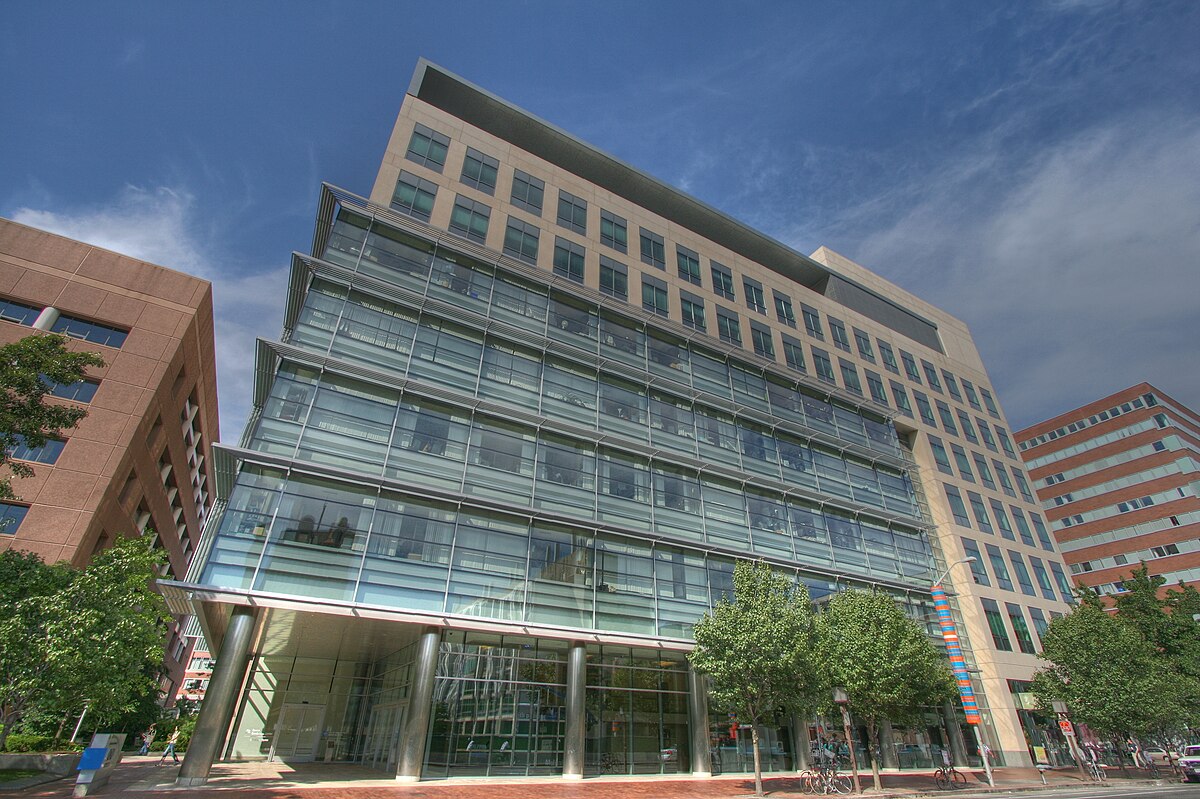
Broad Institute
Research institute in Cambridge, MassachusettsWikipedia
50
MENTIONS
28
EPISODES
23
PODCASTS
Search complete. 50 mentions across 28 episodes found for "Broad Institute".
Nov 4, 2026

Walter IsaacsonGUEST
And then I waited for the names, and it was Emmanuel and then Jennifer.
Walter IsaacsonGUEST
I thought it was going to be Feng Zhang as well, the competitor they have at the Broad Institute of MIT in Harvard.
Walter IsaacsonGUEST
But in some ways, what he did was show how it can work in human cells.
Walter IsaacsonGUEST
And I'm hoping maybe someday he and George Church win the Nobel Prize for medicine.
37 MINS LATER
Walter IsaacsonGUEST
But as they leave the parking lot, They get a text message saying, robot competition canceled.
Walter IsaacsonGUEST
And that's when Jennifer decided to gather people throughout the Bay Area, the scientists, and focus their attention on turning their tools to fighting coronavirus.
Walter IsaacsonGUEST
Likewise, Fong Zhang and the people of the Broad Institute in Cambridge, Mass., did the same.
Walter IsaacsonGUEST
And what they do are multiple things.

Finny KuruvillaGUEST
So I had plenty of opportunities to see patients, work in the trenches.
Finny KuruvillaGUEST
After that, I spent some time at the Broad Institute, which is a joint Harvard and MIT Institute where I worked in medical genetics.
Finny KuruvillaGUEST
And so I spent lots of years on the science clinical side.
Finny KuruvillaGUEST
And a lot of what being in venture capital is is meeting new companies, trying to figure out what's going to be great ideas, successful ideas.

Susan SharfsteinGUEST
And this has been somewhat of a fraught topic because of the IP around CRISPR.
Susan SharfsteinGUEST
But there are now Cell editing technologies out there that don't fall into the CRISPR, Berkeley, Broad Institute conundrum.
Susan SharfsteinGUEST
And so I think that there are some real possibilities there for thinking about how you might relatively straightforwardly engineer cell lines for better growth or productivity or things like that.
Susan SharfsteinGUEST
It was much harder before we could do cell line editing.

Mary Ellen WiltroutHOST
So maybe during your time here, there have been scientific developments in bipolar disorder.
Mary Ellen WiltroutHOST
Even just across the street, the Broad Institute published in 2022 an article that found a genetic connection between bipolar disorder and this specific gene, ACAP11.
Mary Ellen WiltroutHOST
And that was done through GWAS studies, genomic wide association studies.
Mary Ellen WiltroutHOST
Super cool.

Keith KleinHOST
Now, there has been, you know, customer announcements like, you know, the Foundation Medicine.
Keith KleinHOST
And then, you know, you were talking about the collaboration with like the Broad Institute seems to be like one of your premier partners.
Keith KleinHOST
So how does like what are the use cases there? Like, how does it all work? So in
Vinay Seth MohtaGUEST
Foundation Medicine's case, for example, you know, they de-identify a lot of the molecular data, you know, that they generate while doing a cancer diagnostic test on a patient.

Gregg DayHOST
Hi, this is Gregg Day from Mayo Clinic in Jacksonville, Florida.
Gregg DayHOST
Today, I'm joined by Erica Minnichol and Sonia Vallabh, husband and wife team and directors of the prion therapeutic science at the Broad Institute in Cambridge, Massachusetts.
Gregg DayHOST
We'll be discussing the prion protein targeting siRNA safety and mechanism study, or PRISM trial for short.
Gregg DayHOST
Now, as our audience knows, prion disease is a rare fatal neurodegenerative disorder that's caused by the misfolding of the prion protein.
25 MINS LATER
Gregg DayHOST
I've just been speaking with Eric Minnickle and Sonia Vallabh, husband and wife team at the heart of the PRISM trial.
Gregg DayHOST
As you've heard, A single diagnosis changed their lives, but now through this study and studies yet to come, they're prepared to change the lives of other patients with prion disease.
Gregg DayHOST
The PRISM trial is recruiting now to learn more about the study, to learn more about the lab and the work going on at the Broad Institute, or specifically to learn how to refer a patient.
Gregg DayHOST
Check out the Broad Institute Therapeutic Science website, searchable on any platform, or go to clinicaltrials.gov.

Stephen McCarrollGUEST
Can you tell us your name and where you work? Stephen McCarroll.
Stephen McCarrollGUEST
I'm from Harvard Medical School and the Broad Institute.
Zach LondonCORRESPONDENT
Tell us what we know about how repeat expansions in a single neuron can impact how long it takes for Huntington's disease to manifest.
Stephen McCarrollGUEST
In Huntington's disease, we think it takes many decades for this CAG repeat to expand from the length at which it's inherited, typically 40 to 60 CAGs, to the length at which it becomes toxic, which we estimate is about 150 CAGs.

Moshe BitonGUEST
So our question was how the epithelial cells really sense and react to different insults coming from different environments.
Moshe BitonGUEST
So in 2018, this is where I was in my postdoc in MIT at the Broad Institute.
Moshe BitonGUEST
We showed that those stem cells, right? can interact with T-cells.
Moshe BitonGUEST
Then the T-cells can govern their differentiation towards whatever lineage they needed depending on the context of the T-cells.

Yossef BaidiHOST
From the Broad Institute in Kendall Square, this is the Pulse Podcast.
Yossef BaidiHOST
I'm one of your co-hosts, Yossef Baidi.
Fang XieHOST
And I'm your other co-host, Fang Xie.
Yossef BaidiHOST
So for today's guest is Dr. Todd Golub.
Yossef BaidiHOST
As a world-renowned physician scientist, Todd needs no introduction.
Yossef BaidiHOST
He is director of the Broad Institute of MIT and Harvard and a founding core member of the institute.
Yossef BaidiHOST
He is also a member of the faculty of the Dana-Farber Cancer Institute and Harvard Medical School.
Yossef BaidiHOST
Todd pioneered the application of genomics to utilize for cancer biology as well as for therapeutic discovery for cancer.
18 more episodes mention Broad Institute.
Create an account to see the whole feed, search across every transcript, and follow the entities you care about.