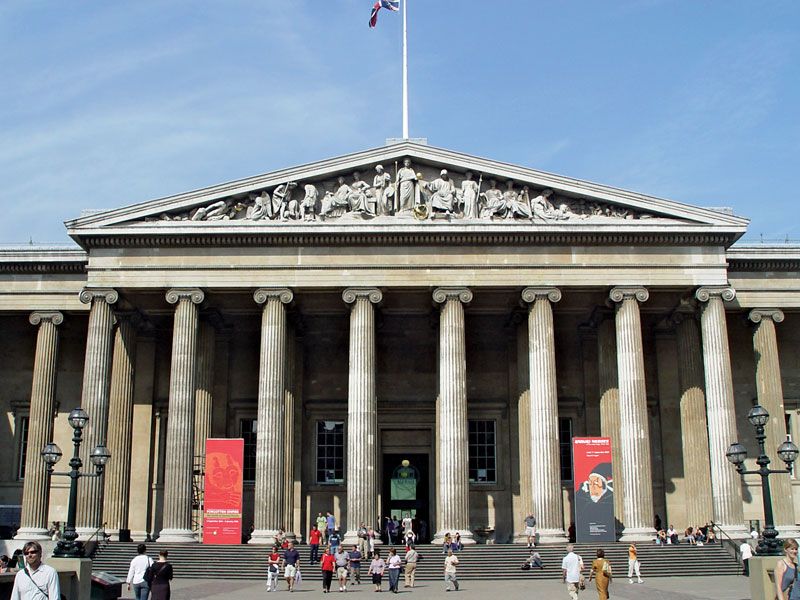
British Museum
Museum in London, EnglandWikipedia
1.1k
MENTIONS
554
EPISODES
467
PODCASTS
Search complete. 1134 mentions across 554 episodes found for "British Museum".
Oct 27, 2026

David PawsonHOST
You know, I've never been interested really in historical relics, but since I got to know what the Bible said about history and the future, I found myself interested.
David PawsonHOST
One of the most fascinating things you can do is to go around the British Museum with a Bible in your hand.
David PawsonHOST
I've got a handbook that tells you everything in the British Museum that's from the Bible.
David PawsonHOST
And it's fascinating to go around and just read your Bible and look into the glass cases.
David PawsonHOST
Now, if you look at the coins of Antiochus Epiphanes, you can see on the coins his growing obsession with himself as God.

Helen GeakeHOST
Tasha and I were colleagues for a few years until she moved on to start a PhD on Roman metallurgy.
Helen GeakeHOST
And although she hasn't quite finished that she's now back with the portable antiquities scheme as a roman coins advisor at the british museum and her research it's really fascinating analyzing the coins has suggested that we need to rethink some of our ideas about how the romans produced all kinds of metal work so i was really keen to invite her onto the podcast to tell you about it
Martyn WilliamsHOST
I'm very excited to meet her.
Martyn WilliamsHOST
So we will do that very, very soon.
31 MINS LATER
Tasha FullbrookGUEST
And I don't see why we sort of need to record them so differently.
Tasha FullbrookGUEST
I mean, we record them as an imitation, but we can still tell you who's on the obverse and what they're potentially trying to copy on the reverse and record it in the same way as we do a coin, which is why I could come up as part of my research is also going to come up with a typology and a new way of recording these.
Tasha FullbrookGUEST
And now that I'm working with the British Museum, we've been lucky to be able to put in some new guidance for recording them and change the description to imitation rather than barfless radio, which is one of the first things I think I tried to do when I joined.
Martyn WilliamsHOST
You're leading the campaign to do it, which is marvellous.

KatieHOST
This has been a bestselling thriller.
KatieHOST
It was voted Editor's Pick of the Week by the Daily Express and one of the five best religious thrillers of all time by bestthrillers.com. You have just handed your publisher a history of the British Museum.
KatieHOST
which is, again, a super interesting time to be writing it when discussions of artefacts and where they should reside are polarised.
KatieHOST
I watched a debate that you were in, you were part of, about the Elgin Marbles or the Parthenon sculptures.
KatieHOST
You speak regularly about history in the media.
KatieHOST
You appear regularly on television and radio as a historical commentator and advisor.
KatieHOST
You speak at schools, universities, literary festivals, learning societies and institutions like the British Library and the British Museum.
KatieHOST
You write articles regularly for all the top respected newspapers and magazines.

Lynette CalkinsNARRATOR
These social activities did not prevent her from keeping up with her studies.
Lynette CalkinsNARRATOR
She defied convention by investing in a bicycle on which she rode to the British Museum when she wanted to do serious reading.
Lynette CalkinsNARRATOR
Extracts from two letters written in 1892 show how easily she could change her mood and adapt herself to different atmospheres.
Lynette CalkinsNARRATOR
We spent a madly amusing five days in Canterbury, of which nothing remains to tell except that we danced every night, saw a good deal of cricket, and talked a little.
46 MINS LATER
Lynette CalkinsNARRATOR
She employed native teachers in London, and by 1896 had read the Koran and much of the Arabian Nights in their original tongues.
Lynette CalkinsNARRATOR
But again, as at Oxford, that mixture of youthful enthusiasm for life and study remained.
Lynette CalkinsNARRATOR
In a letter from London she talks enthusiastically about a fancy dress ball and the costumes she wore, and then of spending the morning at the British Museum reading the life of Hafiz with a Latin crib.
Lynette CalkinsNARRATOR
She went to Italy and lived for some time in Venice where her first step was to learn Italian.

KatieHOST
This has been a bestselling thriller.
KatieHOST
It was voted Editor's Pick of the Week by the Daily Express and one of the five best religious thrillers of all time by bestthrillers.com. You have just handed your publisher a history of the British Museum.
KatieHOST
which is, again, a super interesting time to be writing it when discussions of artefacts and where they should reside are polarised.
KatieHOST
I watched a debate that you were in, you were part of, about the Elgin Marbles or the Parthenon sculptures.
KatieHOST
You speak regularly about history in the media.
KatieHOST
You appear regularly on television and radio as a historical commentator and advisor.
KatieHOST
You speak at schools, universities, literary festivals, learning societies and institutions like the British Library and the British Museum.
KatieHOST
You write articles regularly for all the top respected newspapers and magazines.

speaker_1NARRATOR
It's the year 1867.
speaker_1NARRATOR
A bearded philosopher named Karl Marx sits in the dim light of the British Museum scribbling the foundational texts of Das Kapital.
speaker_1NARRATOR
He is writing about a terrifying future where every human interaction is reduced to a cold transaction.
speaker_1NARRATOR
A world where even kindness is a commodity bought and sold for a profit.

speaker_0NARRATOR
Thank you for watching Lato's Law.
speaker_0NARRATOR
Why are the pyramids in Egypt? Because they were too heavy to carry to the British Museum.

Ben EnglandHOST
How exciting.
Ben EnglandHOST
I'm trying to explain this to my teenage children and they just give me this look that just made me feel like, you know, I was behind glass in the British Museum or something.
Ben EnglandHOST
You do fossil.
Ben EnglandHOST
What are you talking about? But it was really interesting to look at these photos because my memory of these photos in the box, in the bag, is that they were beautifully framed and in focus and get the photos out and they're wonky and everyone's got terrible red eye.

Santiago SegoviaHOST
Seres que mediante la manipulación emocional, la culpa y el acoso drenan la vitalidad de sus víctimas, dejándolas en estados de agotamiento físico absoluto e inmunodepresión.
Santiago SegoviaHOST
La fecha de publicación de la mayor obra sobre vampiros de la historia guardaba una coincidencia con los archivos del Museo Británico.
Santiago SegoviaHOST
El 26 de octubre de 1897, día en que se lanzó al mercado la primera edición de la novela Drácula de Bram Stoker, en Londres, en el Departamento de Antigüedades del Museo Británico, registró la minuta BM-97-1026 Aquel 26 de octubre, los conservadores clasificaron un lote de cartas y reportes médicos enviados desde la frontera de Serbia en 1732.
Santiago SegoviaHOST
El informe del 26 de octubre Confirmó que Stoker no inventó la figura del conde, sino que transcribió los peritajes forenses de las epidemias del vampirismo de Kicillofa, donde la medicina militar del imperio austrohúngaro certificó bajo sello imperial la exhumación de cuerpos incorruptos repletos de sangre fresca.
Santiago SegoviaHOST
El vampiro es el reflejo de nuestro mayor temor, la inmortalidad a costa del dolor ajeno.

Frankie BeresteinHOST
get that far.
Josh BaldHOST
Well, I don't know about you, Frankie, but if it's behind the Sphinx's ear, knowing humanity, that thing that's going to save humanity is in the British Museum.
Josh BaldHOST
That's an imperialism joke.
Josh BaldHOST
Thank you very much.
Josh BaldHOST
Yeah.
Josh BaldHOST
For those unfamiliar, the British, when they colonized or conquered different parts of the world, took a whole bunch of stuff back with them to Britain and put it in the British Museum.
Josh BaldHOST
I'm sure my disgust is shining through.
Josh BaldHOST
I just can't, like, call me Fox Mulder because I want to believe, but I cannot believe this.
544 more episodes mention British Museum.
Create an account to see the whole feed, search across every transcript, and follow the entities you care about.