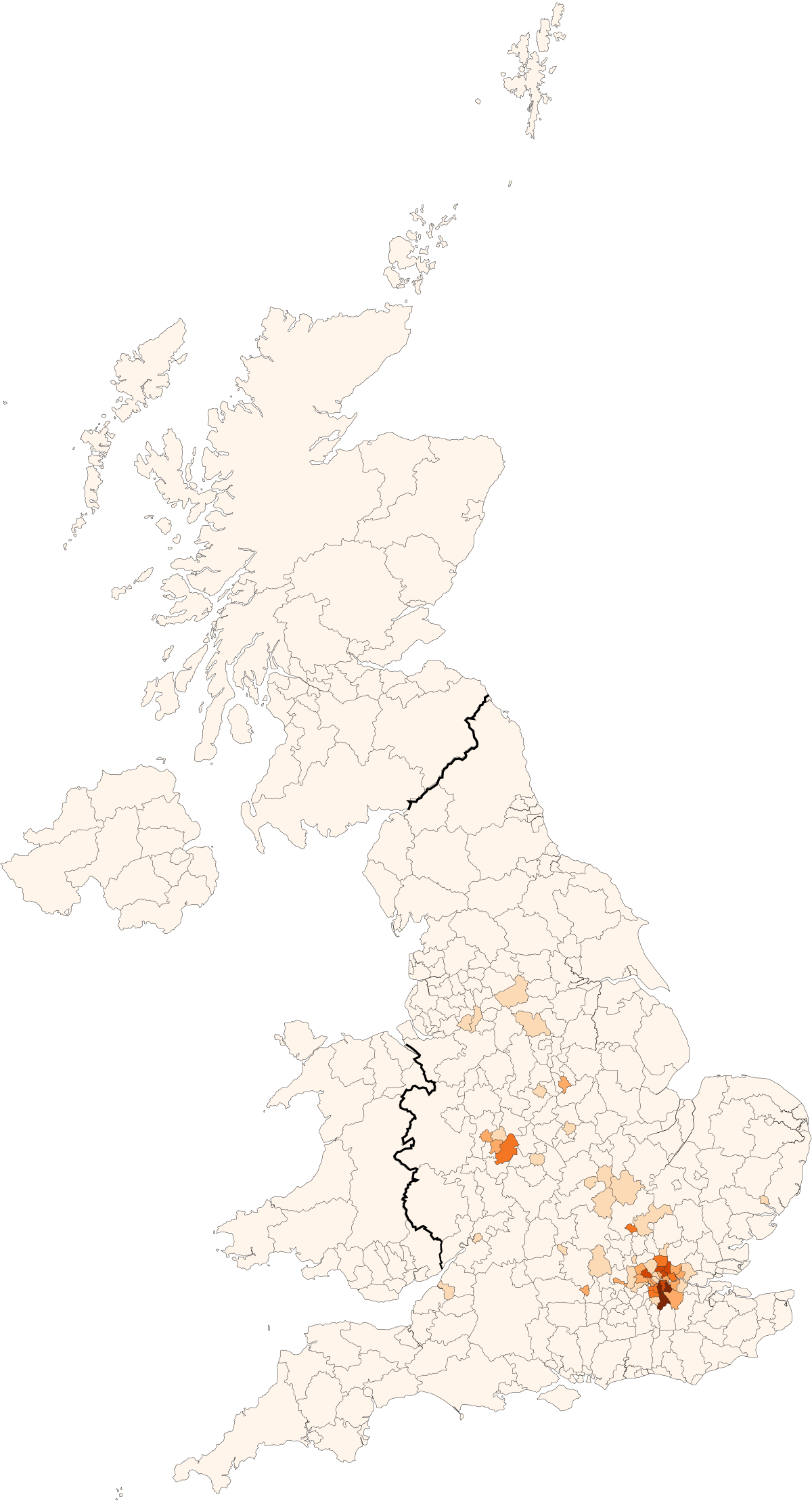
British African-Caribbean people
Ethnic groupWikipedia
27
MENTIONS
18
EPISODES
17
PODCASTS
Search complete. 27 mentions across 18 episodes found for "British African-Caribbean people".
Sep 16, 2026

Lucy AthaHOST
But yeah, we'd love to know how exactly it works and, and what you've been doing.
Lorraine LawrenceGUEST
I work with the Black Caribbean and Black African communities.
Lucy AthaHOST
Mm.
Lorraine LawrenceGUEST
So as you know historically, or may not know, um, Black Caribbean and African communities, not always been very well represented in research.
Lucy AthaHOST
Mm-hmm.
Lorraine LawrenceGUEST
So, um, when communities aren't represented, we can end up with gaps, as we've said before-

Tamara HibbertGUEST
Yeah.
Tamara HibbertGUEST
So I'm of Black Caribbean descent, and in the very diverse, you know, sort of world of living in London, but not in a particularly deprived area of London, when I became pregnant, it was like, oh, okay, you, you do tick that box.
Tamara HibbertGUEST
But I think it was probably more about the weight than the ethnicity, to be fair.
Tamara HibbertGUEST
So I had a, an, an oral glucose tolerance test.

Tim WyattHOST
This is centuries ago in the 17th and 18th centuries.
Tim WyattHOST
And as a result of finding out this very unpalatable news, the Church of England decided that they wanted to put aside 100 million pounds of their assets, their investments into a new special fund that will be dedicated to doing impact investment for kind of black African Caribbean communities to try and in effect make recompense for their historic involvement in slavery.
Tim WyattHOST
And this hasn't actually been set up yet.
Tim WyattHOST
It's still been a kind of torturous process of getting all the new funds set up.
24 MINS LATER
Richard ReddieGUEST
You know, how helpful are they? Are we perpetuating or continuing to use language that is unhelpful in this particular sort of context? So to me, it's sort of looking at the issues of the past and seeing, you know, what are the legacies of that, you know, what issues of the past are currently being played out today and other ways that we can sort of address them.
Richard ReddieGUEST
Particularly if you're sort of going to a church that is quite, or you attend a church rather, that is diverse, you know, ethnically or demographically diverse.
Richard ReddieGUEST
And, you know, some of the individuals with whom you worship are people who are from, you know, particularly from an African or an African Caribbean context.
Richard ReddieGUEST
But I think it's recognizing, again, that, you know, the events of the past continue to inform the present.

Shahzadi HarperGUEST
You know, somebody of my South Asian origin, average age of menopause is 46 and a half.
Shahzadi HarperGUEST
You know, somebody of, um, African Caribbean origin, Hispanic origin, um, it can be a couple of years earlier as well.
Shahzadi HarperGUEST
Women who've not had children, a couple of years earlier too.
Shahzadi HarperGUEST
You know, um, whilst there haven't been sort of formal studies, I've seen a number of patients who've had IVF cycles.

Eric KaufmannGUEST
So for example, if you have, uh, certain kids who are unruly, uh, if they're not being excluded from class because you're getting a disproportionate number of kids from certain ethnic groups, let's say Black and Indigenous.
Eric KaufmannGUEST
Um, although it's interesting in Britain that, that the Black African kids have actually lower exclusion rates than average, and the Black Caribbean kids have higher exclusion rates.
Eric KaufmannGUEST
So it, it may not be as simple as, as, as Black.
Eric KaufmannGUEST
Uh-

Taj AliGUEST
I'm proud of that.
Taj AliGUEST
But at the same time, if I see a Sikh or a Hindu being abused or an African Caribbean, I'm going to intervene because racism is wrong.
Taj AliGUEST
It's not about transactional solidarity that you help me and therefore I should help you.
Taj AliGUEST
It's racism is wrong.
Taj AliGUEST
Because Islamophobia was so bad post 9-11, you had Bosnia and Chechnya in the 90s.
Taj AliGUEST
I've written about this in my book.
Taj AliGUEST
You have the shift from South Asian Islamophobia to Muslim or Sikh or Hindu, but also there was a deliberate policy, state multiculturalism, which said, after the riots of 81, that we're going to put money into these poor inner city areas and suddenly you have the African Caribbean community centre, you have the Pakistani community centre, you have the Indian community centre, and communities that were once united in a shared struggle against racism are suddenly divided because they're all competing for the same pots of government funding.
Taj AliGUEST
And we then empower these so-called community leaders, who are always men, by the way, who are unelected, that the state just decides, well, they speak on behalf of this entire community, which was never a monolith.

CarolPANELIST
And also I was reflecting on family trauma and the messages that you've gotten in your early years that builds up a certain core of who you are.
CarolPANELIST
And, you know, I really delve deeply into my own African Caribbean background and a very traumatic and almost toxic environment where there's favoritism.
CarolPANELIST
And if you're not the favorite child, it can stack a lot of psychological second guessing of yourself.
CarolPANELIST
And you may be bright, but don't think you're bright because nobody's ever told you you're bright or capable.

Holly Marie CatoGUEST
And so they were confronted for the first time with like racism and discrimination.
Holly Marie CatoGUEST
And they never thought they, the idea of the, I guess the black Caribbean church was never meant to be a thing.
Holly Marie CatoGUEST
they were very it was meant to be they thought it'd be a diverse place of worship but it was born out of necessity by not being accepted and creating their own places of worship and so i thought that was quite interesting because now the church that i have always kind of gone to or i would say go or the church that i started to go to at least in my 20s it was a very diverse form of worship even the idea of like putting on your Sunday's best wasn't really a thing we could kind of just dress in jeans and a t-shirt and go to church and so there was a lot about that culture that I'd maybe seen as a younger kid that I wasn't really seeing anymore and so to see this church was so beautiful and I was really led to photograph them But it took convincing because they're really old school.
Holly Marie CatoGUEST
They have a lot of rules.

Sarah AndersonHOST
I can't remember.
Louise AllenHOST
I think I was Black Caribbean.
Louise AllenHOST
That's right.
Louise AllenHOST
Which I'd love.
8 more episodes mention British African-Caribbean people.
Create an account to see the whole feed, search across every transcript, and follow the entities you care about.