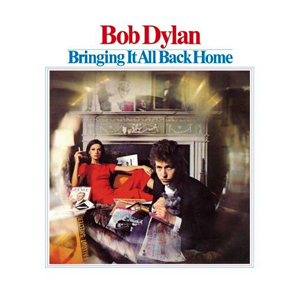
Bringing It All Back Home
Studio album by Bob DylanWikipedia
13
MENTIONS
7
EPISODES
6
PODCASTS
Search complete. 13 mentions across 7 episodes found for "Bringing It All Back Home".
Sep 29, 2026

Wesley SmithHOST
[laughs]
Elliot AronowGUEST
Dylan is, is a little bit the same way, where like, you know, um, Bringing It All Back Home, Highway 61, and Blonde on Blonde are pretty much his imperial period.
Elliot AronowGUEST
Um, and then depending on how much you care for it, there's all these weird mutations that are kind of interesting.
Wesley SmithHOST
Yeah.

Nish KumarGUEST
I don't think there's anything from the first self-titled album.
Nish KumarGUEST
But it's then from Freewheelin' Bob Dylan, Times They Are A-Changin', Another Side of Bob Dylan, uh, Bring It All Back Home, Highway 61 Revisited, and Blonde on Blonde.
Nish KumarGUEST
And so it's just that.
Nish KumarGUEST
It will, as you age, it will devastate you, because if you look at the original vinyl back cover, it shows you the albums that it's taken from, and if you know enough about Bob Dylan, you know that he was 25 when he recorded Blonde on Blonde.

CraigHOST
By the show in 65, though, Dylan had kind of moved on from his protest era the year before, really, and was moving so fast he was hardly recognizable.
CraigHOST
Over a 14-month period, he released three amazing groundbreaking records, Bringing It All Back Home, Highway 61 Revisited, Blonde on Blonde, Taking Him to the End of 1966.
CraigHOST
And something that's always fascinated me about this period is how fast the culture moved.
CraigHOST
The difference between I Want to Hold Your Hand and Day in the Life was just three years and six months.

Jim LillHOST
It had a lot to do with that.
Jim LillHOST
Dylan created controversy when he used electrically amplified rock instrumentation for his albums Bringing It All Back Home, Highway 61 Revisited, both 1965, and Blonde on Blonde, 1966.
Jim LillHOST
Okay, I also know that Blonde on Blonde is a big deal.
Jim LillHOST
Blonde on Blonde's a big deal.
Jim LillHOST
During this period, he recorded a large body of songs with members of the band.
Jim LillHOST
Hey, there it is! Which produced the album The Basement Tapes, 1975.
Jim LillHOST
Dylan explored country music and rural themes on the albums John Wesley Harding, 1967, Nashville Skyline, 1969, and New Morning, 1970.
Jim LillHOST
So I'm pretty sure Nashville Skyline I know because of the Ken Burns documentary Country Music.

JohnHOST
Like he could have written this at like 22.
RebeccaGUEST
Even the titles, like "She Belongs to Me" is the, on "Bringing It All Back Home," and this is-
JaredHOST
Yeah
RebeccaGUEST
... "If You Belong to Me."

Ken ConnorsHOST
Dylan was so prolific, I guess, in terms of lyrics and crafting stories that Robertson said there was this constant sound throughout the day of typewriter keys being pounded.
Mitch MelnickGUEST
That's music in itself, isn't it? And yeah, hotel rooms, also making songs up in the studio, like some of his mid-60s masterpieces, Bringing It All Back Home, Highway 61 Revisited, Blonde on Blonde was mostly recorded in Nashville, but those first two of that troika of albums from the mid-60s, He was literally writing songs out at the piano in between breaks and studio musicians where they had no idea what was coming.
Mitch MelnickGUEST
He's very much Dylan has always had the spirit of an old school jazz musician in that regard.
Ken ConnorsHOST
We're with Mitch Melnick.
Ken ConnorsHOST
Dylan was so prolific, I guess, in terms of lyrics and crafting stories that Robertson said there was this constant sound throughout the day of typewriter keys being pounded.
Mitch MelnickGUEST
That's music in itself, isn't it? And yeah, hotel rooms, also making songs up in the studio, like some of his mid-60s masterpieces, Bringing It All Back Home, Highway 61 Revisited, Blonde on Blonde was mostly recorded in Nashville, but those first two of that troika of albums from the mid-60s, He was literally writing songs out at the piano in between breaks and studio musicians where they had no idea what was coming.
Mitch MelnickGUEST
He's very much, Dylan has always had the spirit of an old school jazz musician in that regard.
Ken ConnorsHOST
We're with Mitch Melnick.