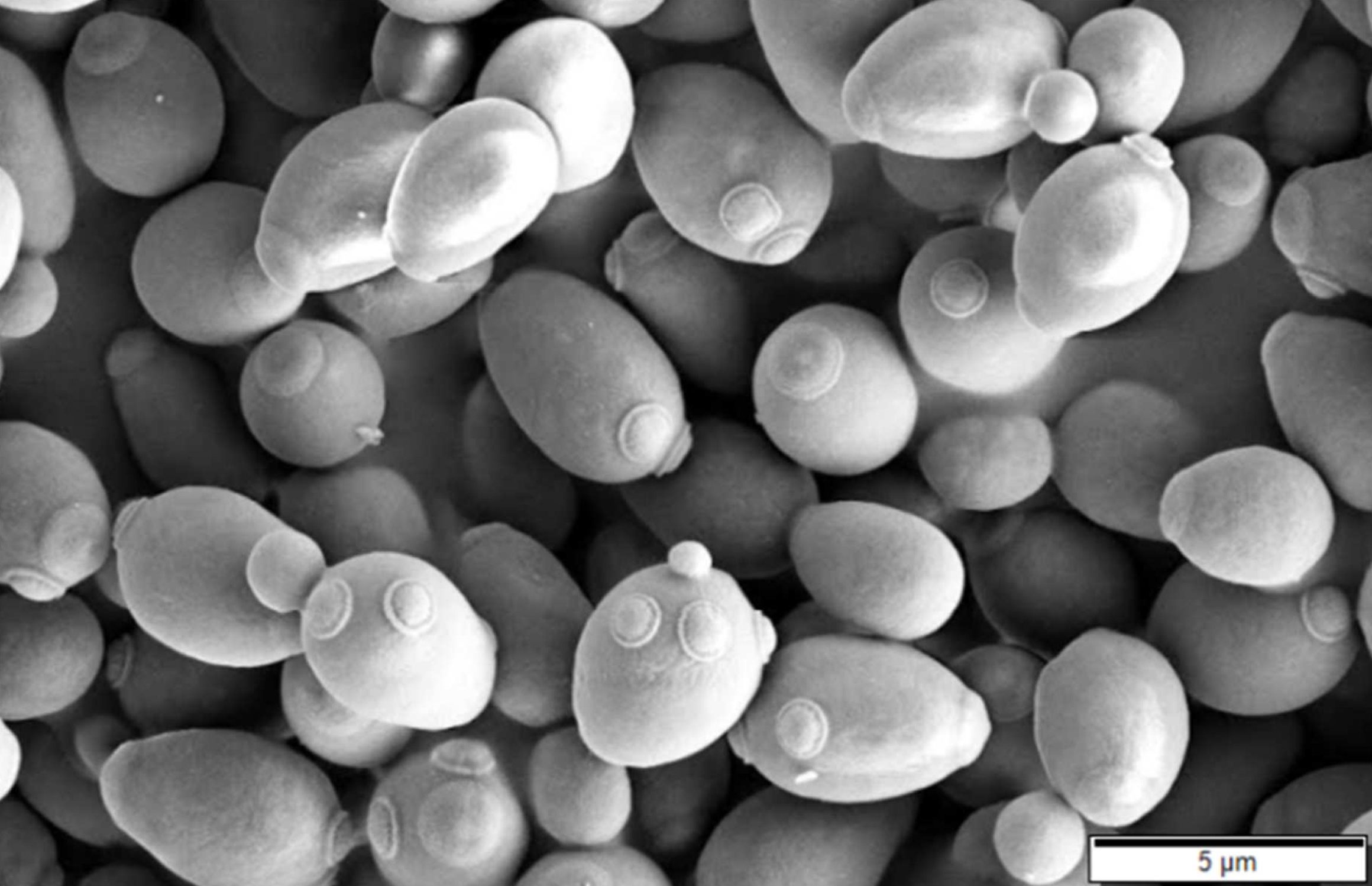
Brewer's yeast
FungiWikipedia
29
MENTIONS
21
EPISODES
19
PODCASTS
Search complete. 29 mentions across 21 episodes found for "Brewer's yeast".
Sep 12, 2026

Ira PastorHOST
Excellent.
Ira PastorHOST
A- a- and Christie, um, your dissertation, metabolic engineering in S. cerevisiae, the production of, uh, benzyl isoquinoline alkaloids, and here you have, you know, a, a, a br- a broad set of, of, of alkaloids, natural products that, you know, normally found in perennial woody crops that further the basis for, you know, a variety of opiates and antimicrobial agents and smooth muscle relaxants and all that.
Ira PastorHOST
Um, again, you know, take us, take us back a little bit, uh, to this work because obviously very crucial, uh, in, you know, coming together with what we're, where we're gonna be going with Antheia in a little bit.
Kristi HawkinsGUEST
Yeah, absolutely.

DaveHOST
The beer is fermented at between 9 and 15 Celsius and then is lagered for about three to eight weeks at very low temperatures, between one and five degrees, depending on the strength and the strain of the lager.
DaveHOST
But this particular yeast is actually a very close relative of Saccharomyces cerevisiae, which is the one that is typically used for ales, which uses a warmer fermentation of between 18 and 24 degrees Celsius.
DaveHOST
And I do believe actually that's where the Spanish Latin term cerveza comes from, which is a term you'll often see on the side of bottles of beer as an alternative name for beer or lager or ale.
DaveHOST
And unfortunately, that is about as far as my research took me.

Keith BeaversHOST
Her name was Dr. Irene Stefani.
Keith BeaversHOST
And a quote from her paper was, Saccharomyces cerevisiae is not airborne, but requires a vector to move.
Keith BeaversHOST
We've talked about the vectors.
Keith BeaversHOST
We've talked about birds and bugs.

speaker_1NARRATOR
Non-saccharomyces yeasts may not necessarily make smoke taint worse, according to new research using smoke-exposed pinotage.
speaker_1NARRATOR
Researchers tested Lachancea thermotolerans, Wickerhamomyces anomalis, and Starmorella bacillaris in sequential fermentations with Saccharomyces cerevisiae.
speaker_1NARRATOR
Early in fermentation, the non-saccharomyces yeasts generally released fewer volatile phenols than S. cerevisiae alone.
speaker_1NARRATOR
By the end of fermentation, however, volatile phenol levels were similar across treatments, suggesting S. cerevisiae dominated their release later in fermentation.

Alex TitovGUEST
If you're making ale, you're trying to find ale yeast.
Alex TitovGUEST
Saccharomyces cerevisiae, if you're looking for lager, you're trying to choose Saccharomyces pasterianus.
Alex TitovGUEST
It's not necessary, but in most cases, if you want to have authentic lager, choose pasterianus.
Alex TitovGUEST
And then you have the huge thing, which is Aroma.

Kyle WoodHOST
That's the process that gives a nice Neapolitan pizza that perfect chewy crust.
Kyle WoodHOST
Baker's yeast, or Saccharomyces cerevisiae, feeds on the simple sugars present in wheat flour during fermentation.
Kyle WoodHOST
As a byproduct, they produce carbon dioxide gas and ethanol.
Kyle WoodHOST
The expanding carbon dioxide gets trapped in the gluten network, inflating microscopic pockets in the dough.

Justin MarchegianiHOST
Hundred percent.
Justin MarchegianiHOST
So quick study application of Saccharomyces cerevisiae, so sacch- saccularity for biological detoxification of chemical contaminants in food.
Justin MarchegianiHOST
So interesting situation out of the gate.
Justin MarchegianiHOST
Healthy levels of these microbes.

Matt PowersGUEST
So, so prevalence of bacteria, lab and yeast, these things are, and there's many, many types of yeast.
Matt PowersGUEST
I'm talking about Saccharomyces cerevisiae.
Matt PowersGUEST
Yeast is a form of things.
Matt PowersGUEST
So you'll find there is, there are forms of yeast that are in completely different families, right? There's Basidiomycota and Ascomycota yeasts, right? So just want to put that out there.

KellyHOST
Humans learn to take advantage of those metabolic processes for food production.
KellyHOST
For example, bread relies heavily on yeast, especially Saccharomyces cerevisiae, which is the yeast in your lab kit.
KellyHOST
As the yeast ferments sugars, it produces carbon dioxide gas.
KellyHOST
Those gas bubbles become trapped in the dough and cause the bread to rise, which is called leavening.

Andrea BedfordHOST
Dr. Todd Gunderson, clinical assistant professor of beef production medicine at Kansas State University, discussing restraint physics and flexible scheduling.
Andrea BedfordHOST
And Dr. Matt Dodd, ruminant field technical specialist with Diamond V, discussing Saccharomyces cerevisiae in cattle diets.
Andrea BedfordHOST
I hope you enjoy these conversations.
Sandra GoddenGUEST
I'm here with Dr. Sandra Godden.
11 more episodes mention Brewer's yeast.
Create an account to see the whole feed, search across every transcript, and follow the entities you care about.