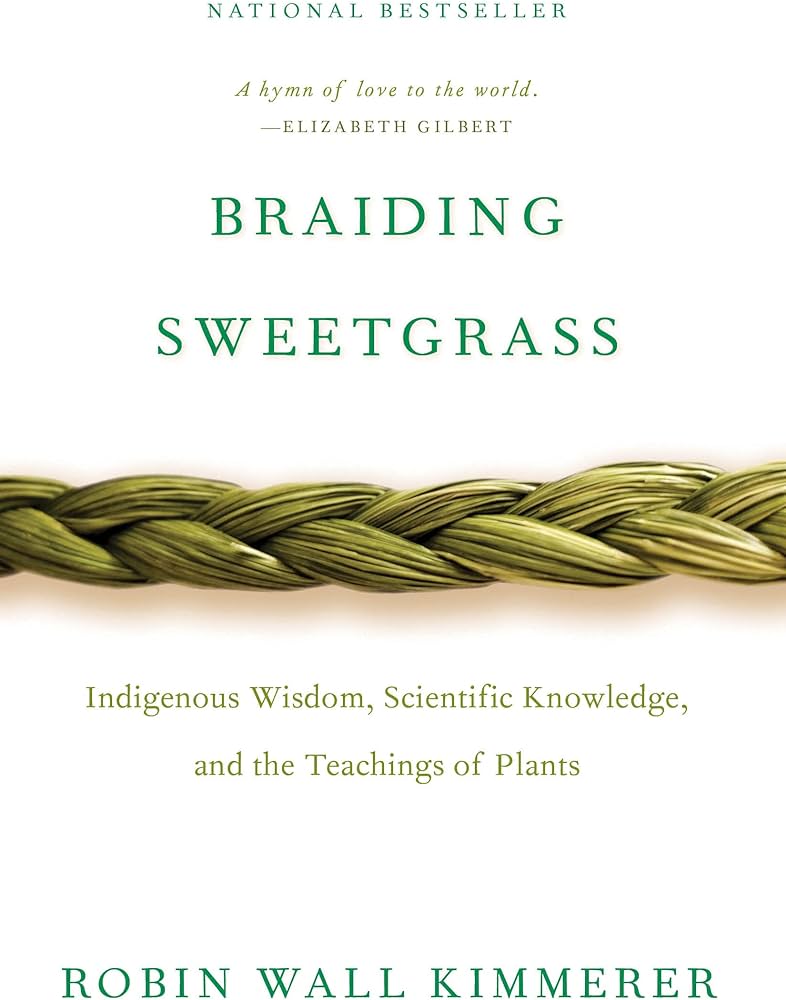
Braiding Sweetgrass
Book by Robin Wall KimmererWikipedia
57
MENTIONS
34
EPISODES
33
PODCASTS
Search complete. 57 mentions across 34 episodes found for "Braiding Sweetgrass".
Oct 30, 2026

Sam TracyHOST
This year, the annual gathering brought together speakers like Ken Burns, Kara Swisher, and Stacey Abrams to reflect on themes of democracy as America turned 250 years old.
Sam TracyHOST
In this final installment of our series, Robin Wall Kimmerer, author of Braiding Sweetgrass, contemplates how to reshape society's relationship with the natural world.
Sam TracyHOST
She's joined in conversation by Ayanna Elizabeth Johnson.
Sam TracyHOST
This talk was recorded in front of a live audience on July 29, 2026, and has been edited for broadcast.
Ayanna Elizabeth JohnsonGUEST
And it is blueberry season.
Ayanna Elizabeth JohnsonGUEST
here in Maine, you didn't know, now you know.
Ayanna Elizabeth JohnsonGUEST
And Robin, berries star in two of your books, very strongly in Braiding Sweetgrass and The Serviceberry.
Ayanna Elizabeth JohnsonGUEST
So I thought I would just kick off this session by sharing my extremely hot take, which is that strawberries are wildly overrated.

CourtneyHOST
yes we got a lot there yeah so that's the pirate queen by ariel lohan Yeah.
CourtneyHOST
And then I do want to say thanks to Eeyore122 for the recommendation for braiding sweetgrass.
CourtneyHOST
Monica is good to send me the Ravelry comments.
CourtneyHOST
I own a copy of it, and I haven't gotten into it.

Adam HermanGUEST
But it's awesome.
Adam HermanGUEST
And then the next book we're going to do, we're currently reading Braiding Sweetgrass, which I don't know if you've read that one by Robin Kimmermer.
Adam HermanGUEST
It's one of my favorite books, who is an indigenous writer.
Adam HermanGUEST
And it's part memoir.

Bex HughesGUEST
It's a bit different.
Bex HughesGUEST
It's Braiding Sweetgrass by Robin Wall Kimmerer.
Bex HughesGUEST
And it's nonfiction.
Bex HughesGUEST
But it's all about... like ancestral knowledge and indigenous like wisdom relating to nature and like the land and the way that people lived um so the author is uh indigenous american and she I feel like is like a botanist as well.

Helen ButlinGUEST
So the journey from soul medicine and adding practices that help participants to engage in nature, nature meditations, exploring themes that have been taught and knowledge systems that preceded the colonial culture in which we live, to approach nature as a living, animated, world of wisdom with what could be called medicines without wanting to co-opt that but having been exposed to indigenous teachers and elders myself realizing what a terrible loss has happened in considering the natural
Helen ButlinGUEST
world to be a noun and not a verb and that comes directly from Robin Kimmerer's book Braiding Sweetgrass where she speaks of how indigenous languages have so many nuances and are very animistic.
Helen ButlinGUEST
They animate the organic world.
Helen ButlinGUEST
There is not a single entity in the organic world that isn't given the place of verb, a process, a right of being, as opposed to a thing or an it.
Helen ButlinGUEST
There is no philosophical space left for something that can treat and address and interact a medical competency, let's say, with that intangible in people's healthcare lives.
Helen ButlinGUEST
journeys with their physicians treating their illness.
Helen ButlinGUEST
There's a beautiful quote I can offer from Thomas Hacking, a phrase he used, and he wrote a book called Rewriting the Soul, tracking how the psychiatric sciences emerged in the 18th century and after about a hundred years when the notion of embodied soul met a dead end in medical practices.
Helen ButlinGUEST
So the notion of an embodied soul that's treated by physicians and an aspect of the medical arts of healing completely dead-ended after the Descartian shift when Descartes came up with his philosophy of the mind as a superior aspect of the whole person and the body being a subsidiary that is directed by the mind.

Caitlyn Ference-SaundersGUEST
And I appreciate my place in all things more.
Caitlyn Ference-SaundersGUEST
Like I love, I know you and I have often talked about the book Braiding Sweetgrass or The Serviceberry.
Caitlyn Ference-SaundersGUEST
One of the things I love about all of her work is sort of her indigenizing to place concept.
Caitlyn Ference-SaundersGUEST
And that part of our responsibility as humans, who I would say, I don't know how she would phrase it, but I would say we are profoundly disjointed in our relationship to our lived reality.

Kristin SilvaHOST
Are you familiar with, um, What's her other one? Here it is.
Kristin SilvaHOST
This is her first more kind of a similar one, Braiding Sweetgrass.
Jake CooperHOST
No, I haven't heard of that
Kristin SilvaHOST
one.

Nate HagensHOST
Uh, she is a writer and a member of the Citizen Potawatomi Nation.
Nate HagensHOST
Her books include Braiding Sweetgrass: Indigenous Wisdom, Scientific Knowledge, and the Teachings of Plants, as well as, more recently, The Serviceberry: Abundance and Reciprocity in the Natural World.
Nate HagensHOST
She is a SUNY, State University of New York, Distinguished Teaching Professor of Environmental Biology, where she also founded and is the Director Emeritus of the Center for Native Peoples and the Environment.
Nate HagensHOST
In this conversation, we discuss her journey of learning through plants, from the three sisters of corn, beans, and squash, to mosses in boreal forests.
11 MINS LATER
Robin Wall KimmererGUEST
We need to scale it down to relationships with our homeplaces.
Robin Wall KimmererGUEST
Because when you know your homeplace, when you know the soil, when you are invested in that soil because it's got to feed your great-grandchildren as well as you, you have a very different relationship with, with land that can lead us to a, an enduringly sustainable future.
Nate HagensHOST
On these issues, um, you're, you're a very well-known author on the two books I mentioned.
Nate HagensHOST
You've written other books as well.

Zoe ScamanGUEST
So I'm rereading The Monk and the Robot at the moment, which I love, um, 'cause I read it last year, but I think I was half asleep from just exhaustion, so I'm kind of rereading it at the moment.
Zoe ScamanGUEST
I've also just finished, uh, no, well, not just finished, I've kind of reread, um, Braiding Sweetgrass by Robin Wall Kimmerer-
Alex DobrenkoHOST
Mm
Zoe ScamanGUEST
... which is phenomenal.
Zoe ScamanGUEST
But there's so much richness there.
Alex DobrenkoHOST
Yeah.
Zoe ScamanGUEST
Especially as you read Braiding Sweetgrass, which is incredible because Robin Wall Kimmerer is a botanist, but she's also, um, part of the Potawatomi nation, and so she's marrying together extreme science with extreme indigenous philosophy, and you can kind of see how much we've lost.
Zoe ScamanGUEST
Um, and so I'm-

Aaron BoikeHOST
What's a book you're reading or listening to right
Kailee OakGUEST
now? I literally just finished a book called View of Golden and I just opened Braiding Sweetgrass last night.
Aaron BoikeHOST
Nice.
Aaron BoikeHOST
Recommend either one?
24 more episodes mention Braiding Sweetgrass.
Create an account to see the whole feed, search across every transcript, and follow the entities you care about.