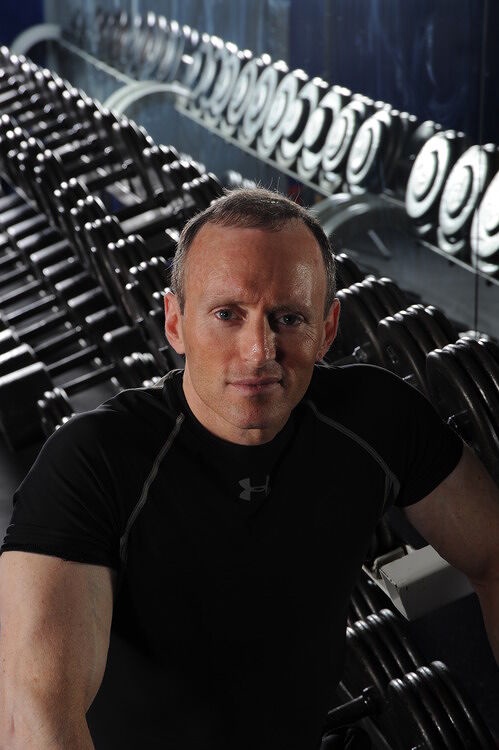
Brad Schoenfeld
Higher education teacher
34
MENTIONS
19
EPISODES
17
PODCASTS
Search complete. 34 mentions across 19 episodes found for "Brad Schoenfeld".
Sep 24, 2026

Taryn RichardsonHOST
So this paper I'm talking about today, and I'll link it below if you do want to go and nerd out, was published in the European Journal of Applied Physiology in April, 2026.
Taryn RichardsonHOST
A couple of the big names on that paper were Alan Aragon and Brad Schoenfeld.
Taryn RichardsonHOST
I'm not sure I said that right, probably hashed it.
Taryn RichardsonHOST
But if you've read any of the papers in this space, those names will be familiar to you.

GusHOST
Then Piniero and colleagues, 2024.
GusHOST
Brad Schoenfeld's group.
GusHOST
Same journal, in a paper titled, I promise you, throwing cold water on muscle growth.
GusHOST
Eight studies on muscle size.

TomHOST
More is better sometimes if you can recover from it, but less than that is also beneficial.
TomHOST
Like in the Brad Schoenfeld method analysis, people who were doing up to four sets a week were getting i think it was it was roughly 60 percent of the gains that the people who would like getting who were doing 10 sets a week so for every set that you do you're basically going to get kind of diminishing returns but you can still get a solid stimulus and make progress if you're doing four really hard sets per muscle group per week um but more will probably yield better results assuming you're not going over what your body's capable of.
TomHOST
And then obviously getting enough protein in, getting enough calories in, being in a slight surplus, all of those things are important.
TomHOST
But depending on how much training you've done previously, you can still build muscle whilst you're on a deficit and whilst you're dropping fat if necessary.

Bret ContrerasGUEST
Um, I think it was published.
Bret ContrerasGUEST
P- my friend Brad Schoenfeld throws me these studies before they're published-
Adam SchaferHOST
[laughs]
Bret ContrerasGUEST
... and says, "Don't talk about it."
18 MINS LATER
Bret ContrerasGUEST
And I, I also think there's a, a g- genetic element to soft tissue strength.
Adam SchaferHOST
Hmm.
Bret ContrerasGUEST
I have friends that if they had strong soft tissue, they could've b- become world-class-
Adam SchaferHOST
Hmm

Andy BakerGUEST
Yeah.
Philip PapeHOST
The, the Brad Schoenfeld, like, just train to failure crowd, and then Chris Beardsley, effective reps crowd.
Philip PapeHOST
And, and you say in your email, like, the claims about them aren't always true.
Philip PapeHOST
Like, what they say might not match what people interpret them on the-

Brandon DeCruzHOST
This is before actually any of those high volume studies besides Radelli and colleagues.
Brandon DeCruzHOST
Brad Schoenfeld's 45 set per week study was not around at that time.
Brandon DeCruzHOST
And it was when I first saw that study come out, I almost thought that was the norm because I was in a bodybuilding gym that Rich Gasperi had trained for the Olympias there.
Brandon DeCruzHOST
I was around a lot of enhanced individuals and my training partner was someone that could sustain a lot of volume.

Rick RicheyHOST
Excuse me.
Rick RicheyHOST
And what I mean by that is that You love reading the textbooks that Brad Schoenfeld puts out about muscular hypertrophy.
Rick RicheyHOST
You don't like to train it, but you love to read it.
Rick RicheyHOST
That's fine.

Chris BeardsleyHOST
So I think it's useful, before we kind of talk about this particular model, I think it's useful to start by asking the question of what these models are all trying to do.
Chris BeardsleyHOST
Um, and I think the best way of doing that is to go back to the original, um, kind of metabolic stress model in the early 1990s, uh, and then talk a little bit about how that was then integrated into, um, a hypertrophy research, uh, kind of literature, largely through the efforts of Brad Schoenfeld, but you know, kind of it dates back before that point.
Chris BeardsleyHOST
Um, and then maybe then mention again Menno's model and what that, uh, kind of tried to do as well.
Chris BeardsleyHOST
And I think that would be useful context to try and understand what it is that we're actually talking about here because, um, a lot of the time, I think when this topic gets discussed, people make assumptions about what is being discussed and what-

Brad StanfieldGUEST
G- on, on the point of, uh, number of sets, I remember, and, and I, I just wanna make sure I get this right.
Brad StanfieldGUEST
So o- one of the leading exercise, um, scientists, his name is Professor Brad Schoenfeld, um, and he, he published a systematic review and meta-analysis, I think it was one or two years ago, and it basically gives a, a really nice summary about how to, um, yeah, h- how to maximize the benefits from your resistance training protocol.
Brad StanfieldGUEST
Uh, one of them was that, uh, the point of training to near failure.
Brad StanfieldGUEST
So, so for people who are listening, that basically just, say if you're doing pushups, failure is the point where you've done so many pushups that you physically can't do another one.
Philip PapeHOST
There's a twenty twenty-four study on single set training.
Philip PapeHOST
Uh, Herman with two Ns, he was the lead author, and Brad Schoenfeld, Milo Wolfe were the co-authors.
Philip PapeHOST
And it was done in trained lifters who averaged over four years of experience.
Philip PapeHOST
And people cite this as a finding of body recomp.
9 more episodes mention Brad Schoenfeld.
Create an account to see the whole feed, search across every transcript, and follow the entities you care about.