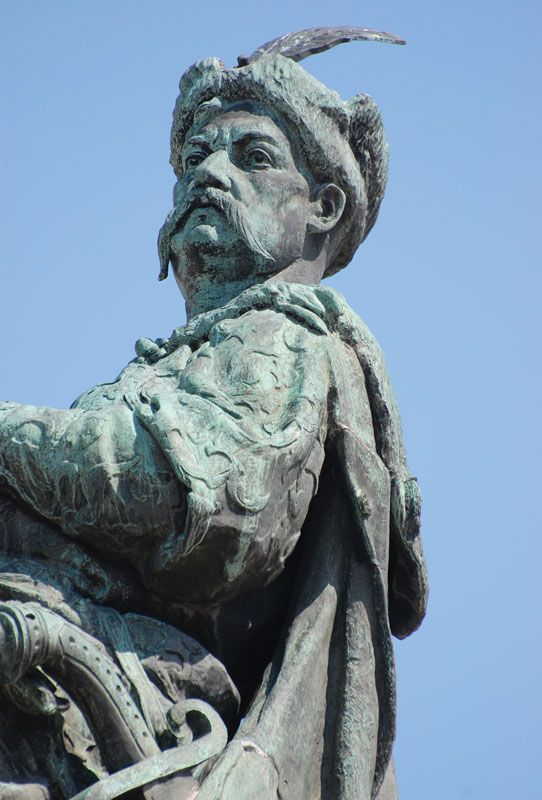
Bohdan Khmelnytsky
Military commander and former Hetman of Zaporizhian HostWikipedia
23
MENTIONS
14
EPISODES
10
PODCASTS
Search complete. 23 mentions across 14 episodes found for "Bohdan Khmelnytsky".
Sep 11, 2026

SophieHOST
And their love of freedom becomes a core piece of the Ukrainian national myth.
SamHOST
Okay, so then 1648, the great Cossack uprising under Bohdan Khmelnytsky against Polish rule, and this is the part where I actually had to put the book down for a second.
SophieHOST
Go on, because this is the tragic hinge of the whole story.
SamHOST
So Khmelnytsky needs a powerful ally against the Poles, so he signs a treaty with the Tsar of Muscovy in 1654.

Dark EnlightenmentPANELIST
I knew all this stuff, but everybody in Washington should know this stuff.
Dark EnlightenmentPANELIST
You should, you know, if you're on the Senate foreign relations committee, you should at least know why people don't like Russia, uh, Why are all these gentle pale of salmon Jews? Like, why do they hate Russia so much? Well, why do they spit when they hear the name Bogdan Khmelnytsky? And then, you
speaker_2UNKNOWN
know, these are the people that have been running everything for, what, 70 years? You know, the occupied government you always correctly talk about.
speaker_2UNKNOWN
Uh, Is anyone surprised that Zelensky is this entitled little worm? I mean, that's, that's, he is what he is.

Pete QuiñonesHOST
This migration presumably ended after the conquest of, this is a good one, Timur Tarakan's eastern shore of the Kerch Straits overlooking the eastern end of the Crimean Peninsula, the eastern flank of the old Bosporan Kingdom, 1097, by the Polovtsy.
Pete QuiñonesHOST
According to Harkavi's opinion, the vernacular of these Jews, at least since the 9th century, was Slavic, and only in the 17th century when the Ukrainian Jews fled from the pogroms of Khmelnitsky, Bogdan Khmelnitsky, Ukrainian Cossack 1593 to 1657, led the successful Cossack rebellion against Poland with help from the Crimean Tartars, did Yiddish become the language of Jews in Poland.
Pete QuiñonesHOST
In various manners, the Jews also came to Kiev and settled there.
Pete QuiñonesHOST
Already under Igor, the lower part of the city was called Kosuri.
1 HR 35 MINS LATER
Matthew Raphael JohnsonGUEST
The Messiah is coming, so there's no restraint on our action.
Matthew Raphael JohnsonGUEST
The fact we control this country so, uh, intensely that this is, uh, the new Israel and, and the Messiah's gonna, uh, arrive here.
Matthew Raphael JohnsonGUEST
Well, instead of the Messiah, they got, uh, Bogdan Khmelnitsky, um, a line that I got from E. Michael Jones, which is, which is, is, is perfect for this.
Matthew Raphael JohnsonGUEST
Um, so now Russia has a serious Jewish problem that came from its success, the same Jewish problem that brought the, the, um, the Polish society to absolute, uh, absolute tyranny.
Pete QuiñonesHOST
According to the testimony of socialist revolutionary S. Maslov, quote, "It is a fact that in towns and cities of southern Russia, especially in cities to the west of the Dnieper that changed hands repeatedly, the arrival of Soviets was mostly celebrated and the most of hollow sympathy was expressed in the Jewish quarters and not infrequently only in those alone." A contemporary American historian, Bruce Lincoln, author of a big treatise about our Civil War, said that the entire Ukrainian Cheka was composed of almost eighty percent by Jews that can be explained by the fact that prior to arrival of the Reds, cruel pogroms went on nonstop.
Pete QuiñonesHOST
Indeed, those were the bloodiest pogroms since the times of Bogdan Khmelnitsky.
Pete QuiñonesHOST
We will discuss the pogrom soon, though it should be noted that the t- that the time sequence was actually the opposite.
Pete QuiñonesHOST
Those eighty percent Jews were already staffing the Cheka in nineteen eighteen, whereas the Petliura, Petliura's, a Ukrainian publicist, writer, and journalist who was head of the state during the Ukrainian independence of nineteen eighteen, nineteen twenty, pogroms only gathered momentum during nineteen nineteen.
Pete QuiñonesHOST
This migration presumably ended after the conquest of, this is a good one, Tarakans, eastern shore of the Kerch Straits overlooking the eastern end of the Crimean Peninsula, the eastern flank of the old Bosporan Kingdom, 1097, by the Polovtsy.
Pete QuiñonesHOST
According to Harkavi's opinion, the vernacular of these Jews, at least since the 9th century, was Slavic, and only in the 17th century when the Ukrainian Jews fled from the pogroms of Khmelnitsky, Bogdan Khmelnitsky, Ukrainian Cossack 1593 to 1657, led the successful Cossack rebellion against Poland with help from the Crimean Tartars, did Yiddish become the language of Jews in Poland.
Pete QuiñonesHOST
In various manners, the Jews also came to Kiev and settled there.
Pete QuiñonesHOST
Already under Igor, the lower part of the city was called Kosari.
3 HRS 51 MINS LATER
Matthew Raphael JohnsonGUEST
Um, in the Polish Empire, of course, the Cossacks were the core of their rebellion.
Matthew Raphael JohnsonGUEST
They rebelled all the time.
Matthew Raphael JohnsonGUEST
Um, but, uh, after Catherine destroyed, uh, Zaporozhia, smashed the, uh, uh, their fortresses, and eq- uh, you know, Peter had done the same 100 years earlier, it, the Cossack military force was now not really the factor that it was, um, you know, for Khmelnitsky's time.
Matthew Raphael JohnsonGUEST
They didn't have the armed, uh, assistance of, of, um, paramilitary organization to assist them.
Pete QuiñonesHOST
A contemporary American historian, Bruce Lincoln, author of a big treatise about our Civil War, said that the entire Ukrainian Cheka was composed of almost 80% by Jews that can be explained by the fact that prior to arrival of the Reds, cruel pogroms went on nonstop.
Pete QuiñonesHOST
Indeed, those were the bloodiest pogroms since the times of Bogdan Khmelnitsky.
Pete QuiñonesHOST
We will discuss the pogrom soon, though it should be noted that the time sequence was actually the opposite.
Pete QuiñonesHOST
Those 80% Jews were already staffing the Cheka in 1918, whereas the Petlioras, a Ukrainian publicist, writer, and journalist who was head of the state during the Ukrainian independence of 1918 and 1920, pogroms only gathered momentum during 1919.

Piotr NaterNARRATOR
As these repeatedly rose in revolt, the Poles, in their diet of 1638, took advantage of their rebellion to take from them all personal and political rights.
Piotr NaterNARRATOR
The Cossacks found a leader in Bogdan Chmielnicki, whom a Polish noble had depraved of his land.
Piotr NaterNARRATOR
As Chmielnicki could obtain no justice in Warsaw, he raised the banner of revolt in 1648.
Piotr NaterNARRATOR
Forthwith the whole Ukraine was under arms.
Piotr NaterNARRATOR
While the nobles in this way doomed the kingdom to weakness and internal dissolution, they revoked the compact entered into with the Cossacks.
Piotr NaterNARRATOR
Above all, the Jesuit party in the Senate would hear nothing of the admission of the schismatic metropolis Kiev into the Diet.
Piotr NaterNARRATOR
Provoked by the constant insults and encroachments of the Poles, Bogdan Chmielnicki once more took up arms.
Piotr NaterNARRATOR
The Cossacks soon found a mightier ally than the Tartars.

Yaakov WolbeHOST
They left afterwards, subsequently.
Yaakov WolbeHOST
Now, so this Sennacherib, he's up there with Antiochus and Titus and Stalin and Hitler and Khmelnytsky is one of the great villains of Jewish history.
Yaakov WolbeHOST
In our history, we have the Haman's and the Amalek's of the world, these people who really stand out for their mistreatment of the Jewish people.
Yaakov WolbeHOST
Amongst them, you have Sennacherib and his great-great-great-grandchildren, they convert.

speaker_2NARRATOR
Each struggle inspired fresh energy in the Ukrainians till at last prolonged reprisals, sixteen thirty-eight to forty-seven, led to a revolution.
speaker_2NARRATOR
In sixteen forty-eight the people rose, led by Bohdan Khmelnytsky.
speaker_2NARRATOR
This insurrection was caused by dissensions between the Cossacks and the Polish government, dissensions which were not more serious than those which had preceded them.
speaker_2NARRATOR
Circumstances, however, were favorable, the leader was talented, and the movement contrary to all expectations became of supreme importance.
speaker_2NARRATOR
It feared war with Poland and remembered the cruel defeats which that nation had inflicted at the beginning of the seventeenth century.
speaker_2NARRATOR
Not till sixteen fifty-three did Moscow decide to extend its protection to the Cossack army and to the Ukraine by committing itself to war with Poland.
speaker_2NARRATOR
In March sixteen fifty-four the treaty was signed bearing the name Articles of Bohdan Khmelnytsky.
speaker_2NARRATOR
Therein was defined the position of the Ukraine to Muscovy.

MarianneNARRATOR
Union with Russia.
MarianneNARRATOR
After a series of uprisings, the Ukrainians succeeded, in 1648, in liberating the central part of Ukraine from Polish rule and establishing, under Bohdan Khmelnitsky, a Ukrainian democratic republic.
MarianneNARRATOR
Threatened by Poland on the west and Turkey in the south, the young republic, in 1654, entered into a voluntary union with Russia, which was looked upon as a menace, on the condition that the Ukrainians should be accorded a full measure of self-government.
MarianneNARRATOR
The czars, however, began curtailing Ukraine's privileges, one after another, until the Ukrainians became, after several unsuccessful uprisings, a subject race.
4 more episodes mention Bohdan Khmelnytsky.
Create an account to see the whole feed, search across every transcript, and follow the entities you care about.