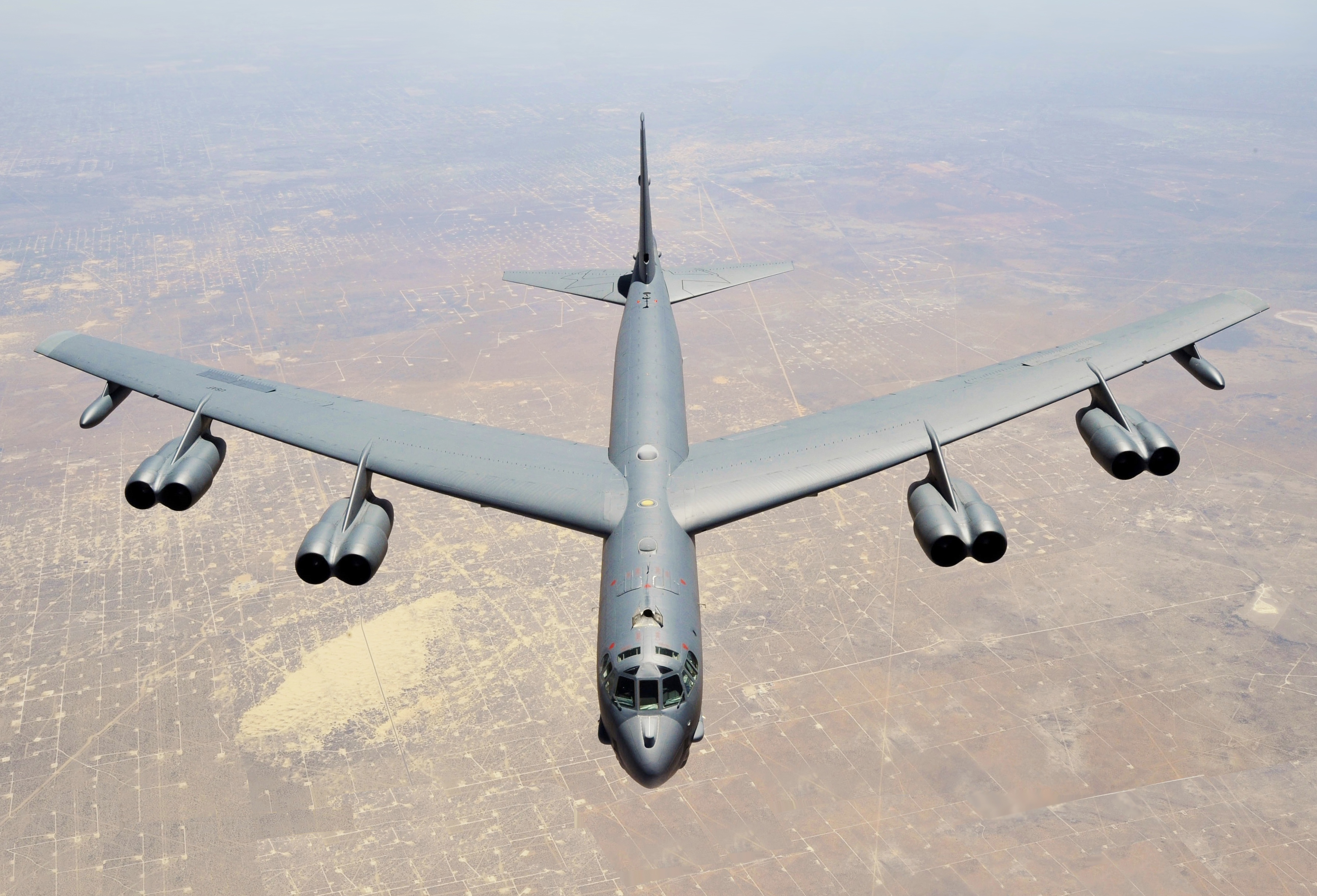
Boeing B-52 Stratofortress
Strategic bomberWikipedia
362
MENTIONS
132
EPISODES
87
PODCASTS
Search complete. 362 mentions across 132 episodes found for "Boeing B-52 Stratofortress".
Sep 12, 2026

AndyPANELIST
I think it's gonna go the same way as the, uh-
CarlosHOST
B52
AndyPANELIST
...
AndyPANELIST
B52.
CarlosHOST
Mm.
AndyPANELIST
Yes.

GeorgeHOST
I was happy about that one.
GeorgeHOST
Question three asks us for a hairstyle reportedly inspired by the B-52, or not inspired by, but resembling the B-52, the aircraft, which would later inspire the name of the band, the B-52s.
AmandaHOST
So this is the beehive, and I didn't really consider any other possibilities.
AmandaHOST
It's a very distinctive, iconic look, and I didn't know all this backstory about it, but the idea of it being the hairstyle worn by the two women singers in the B-52s um you know that's that's hard for a gen x person to forget really um and so uh i figured this had to be the beehive
GeorgeHOST
so my first thought was the bouffant um but then i i came back to it later and thought no i feel like the b-52s in particular it was beehive was what was what that in particular was called and therefore yeah Kate and blanking wore their hair up in a beehive specifically so maybe they were the same thing but I figured more precisely it was the beehive in this case because that's what the B-52s wore
AmandaHOST
And that was the correct answer.
AmandaHOST
The bouffant is also a poofy kind of hairstyle.

Jaafar Sheikh MustafaGUEST
How? By providing coordinates to the airplanes.
Jaafar Sheikh MustafaGUEST
I believe they were B-52 bombers participated in bombarding that area where the terrorists were.
Jaafar Sheikh MustafaGUEST
And also he's saying that from the Red Sea, the sea between Saudi Arabia and Egypt.
Jaafar Sheikh MustafaGUEST
36 missiles were launched by the U.S. Navy to attack the terrorist area, which helped a lot, and they were supposed to be 64.

Georgia HoweHOST
The tragic events that unfolded 25 years ago changed the world forever, but they also gave rise to incredible unity, as regular Americans stepped up to answer the call, from firefighters to reservists, and even civilians.
John BickleyHOST
Joining us now to talk about the US response to 9/11 is Trey Morris, a retired US Air Force colonel and B-52 aviator, who was among those called to respond in the weeks afterward.
John BickleyHOST
Colonel, first of all, thank you so much for your service, and thank you for coming on.
Trey MorrisGUEST
And you're welcome, and again, thank you also for having me on.
John BickleyHOST
Amazing.
Trey MorrisGUEST
Yes.
John BickleyHOST
So you flew B-52 missions in Afghanistan.
John BickleyHOST
Uh, how many combat missions were you involved in, and what was that experience like?

David FrenchPANELIST
Oh, I [laughs] I mean, it's so many parts of our politics today are, "But for the 9/11 attacks, we wouldn't..." dot, dot, dot, that it's almost impossible to untangle and unwind.
David FrenchPANELIST
And I think, again, you know, with the benefit of 25 years of hindsight, if I had a theme that I was gonna use to sort of describe why everything seemed to go south in a relatively short span of time between the unity of 9/11, the Congress singing on the steps of the Capitol, the 90% Bush approval rating, something I never thought I'd ever see in my life, images of, like, good liberals from Manhattan cheering B52 strikes in Afghanistan.
David FrenchPANELIST
Like, these things happened.
David FrenchPANELIST
It sounds weird to say that, but literally you would see gatherings of people in New York City looking at the TV footage of the airstrikes outside of Kabul and other places in Afghanistan, and they were cheering like it was a football game.

Marcus HellyerHOST
It's not the same business.
Marcus HellyerHOST
B-52 bomber.
Marcus HellyerHOST
It's not the same U.S. Marine Corps battalion.
Marcus HellyerHOST
It's not the same U.S. nuclear-powered submarine.
Marcus HellyerHOST
base.
Marcus HellyerHOST
So this is the important thing.
Marcus HellyerHOST
michael this is the important thing because no matter how mr miles may refer to these u.s facilities the chinese don't care if it looks like a base walks like a base talks like a base smells like a base for the chinese it is a base so if a u.s Air Force B-52 is launching from a facility in Australia and is dropping bombs or launching missiles against Chinese targets.
Marcus HellyerHOST
The Chinese don't care how Mr.

Scott KestersonHOST
And effectively, the regime was toppled within about a month, and the culmination of the most drastic fighting ended by March with the end of Operation Anaconda.
Scott KestersonHOST
December 5th, 2001, Master Sergeant Jefferson Donald Davis, Sergeant First Class Daniel Pitahorny, and Staff Sergeant Brian Cody Processor killed by the U.S. B-52 friendly firebombing near Kandahar.
Scott KestersonHOST
3rd Battalion, 5th Special Forces Group.
Scott KestersonHOST
January 4th, 2002, Sergeant First Class Nathan Ross Chapman killed by enemy small arms fire near coast.

Tail DraggerHOST
The Soviet Union has nuclear weapons and bombers capable of reaching the American continent, and the United States Air Force is trying to stay ahead of a threat that keeps changing shape.
Tail DraggerHOST
they have the B-52 Stratofortress, which is a magnificent aircraft.
Tail DraggerHOST
But even as the first B-52s are rolling off the line in Seattle, Strategic Air Command is already thinking past it, because here is the problem with the B-52, it flies at around 500 miles an hour.
Tail DraggerHOST
Soviet radar can track it for hours before it arrives.

Paul WolfowitzGUEST
We can't prove that all of these measures but I think to a very large measure they did.
Paul WolfowitzGUEST
And I think too much dwelling on that part of it tends to underemphasize the extent to which one of the most impressive things about the post 9-11 period was the resilience with which the American people fought back on the United Airlines jet, and in many other situations, the courage of these special forces operators who went to Afghanistan and were calling in airstrikes from B-52 bombers within 100 or 200 yards of them, it's called danger close.
Paul WolfowitzGUEST
They did it unprepared.
Paul WolfowitzGUEST
They did it improvised way.

Chuck WilliamsonNARRATOR
Two miles ahead was launching Base One, throwing long, sharp shadows at him in the rosy dawn light.
Chuck WilliamsonNARRATOR
A cluster of squat, gray blockhouses, a long runway tapering into the distance with an Air Force B-52 motionless at the near end, that was all.
Chuck WilliamsonNARRATOR
Except the ship.
Chuck WilliamsonNARRATOR
The ship towered high, dominating the desert like a pinnacle of bright silver.
Chuck WilliamsonNARRATOR
A crew chief came up and touched Johnny's shoulder.
Chuck WilliamsonNARRATOR
Colonel Youngbear, he said, observation is going up.
Chuck WilliamsonNARRATOR
Johnny stood and looked out the tiny window at the red-painted B-52.
Chuck WilliamsonNARRATOR
See you tonight, Mitch.
122 more episodes mention Boeing B-52 Stratofortress.
Create an account to see the whole feed, search across every transcript, and follow the entities you care about.