Body fat percentage
464
MENTIONS
35
EPISODES
29
PODCASTS
Search complete. 464 mentions across 35 episodes found for "Body fat percentage".
Nov 4, 2026

LudwigHOST
You could still lose a few.
LudwigHOST
And then he said, my son is 0% body fat.
LudwigHOST
damn his son has zero yes he shouldn't say it as a doctor it's a lie nothing here zero percent body fat and he's lying he's a he's a lying doctor even if he's really like 13 maybe what is your
Magnus MidtbøGUEST
bmi my bmi i don't know bmi is not that important though but body fat is more interesting i feel like a lot of people say they're like three three percent i've heard a lot of people say but that's like almost dying yeah not healthy Pretty much no one is 3%.
Magnus MidtbøGUEST
Definitely 0% is impossible.
Magnus MidtbøGUEST
His son is 0%.

Tony SmithHOST
And boy, they both looked just in incredible shape.
Tony SmithHOST
And I think Tom Bergeron even mentioned something here at the very beginning when he talks about looking for the body fat.
Tony SmithHOST
But let's listen to what the judges had to say for Kelly and Derek's top 10 jazz back in season 16.
Tony SmithHOST
If
Tom BergeronSOUNDBITE_SPEAKER
you're just tuning in, we're playing Find the Body Fat.
Tom BergeronSOUNDBITE_SPEAKER
Come over here, you guys.
Tom BergeronSOUNDBITE_SPEAKER
Over here.

Jeff HoehnHOST
So I think first, what I just wanted to ask you is what do you define as body recomp? When somebody asks you that, what does that mean? What is that to you?
Eric HelmsGUEST
Yeah, so simultaneous loss of fat mass and gain of lean tissue or muscle mass, right? That is what it is if I'm putting my objective hat on and then just acknowledging that you can't actually know that's happened without, you know, like lab-based stuff like DEXA or a really good anthro.
Eric HelmsGUEST
So that's...
Eric HelmsGUEST
I think a lot of the times in practice, it's more based upon visuals and scale weight and not being in an intentional, you know, surplus and people conflate it with maintenance.
Eric HelmsGUEST
So body fat's like 80 to 90% fat, you know? So that's why we have like the 3,500, you know, KCAL quote unquote rule that approximately tracks to telling you how much fat you lost and therefore the deficit.
Eric HelmsGUEST
And it is a lot less than that for lean mass, five to six times different.
Eric HelmsGUEST
So if we want to speak in kilograms, which is 2.2 pounds just for the Americans listening, we're talking over 9,000 calories in a kilogram of fat mass, you know, as measured by DEXA.
Eric HelmsGUEST
And then we're talking like under, you know, 2000 calories for a kilogram of lean mass.

Kori HagemanHOST
to refer back to when someone's setting physique goals and it also then prompts me it gives me the ability to be like okay so what is it all that you like about this physique and really have you considered that like okay you might like this girl's abs if you know this is generally the direction you want to go for but do you like her legs do you like her upper body muscularity do you like how she is in this pose but also not in this pose at this conditioning and muscularity So historically, we've done a lot of exercises kind of like this where she's brought pictures and like I've kind of, not debunked, but like broken down.
Kori HagemanHOST
I'm like, okay, this is roughly where this person is in terms of body fat.
Kori HagemanHOST
This is probably how long she's been lifting.
Kori HagemanHOST
Here's like proportionally what I see in her physique, what she's focused on, whether there's, you know, I'm theorizing, obviously, because I can't be certain whether there's the use of enhancements and what I can say, like in my own experience, what it's going to take for my client to get there, even in terms of lifestyle, length of time, in terms of dieting, in terms of building.
Kori HagemanHOST
And she was even like, Jesus Christ, this is a lot of pictures of you in a thong just standing there.
Kori HagemanHOST
For me, it's been so helpful to have these pictures over the course of the last, I don't know, the last five years, because that's really when I started doing this.
Kori HagemanHOST
And I sent her, anyways, I sent her 10 pictures across the last five years at varying body fats, at varying levels of muscularity, at points in which I was peak off season, at points in which I was getting ready to compete.
Kori HagemanHOST
And the idea was, I mean, really, I asked her, I was like, hey, so you want to bring in that upper thigh, lower glute area.

Noelle ShanahanGUEST
And maintenance is great, but there's only so much that can be done at maintenance.
Noelle ShanahanGUEST
The reality is a lot of people want to see their muscles grow and their body fat decrease, and they expect it to happen all at the same time.
Noelle ShanahanGUEST
And recomposition can and does happen, but it happens slowly and a lot of times not nearly at the rate that we want it to.
Noelle ShanahanGUEST
And so I think a lot of people have this disillusion of what they can accomplish without having to go into a surplus.
Noelle ShanahanGUEST
We have to have an anabolic stimulus.
Noelle ShanahanGUEST
We have to have enough food in order to actually produce growth.
Noelle ShanahanGUEST
And so, yes, that will come alongside body fat as well.
Noelle ShanahanGUEST
Sorry, that's the case.

Jason FungHOST
It's coming right up.
Jason FungHOST
The body set weight acts like a sort of thermostat for body fat percentage.
Jason FungHOST
Let's think about the concept of how a thermostat works.
Jason FungHOST
What you do is you set the thermostat and for room temperature, for example.
Jason FungHOST
That is, when things get too hot on your body, you're gonna cool it down and you do that to sweat.
Jason FungHOST
When it gets too cold, you're gonna shiver and bring the temperature up.
Jason FungHOST
It turns out that homeostasis also applies to the concept of body fat.
Jason FungHOST
And the reason is that the body fat percentage is a hugely important factor in survival for wild animals.

Sal Di StefanoHOST
All right, here's something super controversial.
Sal Di StefanoHOST
Tracking your food, your body fat percentage, your measurements.
Sal Di StefanoHOST
For many of you, it might be ruining your progress.
Sal Di StefanoHOST
Almost all health correlations are connected to performance.
Sal Di StefanoHOST
You know, you're going to live longer.
Sal Di StefanoHOST
That's what they'll say, right? And the data shows it clearly.
Sal Di StefanoHOST
But the correlation has less to do with muscle and body fat and how you look.
Sal Di StefanoHOST
Far stronger correlation to performance.

Lance WilsonHOST
Earlier this year, he did something very impressive.
Lance WilsonHOST
He went from 19% body fat to 9.7% body fat in three months.
Lance WilsonHOST
That is amazing.
Lance WilsonHOST
Welcome to the show, Bruce.
Bruce DaSilvaGUEST
And then my next goal when the new year came was when we were in Toronto, we were visiting there and I think it was New Year's and I just, I think I was in the bathroom.
Bruce DaSilvaGUEST
I looked in the mirror and I said, oh my gosh, I'm huge for me, for my standard.
Bruce DaSilvaGUEST
So I went to LA, I got a DEXA scan thinking I was maybe 13% body fat, maybe.
Bruce DaSilvaGUEST
And it said I was 19.

Chris WrightHOST
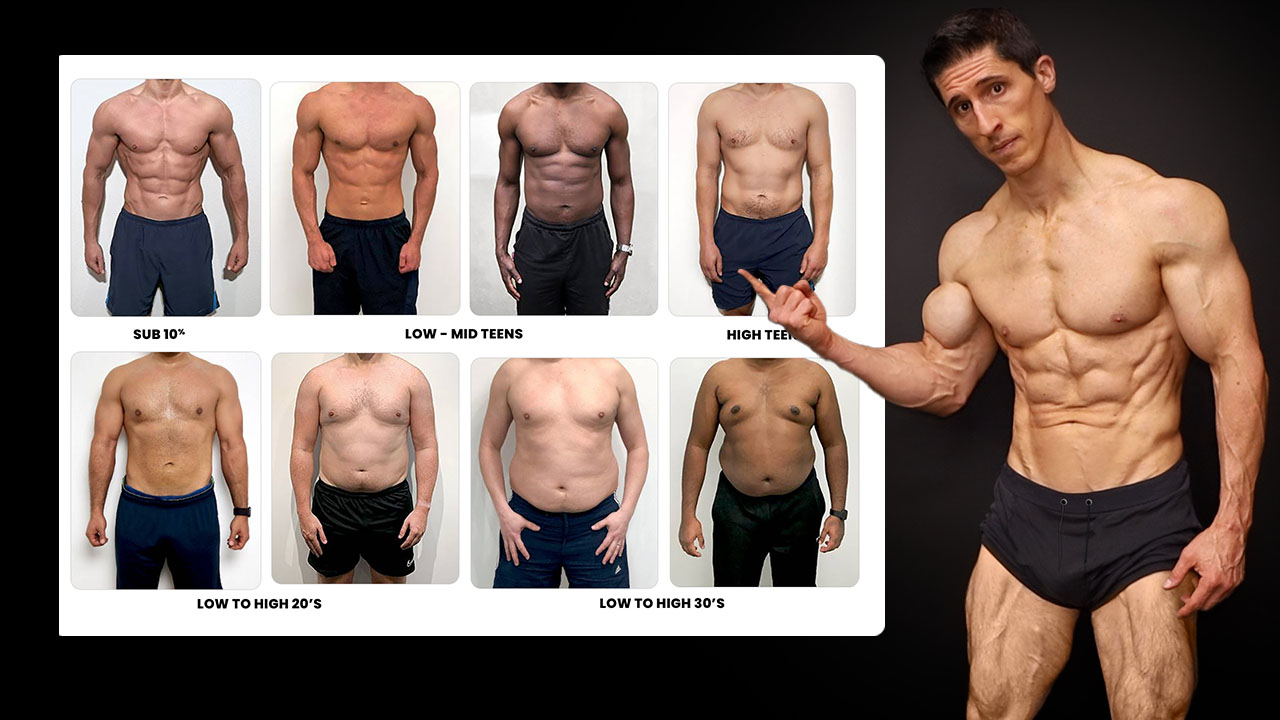
Welcome back to another video gents and in this one i'm going to be discussing exactly what your body looks like every single time your body fat changes going through the kind of key steps and journey that lots of guys go through all the way starting from the top down to the lean level of body fat that a lot of guys want to achieve most men don't really have any idea what body fat that they actually are so i want to hopefully try and give you guys a bit of an understanding of maybe where you're at at the moment and what to expect as you go from body fat or average body fat to low body fat to being in the best shape to maybe where you actually can sit and maintain as well as that's a really important thing to actually understand as well so guys we're going to start right from the top now this isn't going to be for all of you but there might be some of you watching this right now and you genuinely know that you are very overweight so 40 body fat is going to be kind of the starting position here that i want to try and cover Now, this is where you are going to be carrying a significant amount of fat on your face, your chest, your stomach, your love handles.
Chris WrightHOST
This is the morbidly obese range.
Chris WrightHOST
You are going to look very fat.
Chris WrightHOST
Your life is really gonna suck to a certain extent, guys.
Chris WrightHOST
You've got zero muscle definition.
Chris WrightHOST
energy is really low your confidence really and i'm not trying to paint a really morbid picture here i'm just being completely honest with really where you're at at this level of body fat and it's honestly a place where like health risks are going to become very very real if you're not already diabetic you're going to be at some point um you're going to have health disease liver oh there's all sorts of stuff really guys that i could cover in this position but i think as adults we know that 40 body fat is not a place that we should be wanting to be certainly not a place that we should want to be staying for a very long time So then we're going to move all the way down to 30% body fat, which I think for a lot of men is realistic for them to do by themselves because you don't really need to do a huge amount other than cut out a lot of the crap.
Chris WrightHOST
Starting in like an adult, maybe just try and move your body a little bit more.
Chris WrightHOST
It's not particularly hard.

Patroklos "Pak" Androulakis KorakakisHOST
And also the fact that your ability to recomp will depend on a few different factors.
Patroklos "Pak" Androulakis KorakakisHOST
But before we get into those factors and the mechanisms behind why a recomp is possible, another example that I wanted to give is that If we take somebody, for example, at 75 kilos at 20% body fat, where let's say they have 15 kilos of body fat, and then they gain 9 kilos of lean mass and a kilo of fat, that would bring them up to 85 kilos with 16 kilos of fat at 18.8% body fat.
Patroklos "Pak" Androulakis KorakakisHOST
So fatter in absolute terms, but leaner by every measure that people care about.
Patroklos "Pak" Androulakis KorakakisHOST
So that's worth flagging because anecdotal recomp usually reflects cases like this, not actual fat loss or not people losing 10 kilos of fat while also gaining 10 kilos of muscle.
Milo WolfHOST
Yes, fat mass has about 9,400 calories per kilogram of tissue, which makes a lot of sense if you even think about it in terms of macronutrient energy density.
Milo WolfHOST
So many people are aware that dietary fat has 9 kilocalories per gram of fat.
Milo WolfHOST
And so if you expand that to a kilogram of body fat, it makes sense that that would be around 9,000-ish calories, right? Likewise, however, when it comes to lean mass, people think lean mass refers to, you know, pure muscle mass.
Milo WolfHOST
For one, that's not true.
25 more episodes mention Body fat percentage.
Create an account to see the whole feed, search across every transcript, and follow the entities you care about.