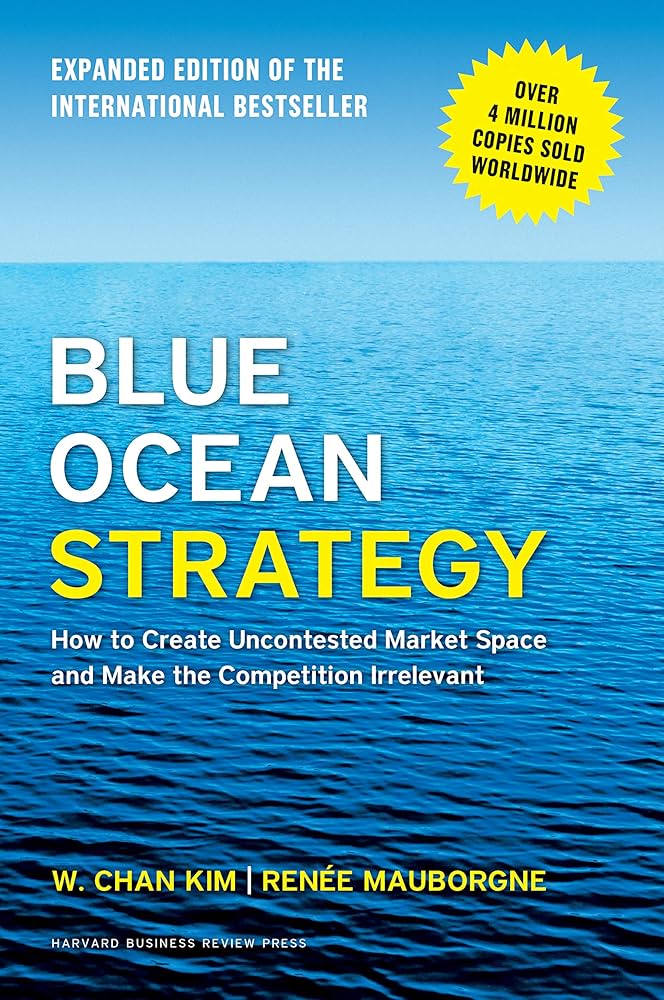
Blue Ocean Strategy
Book by Renée Mauborgne and W. Chan KimWikipedia
21
MENTIONS
9
EPISODES
8
PODCASTS
Search complete. 21 mentions across 9 episodes found for "Blue Ocean Strategy".
Oct 12, 2026

Steve MacDonaldHOST
I love that.
Steve MacDonaldHOST
You know, what I started thinking about was one of my favorite books, and it's an oldie, but it's the Blue Ocean Strategy, where you're redefining a market, right? You're carving out a blue ocean and you're moving out of the red, which is red from the battle of competition, right? And so, you know, carving out the shift And leading that, right, places you in a different, you know, in a different location than your competitors, right? In a place that's aspirational where you want to go.
Steve MacDonaldHOST
So I love that.
Steve MacDonaldHOST
I love that thinking.
David CarrelGUEST
shelf.
David CarrelGUEST
Yeah.
David CarrelGUEST
I actually thought you were going to say crossing the chasm, but definitely Blue Ocean Strategy is a great one too.
David CarrelGUEST
Yeah.

speaker_1HOST
That is Section 4.5, Approaches to Developing New Products and Services.
speaker_1HOST
And we are going to dive into two massive methodologies here, design thinking and blue ocean strategy.
speaker_0HOST
Let's start with design thinking.
speaker_0HOST
The guide defines this as a fundamentally human-centered approach to innovation.
speaker_0HOST
which drastically reduces the risk of building something nobody wants.
speaker_1HOST
Exactly.
speaker_1HOST
While design thinking focuses on the user, the second methodology, Blue Ocean Strategy, focuses on the market landscape.
speaker_0HOST
And this is a highly testable concept.

speaker_1UNKNOWN
We're diving into the foundational frameworks that have pretty much defined modern business.
speaker_1UNKNOWN
So we're pulling from Sarah L. Thompson's work on competitive analysis, Michael Porter's classic Market Forces, uh, Birger Wernerfelt's resource-based view, all the way to the dynamic capabilities framework by Teece, Pisano, and Shuen, and of course, Chan Kim's Blue Ocean strategy.
Matt GilhoolyHOST
Yeah, it's a heavy lineup.
Matt GilhoolyHOST
But our goal here is to give you, the listener, a total shortcut to understanding how strategy actually works out there in the real world.
6 MINS LATER
speaker_1UNKNOWN
You don't fight.
speaker_1UNKNOWN
You shift the boundaries of the universe so that the fight literally no longer exists.
Matt GilhoolyHOST
And this brings us to one of the most fascinating shifts in modern business strategy, blue ocean strategy.
Matt GilhoolyHOST
This is based on Chan Kim and Renée Mauborgne's research, where they looked at over a hundred and fifty strategic moves across thirty different industries spanning a whole century, and they completely reject the premise that you have to benchmark yourself against your rivals.

Gary MitchellGUEST
They're Jim Collins.
Gary MitchellGUEST
Blue Ocean Strategy.
Gary MitchellGUEST
Have you read that one?
Mark CundiffHOST
Yeah.

Lawrence ArmstrongGUEST
And then dominate.
Lawrence ArmstrongGUEST
And then, you know, for us, here's another business book, you know, Blue Ocean Strategy that we spent a lot of time studying.
Lawrence ArmstrongGUEST
That's a great one because the whole book is about how you, create markets that make your competition irrelevant based on what you're doing, what your skill sets are, what your company is great at.
Lawrence ArmstrongGUEST
And so we've spent a lot of time as we've developed strategies to grow into new markets and to grow our people and to diversify.
Steve MacDonaldHOST
So here's what I'm going to have you do.
Steve MacDonaldHOST
You mentioned right away, we had a conversation before this, and you mentioned a concept out of one of my favorite business books ever, the Blue Ocean Strategy.
Steve MacDonaldHOST
And you talked about red ocean differentiation and escaping from the commodity trap.
Steve MacDonaldHOST
So I'd love to have you maybe explain, first off, why you brought up the Red Ocean and how and why we need to differentiate and maybe even start out and explain what the Red Ocean concept is, just if somebody else hasn't read the book here.
Steve MacDonaldHOST
And you say kind of like you get to be more orange or, you know, like, In the United States, you know, we have like Republican and Democrats here and it's red versus blue.
Steve MacDonaldHOST
And we even call it like swing states, purple states, like even if you could get orange into purple, right, where where you're starting to define you're taking control and you're saying, no, there's a there's a different way that you can go.
Steve MacDonaldHOST
to your clients, your prospects, and we're gonna help lead you there, and that then defines a path that nobody else is doing, and you're moving closer to that blue ocean strategy.
Steve MacDonaldHOST
You mentioned that margin pressure is a reality.

Thomas WatkinsHOST
Here's what you should do.
Jamie LevyGUEST
Well, we know with innovation that it's not something you can backwards engineer just because you read Blue Ocean Strategy and read 100 case studies of innovative companies and say, oh, Cirque du Soleil founded a new customer segment by reinventing the circus and repurposing it for people who could spend more money.
Jamie LevyGUEST
You know, I mean, when they did that and they gave us the strategy canvas and all these tools, I played around with them, but it's still...
Jamie LevyGUEST
You know, to come up with something innovative, you have to be really, really lucky.