Bloom's taxonomy
16
MENTIONS
9
EPISODES
8
PODCASTS
Search complete. 16 mentions across 9 episodes found for "Bloom's taxonomy".
Sep 15, 2026

Graham BalchGUEST
It was my developmental, not my developmental, sorry, my line editor who checked that for me, and thank goodness she did, right? But you, you said like, you know, "Why did you start writing and why this?" Right? So if I can, I'd love to answer that.
Graham BalchGUEST
I was in a graduate education course in 2004, and there's something in education called Bloom's Taxonomy, and the lowest-
Hayes WolfendenHOST
Yes
Graham BalchGUEST
... level...
Graham BalchGUEST
Great.
Graham BalchGUEST
The, so the lowest level of Bloom's Taxonomy is low-level thinking.
Graham BalchGUEST
It's identity recall.
Graham BalchGUEST
And the example used in that class was, in what year did Christopher Columbus sail the ocean blue? And everybody knows it was 1492.

Michael Erickson FacchinHOST
The thing that I think is so, so, so helpful, I've mentioned it on this show before, which is it's really, really good to have a framework.
Michael Erickson FacchinHOST
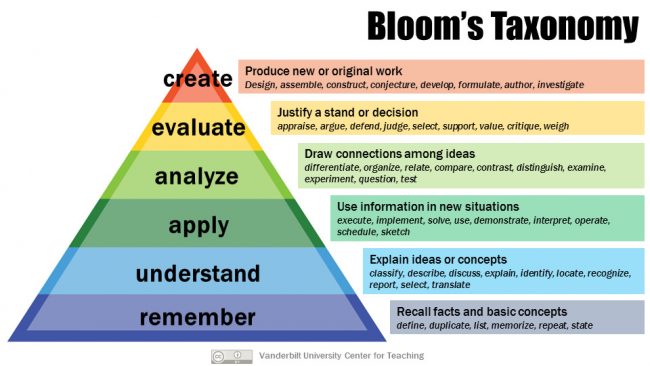
We need to work our way up Bloom's taxonomy where we are going from just like remembering that these things exist to understanding why they exist.
Michael Erickson FacchinHOST
So using them effectively.
Michael Erickson FacchinHOST
analyzing them, break it down.

Ruben OgbonnaGUEST
You mentioned me being an educator myself and my co-founder, Maya Bhattacharjee, that we founded at Marcy Lab School in 2019, both of us previously having backgrounds in education and school leadership.
Ruben OgbonnaGUEST
One of the first things you learn as a first-year teacher is this beautiful framework called Bloom's Taxonomy.
Ruben OgbonnaGUEST
It's almost like the food pyramid of teaching.
Ruben OgbonnaGUEST
And the idea is that it kind of lays out a series of kind of like educational attainments with the bottom being essentially just like recall with the top of that pyramid being creation and evaluation.

Kristen ZimanHOST
... um, how to get into the program.
Kristen ZimanHOST
What's that called? Bloom's Taxonomy.
Sylvia MoirHOST
Bloom's Taxonomy.
Kristen ZimanHOST
For you nerds in the-
Sylvia MoirHOST
All the, yep, Bloom's Taxonomy.
Kristen ZimanHOST
Okay.
Kristen ZimanHOST
There's...
Sylvia MoirHOST
It is.
Ruben OgbonnaGUEST
You mentioned, um, me being an educator myself and my co-founder, Maya Bhattacharjee, and we founded Marcy Lab School in 2019, both of us, uh, previously having backgrounds, uh, in education and school leadership.
Ruben OgbonnaGUEST
Uh, one of the first things you learn, uh, as a first-year teacher is this, uh, beautiful framework called Bloom's Taxonomy.
Ruben OgbonnaGUEST
It's like this-- It's almost like the food pyramid of teaching.
Ruben OgbonnaGUEST
Um, and the idea is that, um, it kind of lays out a series of kind of like, uh, educational, um, attainments, uh, with the bottom being essentially just like recall, um, with, and then with the top of that pyramid being creation and evaluation.

Dave VanVickleHOST
So that was a time where-
Mike GormleyHOST
I just imagine you're 15 years old, reading Bloom's Taxonomy, followed by Dorothy Sayers' The Lost Tools of Learning.
Mike GormleyHOST
[laughs]
Dave VanVickleHOST
Right, right, and Mortimer Adler.

speaker_0HOST
So what does this all mean? Let's recap this journey we've been on today.
speaker_0HOST
We start by looking at the sheer exhaustion of grading AI slop and why traditional assignments, that linear climb up Bloom's taxonomy, are fundamentally broken when a machine can jump straight to the create phase.
speaker_1HOST
Then we examined the paradigm shift of inverted blooms.
speaker_1HOST
We moved from valuing the generation of an artifact to valuing the rigorous critique of that artifact.

BrookeHOST
They know that students are operating on a recall level, so they have all these answer choices that have plenty of details that were in the passage, and the only way that you're going to get the right answer is not by recalling facts, but by analyzing the situation and going a level deeper.
BrookeHOST
So when I was in school, my teachers taught me a hierarchy of thinking called Bloom's Taxonomy, right? And in Bloom's Taxonomy, and we'll show you on the screen, you can see at the bottom level is recall, right? And in higher levels, we have things like analysis or even synthesis, right? The SAT is going to require you to engage in these higher levels of thinking, and to do so requires students to do two things.
BrookeHOST
One, to throw out the way that they've approached tests for so much of their life that has given them success in the classroom, and two, learn how to engage in different modes of thinking when they're doing multiple choice, which is just a totally different exercise.
BrookeHOST
So in that sense, two things going on.

Erin VanekGUEST
And then with creativity, I feel like, well, I do a lot of project based learning, especially when we're wrapping up units and that sort of thing.
Erin VanekGUEST
Bloom's taxonomy is my go-to.
Erin VanekGUEST
So I feel like a lot of times my co-teacher and I, right, we'll sit down, she might give me the questions that she's going to use in the classroom and I'll read them and I'll say, okay, how can I still get this concept, like compare and contrast across to my gifted kids, but at another level, like how can I add evaluative thinking in that? How can I push it to creative thinking? And so it takes a lot of planning on the back end, for me, but putting in all that work behind the scenes is what helps it to run smoother in the classroom.
Erin VanekGUEST
So I guess circling back to your original question, definitely I use Bloom's Taxonomy.
Erin VanekGUEST
I use that all the time.
Erin VanekGUEST
Discussion and teaching how to have a discussion and being very validating of questions.