Bloomberg US Aggregate Bond Index
15
MENTIONS
10
EPISODES
10
PODCASTS
Search complete. 15 mentions across 10 episodes found for "Bloomberg US Aggregate Bond Index".
Oct 3, 2026

Gustavo CanoHOST
That is exactly what just happened to the U.S.
Gustavo CanoHOST
Aggregate Bond Index, the bedrock of conservative investing, the thing you were supposed to build your retirement on.
Gustavo CanoHOST
It just fractured.
speaker_1HOST
Yeah, it forces a complete recalibration for everyone.
Gustavo CanoHOST
I want to start with the data here because it is a massive wake-up call.
Gustavo CanoHOST
The source tracks the Bloomberg U.S.
Gustavo CanoHOST
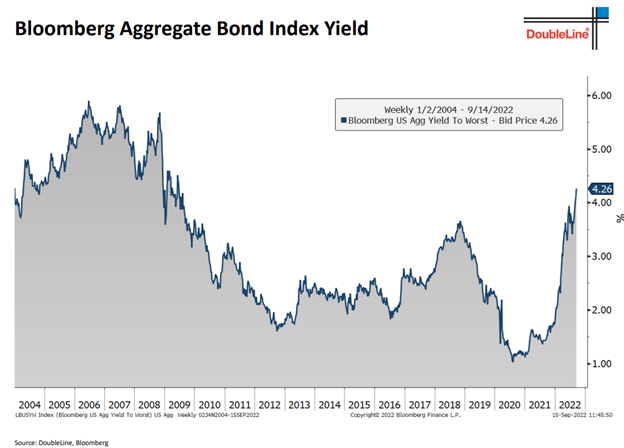
Aggregate Bond Index, noting a severe drawdown of roughly 2.8%.
speaker_1HOST
Which sounds small if you're used to stocks.

George SchultzeGUEST
Um, really a long, you know, bear mount- market so far for the, you know, fixed income market.
George SchultzeGUEST
Uh, the sixth year of a bear market according to the US, uh, Bloomberg Aggregate Bond Index, which, uh, peaked in August of 2020, and, um, you know, hasn't recovered since then.
George SchultzeGUEST
So much higher interest rates.
George SchultzeGUEST
That's one of the big things leaning on stocks and making it difficult for, uh, most stocks to climb, um, even though you're seeing some, you know, optimism among the, the Mag Seven and the, you know, technology companies with rapid growth in AI.

Jeffrey GundlachGUEST
But bond yields on, uh, the, the 10-year Treasury and the long bond are up by about 45 basis points in the last month.
Jeffrey GundlachGUEST
And so we've seen bond returns on sort of like the, the Bloomberg Aggregate Index go from pretty, you know, okay, kind of like zero types of returns or maybe negative a half or something, now down to about negative three and a half, uh, on, on, uh, investment-grade bonds, which is really putting pressure, not surprisingly, on the valuations of equities.
Jeffrey GundlachGUEST
The S-S&P 500 as of June-- as of July 31st, the most recent number I have, had a CAPE ratio of forty-two point zero four, which is one of the highest of all time.
Jeffrey GundlachGUEST
And with rising interest rates, that CAPE ratio becomes more and more challenged to sustain.

Jim BiancoHOST
So as these coupons keep moving up and as these durations keep moving down, The bond market becomes more attractive because it's throwing off enough income and it's becoming less sensitive to price movements that even if the price moves up, you could still wind up with a positive return.
Jim BiancoHOST
In fact, right now on the bond market, if you look at the like the Bloomberg Aggregate Index or some of the other broad based measures, we're at the point now where if you bought the broad aggregate index, and it went up 1% over the next year, and you'd still walk away with a positive return.
Jim BiancoHOST
It'd be a small return, but a positive return.
Jim BiancoHOST
Contrast that to 2021, when it went from 1% to 2%, and you walked away with one of the worst bond losses, something like 11%, in the last 250 years.

Tyler SimonisHOST
So the outperformance we saw from international markets went away last week for sure.
Tyler SimonisHOST
In the bond market, We saw the aggregate bond index, which is sort of the S&P 500 of the bond world, trade fractionally lower from a price perspective, which means yields were higher.
Tyler SimonisHOST
Remember that bond prices and bond yields have an inverse relationship, just like your house.
Tyler SimonisHOST
So as interest rates go up, your house price is going to go down, while as interest rates go up, bond prices go down.
11 MINS LATER
Tyler SimonisHOST
And the longer duration bonds you own in your portfolio, the more interest rate sensitive they are, meaning the price is going to go down more.
Tyler SimonisHOST
So I'll try to explain that in a little bit more detail.
Tyler SimonisHOST
The Bloomberg Aggregate Bond Index, which is sort of the S&P 500 of the bond world.
Tyler SimonisHOST
It's an index that tracks over a thousand bonds and bonds.

Dan SotiroffGUEST
I think that's the most obvious one and the easiest one to discuss these.
Dan SotiroffGUEST
And so on the passive side, the indexing side, we're talking about index ETFs that would track something like the Bloomberg Aggregate Index, right? Broad bond market exposure index.
Dan SotiroffGUEST
Or at least that's what it's trying to do.
Dan SotiroffGUEST
It's trying to the best of its abilities.

Chuck JaffeHOST
So you've got treasury markets that are struggling.
Chuck JaffeHOST
How much are they struggling? Well, the Bloomberg Aggregate Bond Index, which basically for the bond world is the S&P 500, it's the equivalent there, down over 1.5% on a total return basis this year.
Chuck JaffeHOST
And you're not buying bonds to get a negative total return.
Chuck JaffeHOST
And again, it's just because as yields rise, prices fall.

Jeffrey GundlachGUEST
So it's a lot better than buying a T-bill.
Jeffrey GundlachGUEST
And then the last one is Deflex, my flexible fund, which has an interesting dual mandate that we've actually succeeded at 1, 3, 5, 10, and since inception, we're trying to beat cash and the Bloomberg Bond Index.
Jeffrey GundlachGUEST
And when you have volatile markets, which we've had over the past 14 years, it's no small trick to be able to do that.
Jeffrey GundlachGUEST
But it's my favorite fund to manage because you have so many moving parts to it, trying to outperform cash and a six-year duration benchmark.

Joe SchmitzHOST
Most of the time what we see if you're working with a financial planner or if you're DIYing your investments, you're probably just gonna get an average bond out there.
Joe SchmitzHOST
And so many people know of Vanguard's Bond Aggregate Index called BND.
Joe SchmitzHOST
And so that's what a lot of people think of as a benchmark for bond investing.
Joe SchmitzHOST
Now I'm personally gonna share why I don't necessarily think this is the best option.

Ira JerseyHOST
It has been more of a global phenomenon.
Ira JerseyHOST
Talk, though, even within the U.S., and when you think about the Bloomberg Aggregate Index or whatever your benchmark is, are there sectors that you'd be rotating into because they're either more or less attractive? I look at credit spreads right now, and even though...
Ira JerseyHOST
For some names who have been issuing quite a lot, the hyperscalers and the like, they've, you know, their spreads have widened a little bit.
Ira JerseyHOST
But in aggregate spreads, corporate spreads are very tight.