Bleeding Kansas
WarWikipedia
64
MENTIONS
30
EPISODES
26
PODCASTS
Search complete. 64 mentions across 30 episodes found for "Bleeding Kansas".
Oct 9, 2026

Joshua LeventhalGUEST
Yeah.
JustinHOST
What would it have been like in the 1850s in a border territory, and it's Bleeding Kansas, and people are killing each other? What it would have been like to be a pastor in those places.
JustinHOST
And so people have been so moved.
JustinHOST
And when we treat things only as cognitive propositions, which we need, that's part of being human as well, we miss out on that full orbit.

David RutherfordHOST
Got 19-- 1776, the Boston Revolution, the Civil War.
David RutherfordHOST
We had Bleeding Kansas, 186-56.
David RutherfordHOST
Uh, Senator Sumner was caned on the Senate floor in 50-- 1856.
David RutherfordHOST
The Dred Scott case, uh, court loses half the country in this, the battle in '57.

Ben SawyerHOST
The fear of.
Ben SawyerHOST
Slave expansion dominating the national elections because Pierce, as we'll talk about here, was totally linked to bleeding Kansas because of his decision to send in U.S. marshals there inside with the slave owners there, the would-be slave state people there.
Ben SawyerHOST
And Buchanan, James Buchanan, a guy who in presidential polls frequently gets voted the, you know, one of the least popular, least effective presidents.
Ben SawyerHOST
He gets the nod in 1856.
15 MINS LATER
Ben SawyerHOST
Yeah, and this is the era, before this is the era of filibustering.
Ben SawyerHOST
You know, Pierce had the idea of giving an informal nod to some filibusters who were these American adventurers that would go in, not officially as U.S. agents, overthrow the government, seize power, and then petition for statehood to be annexed.
Ben SawyerHOST
What happens with Bleeding Kansas burns all his social capital, so he has to back off from that.
Ben SawyerHOST
But that does actually happen in Nicaragua, where William Walker, which we've talked about before on the show, takes over.

Victor Davis HansonGUEST
Well, you knew what was going to happen.
Victor Davis HansonGUEST
So the South flooded southern Ka-Kansas from Missouri, and the North came into northern Kansas, and the re-the rest was under his tenure, bleeding Kansas.
Victor Davis HansonGUEST
And then you had the Mormon, quote-unquote, "revolt," where Brigham Young basically for a while said Utah and-- Because there were two things that the Northern abolitionists and the Northern Democ-- uh, Whigs and then the new Republican Party said were not compatible with the United States.
Victor Davis HansonGUEST
One was slavery, and the other was polygamy.

Joseph ParkinsonHOST
They were no longer simply migrating west to build farms, they were migrating to win a political battle.
Joseph ParkinsonHOST
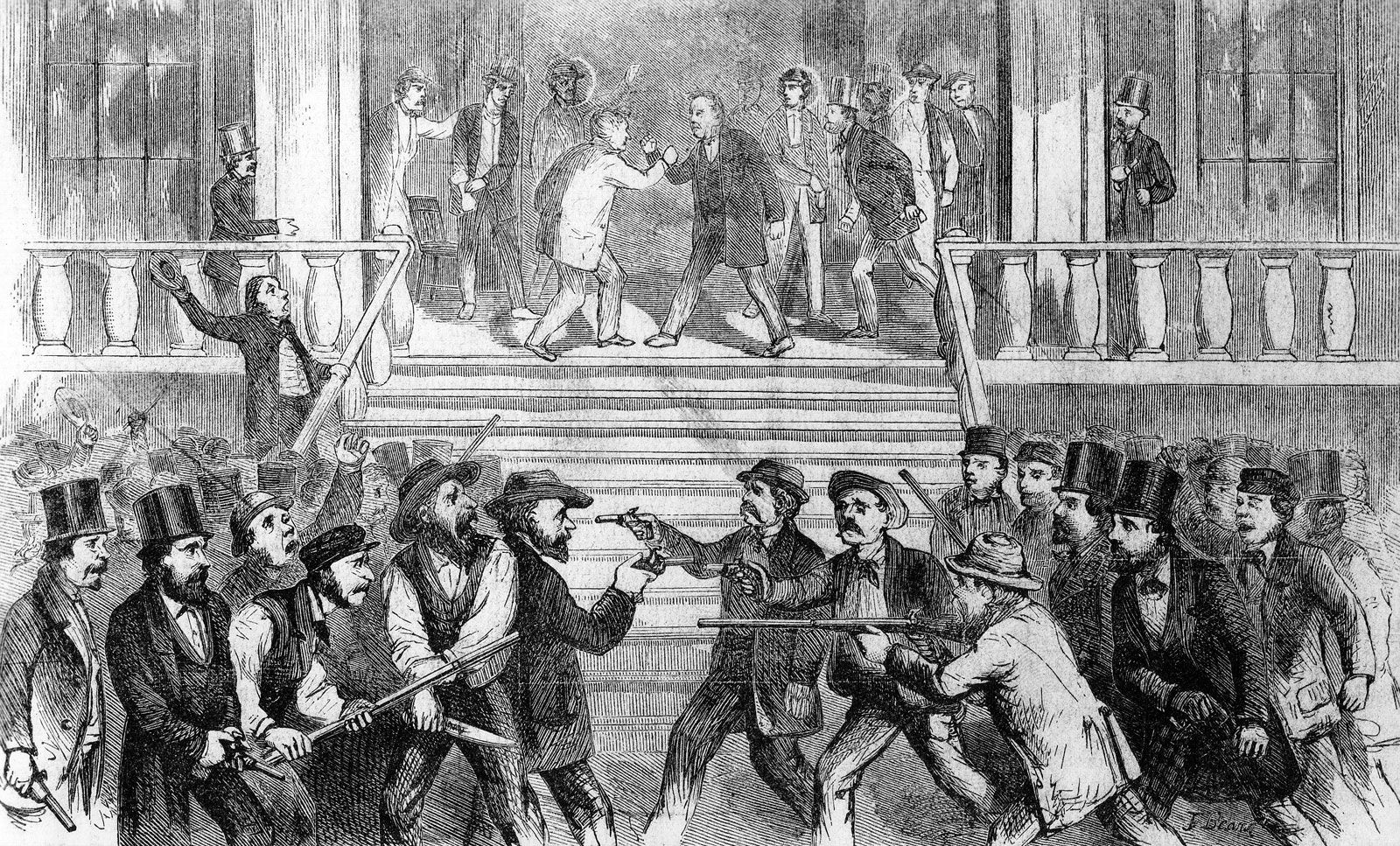
And Bleeding Kansas, as it became known, became a killing field.
Joseph ParkinsonHOST
Raids, murders, Burned buildings, armed bands, neighbor fighting neighbor, and deep resentments that sent a clear message to the two sides of the slavery debate.
Joseph ParkinsonHOST
What's more, Bleeding Kansas gave the opposing camps martyrs, those who had sacrificed their blood either to make the nation free or to save the Southern way of life.
Joseph ParkinsonHOST
Increasingly, the language of American politics became ever more divisive.
Joseph ParkinsonHOST
Fighting broke out on the Senate floor.

David BlightHOST
And by January of 1856, the beginning of the next year, in a sense, in essence, there were two fledgling territorial governments in Kansas, one free soil, one pro-slavery.
David BlightHOST
And it was then that spring of 1856 that what we call Bleeding Kansas, this border frontier civil war, this village against village, river ravine against river ravine, broke out.
David BlightHOST
Before it played out over about a year and a half, about 250 people would be killed, many of them in nighttime raids and vigilante violence, and millions in I will come back to John Brown later, next week in fact.
David BlightHOST
Our friend John Brown from upstate New York, or somebody's friend, he wasn't easy to be had already sent out some of his sons, more on that later, and John Brown arrived himself in the winter of 1856.
8 MINS LATER
David BlightHOST
It was news of the beating of Sumner on the floor of the Senate that apparently made John Brown snap, and within forty-eight hours he led what's called the Pottawatomie Creek Massacre, where he murdered five pro-slavery advocates in cold blood, with broadswords, in the dark of the night.
David BlightHOST
We will return to John Brown's Now, that year was, though, a presidential election year, and the problem is still just laying there out on the landscape.
David BlightHOST
What is to happen with Kansas, Nebraska? What's to be done with bleeding Kansas? What's to be done with Now, in that election of 1856, this is terribly important, The Republican Party will mount its first effort at the presidency, in it all but one.
David BlightHOST
This has never happened in American history till then.

JoeHOST
Yeah, interesting.
JonHOST
The, the only exception that I'm aware of was Kansas, which was punished for Bleeding Kansas, the kind of dress rehearsal for the Civil War, about six years, I think, prior to the actual outbreak of Civil War.
JonHOST
The US government modified the statute that said 60,000, said, "You have to get to 90,000.
JonHOST
We want more people in there before you can become a state." So Kansas was admitted to the Union later than it otherwise would have been.

Wilfred McClaySOUNDBITE_SPEAKER
Would the new state of Kansas be slave or free? The two sides clashed.
Wilfred McClaySOUNDBITE_SPEAKER
Blood was spilled, so much so that the conflict came to be known as Bleeding Kansas.
Brion McClanahanHOST
One thing I'm glad they did there is show John Brown.
Brion McClanahanHOST
That's the real blood being spilled.

speaker_2HOST
I didn't know that.
speaker_2HOST
Bleeding Kansas?
TroyerHOST
Yeah.
TroyerHOST
Yeah.
speaker_2HOST
So that was just in the
TroyerHOST
background of what was going on.
speaker_2HOST
And as you mentioned, this whole period of time was called Bleeding Kansas.
speaker_2HOST
And And essentially, it was like the beginning of the Civil War.
David BlightGUEST
It's actually a pretty serious question.
David BlightGUEST
Is it Kansas-Nebraska Act? Is it Bleeding Kansas? Is it John Brown's right? Is it? the Dred Scott decision, is it the election of 1860 and so forth.
David BlightGUEST
At the heart of this, of course, is the huge, huge question, how did slavery and its concomitant problems and issues, economic, social, moral, constitutional, how did it tear apart our society? There've been many interpretations of that.
David BlightGUEST
But the fact is it became a question the political system could not contain, could not solve, and ultimately, though there were many attempts at it, could not compromise.
20 more episodes mention Bleeding Kansas.
Create an account to see the whole feed, search across every transcript, and follow the entities you care about.