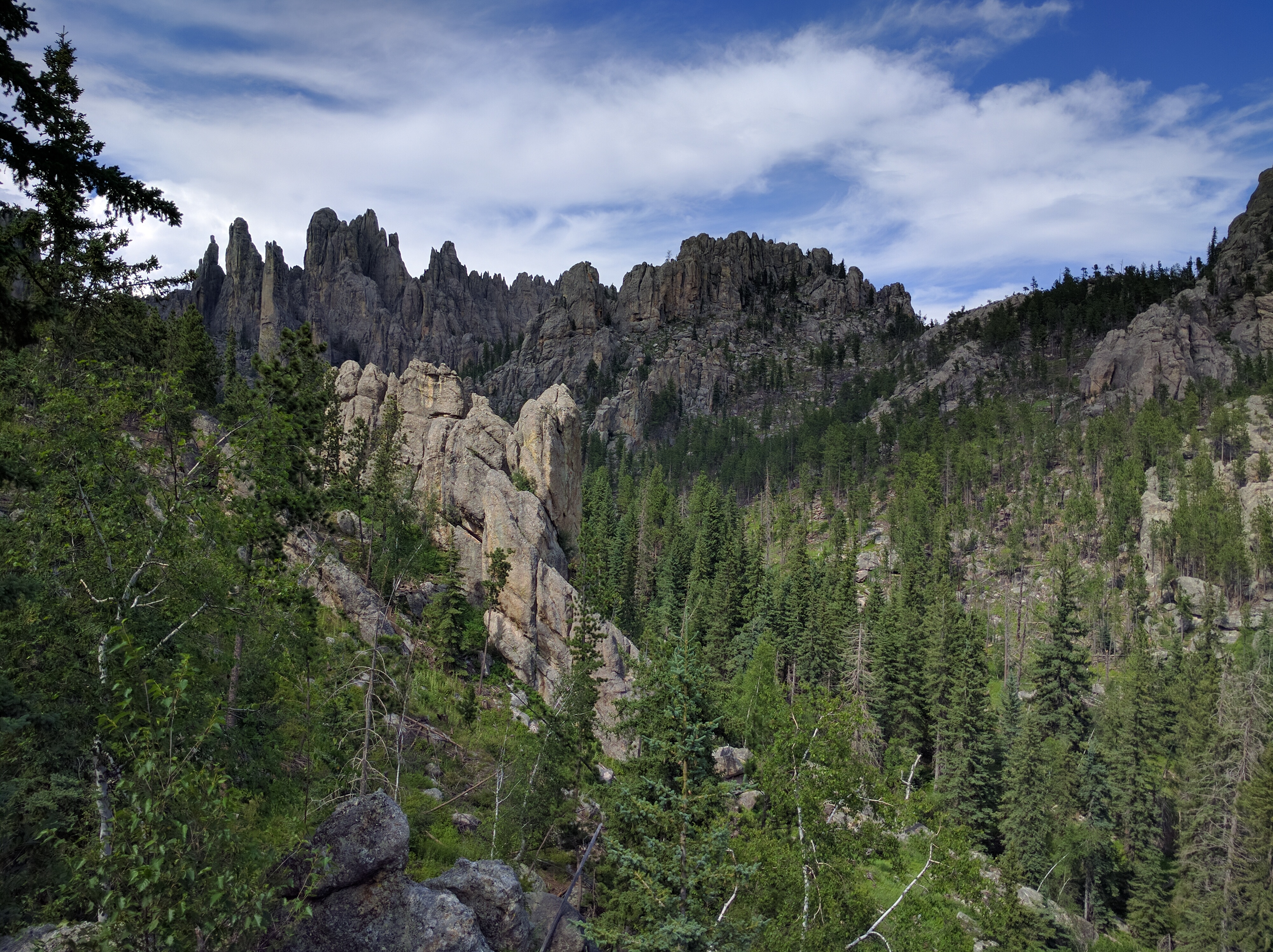
Black Hills
Mountain system in the United States of AmericaWikipedia
403
MENTIONS
155
EPISODES
132
PODCASTS
Search complete. 403 mentions across 155 episodes found for "Black Hills".
Oct 28, 2026

David BrownHOST
Harley-Davidson is using this year's rally to reveal its new cruiser, the Deadwood.
David BrownHOST
It's a study in Americana that honors the post-World War II servicemen who rode their Harleys to the Black Hills of South Dakota in 1947.
David BrownHOST
Indian, meanwhile, is showing off its new Chief Vintage Sturgis SD Edition.
David BrownHOST
It's a reminder that Sturgis' roots go back to a 1938 event organized by a local Indian dealer.

Drew DonaldsonHOST
And the
Christopher BronsonGUEST
second thing is how tightly or aggressively does it need to be controlled? I mean, if you live in the Black Hills of South Dakota, like the western part of my state, which is also at high altitude, and you take testosterone and you're one of those people after a year, you're like sitting at 55.
Christopher BronsonGUEST
I mean, it's hard to control.
Christopher BronsonGUEST
I mean, and so sometimes it's just not possible and you have to accept that that's the way it's going to be.

NinaHOST
So now we're going into the native sort of miscellaneous here, okay? People emerging from underground.
NinaHOST
Let's begin in the Black Hills of South Dakota, which is close to where Robert's living.
NinaHOST
He's in the north end of Dakota, but it is in the Dakota area where this is happening here.
NinaHOST
The Lakota have an emergency tradition, emergence tradition, connected with Wind Cave, a real underground cave system.

Ross WidmoyerGUEST
We're about 45 minutes south of downtown Minneapolis and downtown St. Paul.
Ross WidmoyerGUEST
to people who drive cross-country on Interstate 90 heading out to the Black Hills of South Dakota.
Ross WidmoyerGUEST
One time we had a gentleman who was such a big fan of our brand, he came over from Germany on his way to San Francisco, flew into Minneapolis, stopped, rented a car, drove down to the mill just so he could see the place in action.
Ross WidmoyerGUEST
So it's fascinating.

Matt WhitmanHOST
Now I'm going to start by talking about a time I heard a pop song that I like, and I'm going to recommend the pop song to you, which is rare for me, but it's going to happen.
Matt WhitmanHOST
I was driving through the Black Hills of South Dakota, where I live, and as I was driving along, I was on this road where there's this one really interesting spot.
Matt WhitmanHOST
You got this craggy cliff on one side, and there's this weird, interesting, this architectural anomaly, this Airbnb that's built on top of this cliff on one side of the road.
Matt WhitmanHOST
And then on the other side of the road, you got beautiful Clearwater Rapid Creek.
6 MINS LATER
Matt WhitmanHOST
between Mount Gerizim and Mount Ebal.
Matt WhitmanHOST
The same way Mr.
Matt WhitmanHOST
Electric Blue is in my head every time I drive around that bend in the Black Hills, so much more so, God wanted his people, every time they walked past or envisioned Mount Ebal and Mount Gerizim and the valley in between, he wanted them to be reminded of the covenant.
Matt WhitmanHOST
That gets spelled out first in Deuteronomy 11.26.

Jim ScarcellaHOST
On February 27th, the U.S. Forest Service approved exploratory drilling in search of graphite, which is the lead in your pencils, despite opposition from local officials, tribal nations, and the general public.
Jim ScarcellaHOST
The NDN Collective, Black Hills Clean Water Alliance, and Earthworks filed suit against the Forest Service, demanding they vacate the permit.
Jim ScarcellaHOST
The plaintiffs argued that the Forest Service unlawfully relied on a NEPA, National Environmental Policy Act, categorical exclusion, but pointed to a 2014 Memorandum of Understanding that protects PSHA and argues that the work would take longer than the one year required to complete.
Jim ScarcellaHOST
Most of the tribal nations in South Dakota also filed suit.
Jim ScarcellaHOST
Mining has a long and contentious history in the Black Hills.
Jim ScarcellaHOST
Pishla was part of the Fort Laramie Treaty of 1868, which established the Great Sioux Reservation and granted the right to live unhindered by white settlement.
Jim ScarcellaHOST
Gold was discovered six years later.
Jim ScarcellaHOST
As a result, in 1877, the government passed the Black Hills Act and confiscated territory where gold was found, another injustice.

Tyler KiwalaHOST
Yeah, there are some articles or people claiming that certain springs now have been contaminated because of that.
Tyler KiwalaHOST
Not all of them, but I do know just because I was there in South Dakota, the Black Hills Springs, They claim, the Native Americans on the land claim it's like one of the healthiest springs left in the country, essentially.
Tyler KiwalaHOST
I don't know if that's true, you know, but it's definitely healthy and they're very proud of their spring water up there.
Tyler KiwalaHOST
and the Black Hills, which is a very safe

Marcus PeterGUEST
He and I both grew up urban, you know, kind of big city, rapid movement, and people who live in farming areas, they have a slower pace of life, they're more involved with their neighbors and community, and yet we assimilated right in, which again goes to show that the work of local Catholic apostles, like Real Presence Radio, is so powerful precisely because of that, that the Catholic family has an ethos that the world just doesn't have and that the world needs and the Catholic Church offers.
Kami BrechtelHOST
Yes, and what a wonderful thing, too, that we have Real Presence Radio in our area, too, because here in the Black Hills, you know, we have Rapid City, Spearfish, Belfou, Sturgis, you know, we're a little bit closer together in proximity, but we do, north and south of us, have some some distance between us and a lot of our listeners are ranchers and they're farmers and they're out working their fields and their livestock and they're listening from their tractors and their pickup trucks and they maybe are an hour or more from town and they're able to receive formation because of Rural Presence Radio and EWTN.
Kami BrechtelHOST
So I know that that is also our reach is important for those reasons as well.
Marcus PeterGUEST
I couldn't agree more.

John CainHOST
No, you can't make this stuff up.
John CainHOST
So the idea of trying to share truths that are uncomfortable to Americans, I mean, they go into the Black Hills and they carve four faces on what they call Mount Rushmore.
John CainHOST
And all four of those faces have a legacy of atrocities against Native people.
John CainHOST
George Washington died.

John HoopesGUEST
And the gold comes in pretty late, around 1000 AD or so, 1000 CE.
John HoopesGUEST
um also something that's kind of a head scratcher um is it think about uh north america think about the american west think about you know the black hills and think about the gold rush in california and think about all the gold in colorado well for all of the gold that was found in the western united states it wasn't something that was widely used or valued by the native tribes that lived in the western united states They traded for turquoise that came from, well, came from the American Southwest, came from sources in New Mexico.
John HoopesGUEST
They used silver.
John HoopesGUEST
But gold is not something that was important to Native American culture in North America, in spite of the fact that obviously there was a lot of gold around.
John HoopesGUEST
It's one of the things that brought Columbus to the New World and resulted in the whole Spanish conquest of Mexico and South America is that they were going for the gold, because there was gold there.
John HoopesGUEST
And the Aztecs used and worked gold, as did the people of Oaxaca in southern Mexico.
John HoopesGUEST
But for some reason, the peoples of the southwest of California, of the Great Plains, of the Black Hills, and of course the Black Hills are notorious for gold.
John HoopesGUEST
for having been the location of white settlement for gold mining, which of course displaced the Lakota and other groups from their sacred landscape.
145 more episodes mention Black Hills.
Create an account to see the whole feed, search across every transcript, and follow the entities you care about.