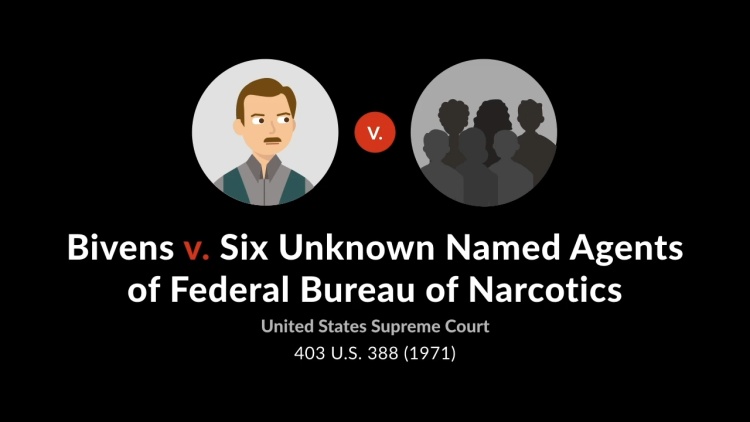
Bivens v. Six Unknown Named Agents
Case in courtWikipedia
89
MENTIONS
10
EPISODES
8
PODCASTS
Search complete. 89 mentions across 10 episodes found for "Bivens v. Six Unknown Named Agents".
Oct 9, 2026

Andrew TorrezHOST
Uh, there is Section 1983 claims, but those only cover state actors.
Andrew TorrezHOST
In 1971, the Supreme Court tried to fill in that gap in a case called Bivens versus Six Unknown Federal Agents.
Andrew TorrezHOST
Uh, that, in that case, uh, the, the Supreme Court created a damages re- remedy against federal narcotics agents who searched a man's apartment without a warrant in violation of the Fourth Amendment.
Andrew TorrezHOST
Uh, but, uh, the Supreme Court almost immediately started confining, construing Bivens very narrowly and rejecting it in other cases.
Andrew TorrezHOST
And then in 2022, in a case called Egbert versus Boule that we have discussed on this show, a, a border patrol agent threw an, an inn owner to the ground, [laughs] the smuggler's inn at the border.
Andrew TorrezHOST
Uh, uh-

Erwin ChemerinskyGUEST
It's important to recognize that state tort suits have always been available against federal officers.
Erwin ChemerinskyGUEST
In fact, prior to the Supreme Court's decision in 1971 in Bivens for six unknown named agents to Federal Bureau of Narcotics, the only way of holding a federal officer accountable would be a state tort suit.
Erwin ChemerinskyGUEST
And all of the justices in that case recognized the availability of state tort suits.
Erwin ChemerinskyGUEST
In Bivens, the Supreme Court said you could have a lawsuit directly against federal officers under the Constitution.
Erwin ChemerinskyGUEST
But in the last 45 years, the Supreme Court has consecutively and consistently cut back on the availability of Bivens suits.
Erwin ChemerinskyGUEST
So now the question is, without the ability to sue federal officers under federal law, including the Constitution, Where can you sue them? And the problem is state tort suits often don't provide a remedy for the kinds of violations of rights that federal officers might engage in.
Erwin ChemerinskyGUEST
And so thus, a number of states have adopted laws that would allow federal officers to be sued civilly under state law for violating the Constitution.

Masha HansfordGUEST
And after receiving all the evidence, the Court actually said, "You know what? Actually, this exception is historically supported, and we're not going to overrule the case." So it's not a foregone conclusion, but my guess is it's fairly likely to overrule the case directly.
Masha HansfordGUEST
Um, the second case is, uh, Nielsen versus Watanabe, which asks whether the Supreme Court should overrule Bivens.
Masha HansfordGUEST
Bivens is the doctrine that implied a private right of action under the Constitution for constitutional violations, um, and so let people sue for money damages based on violations of constitutional rights.
Masha HansfordGUEST
That doctrine, uh, that was a nineteen seventy-one decision, by the way.
Masha HansfordGUEST
That doctrine has fallen into big disfavor in the Supreme Court and has been essentially narrowed to its facts.
Masha HansfordGUEST
But this case actually presents the question in part of whether Bivens should be entirely overruled.
Masha HansfordGUEST
Um, this case arises from the d-deliberate indifference to a prisoner's medical needs.
Masha HansfordGUEST
So Bivens itself was a case that arose in the Fourth Amendment context.

Wilson ParkerGUEST
Do you wanna repeat the question? Right,
Justin PearsonHOST
so the question correctly points out that cases addressing Bivens are on the docket this term.
Justin PearsonHOST
Do we think the court did that because they want to get rid of Bivens altogether or somehow narrow it even more than they already have? I don't know how that's possible.
Justin PearsonHOST
And basically, the question is, you know, what are they going to do with Bivens in light of the cert grants?
Wilson ParkerGUEST
And I'll address that.
Wilson ParkerGUEST
I think they accepted the case so that they could kill Bivens.
Justin PearsonHOST
Yeah, I think that's probably right.
Justin PearsonHOST
It's been frustrating for me to see that because I get why some people, especially here at a federal society event, why some people disagree with Bivens on original grounds, but what really bothers me is then they just go back to the day before Bivens, when they don't realize that Bivens arose because of the failure to follow things that happened before that, where if you go back to the founding, if a federal, excuse me, if a government official violated your rights, you could sue them for torts and for trespass and things like that.
Liz DyeHOST
We can talk about it in a minute why I think that they might not.
Liz DyeHOST
But okay, on their face, these complaints state two causes of action, as you said, the Federal Tort Claims Act, or FTCA, and a Bivens claim, and it's virtually impossible to win an actual lawsuit on either one of them.
Andrew TorrezHOST
Yeah, we have talked about both of these avenues before, but, but briefly, first, the Federal Tort Claims Act is where the government has engaged in a limited waiver of its sovereign immunity for certain kinds of claims, right? But procedurally, you must have filed an administrative claim first, that is Standard Form 95, and you must file it within two years of your claimed injury.
Andrew TorrezHOST
If not, your case is barred, and there is no way any of these chuds filed an SF-95 by 2023 back before the Department of Justice was run by Trumpoons, right?
Liz DyeHOST
Right.
Andrew TorrezHOST
So they're-- all of those are just gonna be barred on procedural grounds.
Andrew TorrezHOST
The Bivens claim, if anything, is even worse, right? [laughs] Like, so Bivens is a judicially created right.
Andrew TorrezHOST
It's the federal equivalent of a Section 1983 claim.

Kate ShawHOST
Yeah, so I think you can draw a clear line from the Court's blessing of those tactics on the ground in Los Angeles and these continued uses of this excessive force as we just saw last week.
Kate ShawHOST
So it's also possible that this term, the Court might double down and make all of the potential for these government abuses even worse because on their docket is a very scary case asking the Court to formally overrule Bivens.
Kate ShawHOST
That's the 1970s case that allows you to sue some federal officers for damages when they violate your constitutional rights, although in now very, very limited circumstances.
Kate ShawHOST
The Court in recent years has all but cabined Bivens and the two other cases that authorized damages suits against federal officers for violating constitutional rights to their very particular facts.
Kate ShawHOST
And now this term, the case, Nielsen versus Watanabe, provides the Court with an opportunity to just overrule Bivens outright, give federal officers even more immunity, make them even less accountable.
Kate ShawHOST
This case arises in the context of a claim where officers allegedly denied an incarcerated person medical care.
Kate ShawHOST
So if you thought it couldn't get worse on unaccountable federal officials, it very much could.
Leah LitmanHOST
But the Court is, I think, likely to say, "Actually, no accountability for federal officers sounds great to us."
Robert SteinbuchGUEST
Part of the calculus as to how reasonable their behavior was, was why did you bother or, or why did you intentionally focus on having him in the house when this is a search warrant for premises, not an arrest warrant for him?
Anthony SandersHOST
So we're gonna turn to the legal claims now, or at least the mechanisms to bring these legal claims, and the warrant is gonna be critical with one of them, uh, which is, is called a Bivens action, that we've discussed on, uh, on, on the show before.
Anthony SandersHOST
But before we get into Bivens and, and whether you have a warrant or not, I think we'll go to Anya first to set the stage of kinda what, what is this Bivens thing.
Anthony SandersHOST
We, we've said the name Webster Bivens a few times before-
Robert SteinbuchGUEST
[laughs]
Anthony SandersHOST
... on the show, so some people may be a bit familiar with it.
Anya BidwellHOST
What was at the center of, you know, cong- Congress people's mind is the, the kind of bias that you would get if you were a state official being sued in state court, so they wanted to bring them, to bring them into federal court.
Anya BidwellHOST
Federal officials could still be sued in state court at the time, so they weren't worried about this being the only avenue.

Rhiannon HamamHOST
The Court, a couple of times in the past, you know, it's just a sprinkle that they do something good.
Rhiannon HamamHOST
We've talked about this case, Bivens.
Rhiannon HamamHOST
This is a Supreme Court decision from the early '70s that says that when federal officials violate your c- Constitutional rights, at least under the Fourth Amendment, you have a private right of action against those federal officials.
Rhiannon HamamHOST
You can sue them for damages.
Rhiannon HamamHOST
They certainly don't want there to be a remedy for it when it happens, right?
Michael LiroffHOST
Right.
Rhiannon HamamHOST
What Bivens does, what Carlson does, is gives you a remedy when your Fourth or Eighth Amendment rights are violated.
Rhiannon HamamHOST
You have a remedy for it.

Robert BarnesHOST
Well, this particular suit is against the FBI agents.
Robert BarnesHOST
So they brought it as Bivens claims for violations of the First Amendment, Second Amendment, Fourth Amendment, Fifth Amendment, and Eighth Amendment.
Robert BarnesHOST
I'll get into what the problem with that is in a second, but it's not due to lack of constitutional credibility in their claims.
Robert BarnesHOST
It's due to how the courts have immunized federal agents from their criminal violations from civil liability.
Robert BarnesHOST
Now, the hard part is this.
Robert BarnesHOST
The Supreme Court of the United States, the so-called constitutional conservatives, not I put quotes around that.
Robert BarnesHOST
because in this capacity they are neither constitutionalists nor conservatives, whatever they're conserving, it ain't the Constitution, it's the power of corrupt federal agents, have said that you can't sue for Bivens under the First Amendment.
Robert BarnesHOST
You can't sue for Bivens under the Second Amendment.

Mike ThompsonGUEST
But it doesn't say what happens if I am subjected to an unreasonable search and seizure.
Mike ThompsonGUEST
So the Supreme Court develops a doctrine called, it's from a federal case, the Bivens case.
Mike ThompsonGUEST
They create this remedy.
Mike ThompsonGUEST
to address violations of the Fourth Amendment.
Mike ThompsonGUEST
Congress has a remedy.
Mike ThompsonGUEST
Bivens is also a remedy.
Mike ThompsonGUEST
It's a judicial remedy.
Mike ThompsonGUEST
That remedy is being very much circumscribed as we go here, pretty much to the point where it's very, very, very difficult to utilize.