Biosphere 2

Biosphere 2

Research institute in the Saddlebrooke, ArizonaWikipedia

Search complete. 61 mentions across 26 episodes found for "Biosphere 2".

Sep 5, 2026

Unknown podcast

The Horrifying Reality of Traveling to Proxima Centaur

Sep 5 · 2 Mentions

speaker_0NARRATOR
78:08
A generation ship must replicate this balance inside a sealed metal hull using a tiny fraction of Earth's biological complexity for centuries without interruption.
speaker_0NARRATOR
78:18
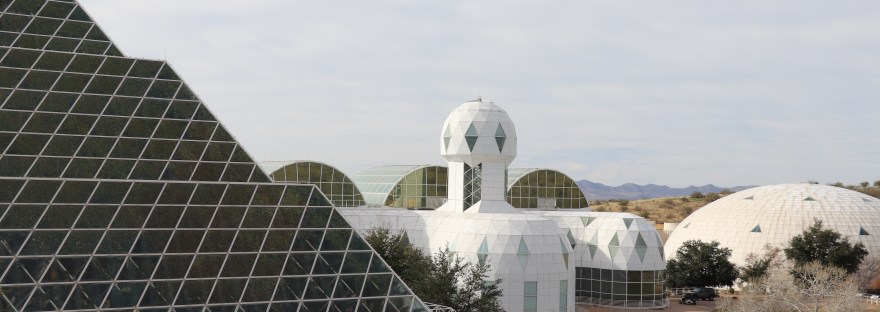
The most ambitious closed ecology experiment ever attempted was Biosphere 2, a three-acre enclosed facility in Arizona that operated between 1991 and 1993.
speaker_0NARRATOR
78:29
The facility was designed to be a completely sealed, self-sustaining ecosystem supporting eight human inhabitants.
speaker_0NARRATOR
78:36
It contained a rainforest, a desert, a coral reef, agricultural areas and a small ocean.
speaker_0NARRATOR
78:55
equivalent to conditions at an altitude of roughly 13,000 feet above sea level.
speaker_0NARRATOR
79:01
Carbon dioxide levels fluctuated wildly, crop yields fell short of requirements, insect pollinators died, pest species thrived, the concrete structure of the facility itself absorbed oxygen through a chemical reaction that no one had anticipated, Silently draining the atmosphere of the gas the crew needed to breathe, the eight inhabitants suffered from chronic hunger and low oxygen for months before the experiment was ended.
speaker_0NARRATOR
79:27
Biosphere 2 lasted two years.
speaker_0NARRATOR
79:31
A generation ship must sustain its ecology for 500.

Unknown podcast

Why Even the Closest Galaxy May Be Too Far For Us

Sep 4 · 2 Mentions

speaker_2NARRATOR
80:30
We have never built a closed ecosystem that works.
speaker_2NARRATOR
80:33
The most famous serious attempt, the Biosphere 2 experiment in the early 1990s, aimed to sustain a small crew inside a sealed environment for two years and encountered severe problems within months.
speaker_2NARRATOR
80:47
Oxygen levels dropped in ways nobody had predicted.
speaker_2NARRATOR
80:50
Certain species collapsed.
speaker_2NARRATOR
81:15
The trip we are describing needs closed ecosystems that work not for two years, but for hundreds of thousands of years.
speaker_2NARRATOR
81:22
without outside intervention, without a support team, without a planet's worth of buffer chemistry to lean on.
speaker_2NARRATOR
81:28
That is not a scaled-up version of Biosphere 2.
speaker_2NARRATOR
81:31
That is a different category of problem.

Unknown podcast

Why Alien Civilizations Could Already Be On Their Way

Sep 4 · 1 Mention

speaker_2NARRATOR
64:26
Earth's biosphere performs this function effortlessly on a planetary scale, but replicating even a fraction of that capability in a sealed vessel requires extraordinarily sophisticated ecological engineering.
speaker_2NARRATOR
64:39
The Biosphere 2 experiment in the early 1990s demonstrated both the potential and the difficulty.
speaker_2NARRATOR
64:45
The sealed facility in Arizona struggled to maintain atmospheric oxygen levels and experienced ecological instabilities that threatened the project within its first two years.
speaker_2NARRATOR
64:56
A generation ship would need to solve those problems permanently, with no option to open a window.

Unknown podcast

The Terrifying Distance to Alpha Centauri

Sep 3 · 1 Mention

speaker_4NARRATOR
42:09
No closed ecological system has ever achieved anything remotely approaching this level of self-sufficiency.
speaker_4NARRATOR
42:16
Biosphere 2, the most ambitious attempt to create a sealed, self-sustaining habitat on Earth, experienced critical oxygen depletion and crop failures within its first two years of operation, despite being built on the surface of a planet with ample sunlight, stable gravity and immediate access to emergency intervention.
speaker_4NARRATOR
42:36
The International Space Station, humanity's most sophisticated space habitat, requires constant resupply from Earth, roughly several tons of food, water, equipment, and spare parts delivered by cargo spacecraft multiple times per year.
speaker_4NARRATOR
42:54
A generation ship would need to replicate the ecological stability of an entire planetary biosphere using only the resources loaded aboard at departure, with zero margin for systemic failure across millennia.
Carol CarterGUEST
38:33
You just reminded me of an experience I had with my parents.
Carol CarterGUEST
38:37
We went on a little road trip, maybe 25 years ago, we went to Biosphere 2 in Tucson.
Carol CarterGUEST
38:45
And one of the experiences we had was, um, we were on a tour in the dome.
Carol CarterGUEST
38:53
And the guide said that the experiment was successful, except for one thing.

Unknown podcast

How Do You Actually Build a Spaceship Bigger Than a City

Sep 2 · 3 Mentions

speaker_1NARRATOR
94:15
Not in any laboratory.
speaker_1NARRATOR
94:17
The most ambitious attempt was Biosphere 2, a 3.14-acre sealed glass enclosure built in Oracle, Arizona in the late 1980s.
speaker_1NARRATOR
94:27
It contained multiple biomes , along with an agricultural wing and living quarters for eight crew members who sealed themselves inside in September of 1991 for a planned two-year mission.
speaker_1NARRATOR
94:42
The experiment was intended to demonstrate that a closed ecological system could support human life without material exchange with the outside environment.
speaker_1NARRATOR
94:51
The results were sobering.
speaker_1NARRATOR
94:52
Within months oxygen levels inside Biosphere 2 began dropping.
speaker_1NARRATOR
94:57
The concentration fell from the normal 21% to roughly 14%, equivalent to breathing at an altitude of roughly 4,000 metres.
speaker_1NARRATOR
95:05
Crew members experienced chronic fatigue, impaired cognitive function and difficulty performing physical tasks.

Unknown podcast

Could a Generation Ship Keep Humans Alive for 10_000 Years

Sep 2 · 2 Mentions

speaker_5NARRATOR
43:33
The most ambitious attempt to build a closed ecological system on Earth ended in a lesson so stark that its implications still haunt life support engineers.
speaker_5NARRATOR
43:44
Biosphere 2 was constructed in the Arizona desert in the late 1980s.
speaker_5NARRATOR
43:49
It enclosed approximately 1.3 hectares under glass and steel, creating an airtight facility containing multiple simulated biomes including rainforest, ocean, savannah, marsh and desert, along with an agricultural area designed to grow food for a crew of eight people.
speaker_5NARRATOR
44:09
The structure was sealed in September of 1991, with its crew inside.
speaker_5NARRATOR
47:21
Interpersonal conflict became severe enough to impair cooperation on tasks critical to the experiment's survival.
speaker_5NARRATOR
47:27
The second mission, conducted in 1994 with a different crew, ended prematurely amid management disputes and allegations that the closure protocols had been violated.
speaker_5NARRATOR
47:40
Biosphere 2 was not a small experiment.
speaker_5NARRATOR
47:43
It was a massive, expensive, carefully engineered facility built on the surface of Earth, where gravity was free, sunlight was abundant, structural integrity was guaranteed by a firm foundation, and the ambient environment outside the glass was breathable air at normal pressure and temperature.

Unknown podcast

How Long Could a Starship Survive Between Galaxies_

Sep 2 · 2 Mentions

speaker_4NARRATOR
63:19
Consider what humanity has actually achieved in closed ecosystem experiments.
speaker_4NARRATOR
63:24
The most famous attempt, Biosphere 2 in Arizona, sealed eight people inside a large glass structure in 1991 with the goal of surviving for two years using only recycled air, water and food.
speaker_4NARRATOR
63:37
The experiment failed on almost every measure.
speaker_4NARRATOR
63:40
Oxygen levels crashed and had to be replenished from outside.

36 MINS LATER

speaker_4NARRATOR
99:27
It may become solvable in centuries or millennia, it may not.
speaker_4NARRATOR
99:31
So the verdict, honestly delivered, depends on which of these clocks we assume the ship can master.
speaker_4NARRATOR
99:37
If we assume only the technology we have actually demonstrated, as of the current decade, the 98% water recovery of the International Space Station's life support system, the imperfect closed ecosystems of Biosphere 2 and Melissa, the decades-long operational lifetimes of Voyager-class spacecraft, The reference starship, even with generous reserves, could last perhaps a few decades to a few centuries before critical systems began to fail beyond repair.
speaker_4NARRATOR
100:05
That is not enough for even the shortest interstellar journey to a nearby star, let alone an intergalactic crossing.

Unknown podcast

Could Humans Actually Survive a Real Interstellar Mission (Brace Yourself)

Sep 2 · 1 Mention

speaker_7NARRATOR
29:51
No closed biological system on Earth has ever operated without external inputs for more than a few years.
speaker_7NARRATOR
29:58
Biosphere 2, the most ambitious attempt to create a sealed self-sustaining ecosystem, famously struggled with oxygen depletion, species die-offs, and social conflict among its crew within its first two-year closure experiment.
speaker_7NARRATOR
30:15
ESA's MELISA program, which aims to develop a closed-loop biological life support system for space, has been under development for decades and has not yet achieved full closure even in ground-based laboratory conditions.
speaker_7NARRATOR
30:30
The lesson from every attempt at closed system life support is the same.

Unknown podcast

The Horrifying Reality of Traveling to Proxima Centauri

Sep 1 · 2 Mentions

speaker_2NARRATOR
79:38
A generation ship must replicate this balance inside a sealed metal hull using a tiny fraction of Earth's biological complexity for centuries without interruption.
speaker_2NARRATOR
79:48
The most ambitious closed ecology experiment ever attempted was Biosphere 2, a three-acre enclosed facility in Arizona that operated between 1991 and 1993.
speaker_2NARRATOR
79:59
The facility was designed to be a completely sealed, self-sustaining ecosystem supporting eight human inhabitants.
speaker_2NARRATOR
80:07
It contained a rainforest, a desert, a coral reef, agricultural areas and a small ocean.
speaker_2NARRATOR
80:26
equivalent to conditions at an altitude of roughly 13,000 feet above sea level.
speaker_2NARRATOR
80:31
Carbon dioxide levels fluctuated wildly, crop yields fell short of requirements, insect pollinators died, pest species thrived, the concrete structure of the facility itself absorbed oxygen through a chemical reaction that no one had anticipated, Silently draining the atmosphere of the gas the crew needed to breathe, the eight inhabitants suffered from chronic hunger and low oxygen for months before the experiment was ended.
speaker_2NARRATOR
80:57
Biosphere 2 lasted two years.
speaker_2NARRATOR
81:01
A generation ship must sustain its ecology for 500.

16 more episodes mention Biosphere 2.

Create an account to see the whole feed, search across every transcript, and follow the entities you care about.

We value your privacy

We use cookies to understand how you use our platform and to improve your experience. Click “Accept All” to consent, or “Decline non-essential” to opt out of non-essential cookies. Read our Privacy Policy.