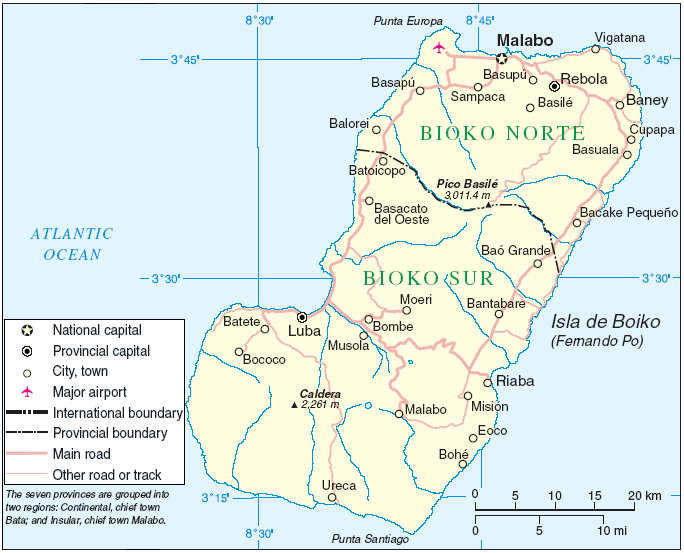
Bioko
Island in Equatorial GuineaWikipedia
6
MENTIONS
5
EPISODES
5
PODCASTS
Search complete. 6 mentions across 5 episodes found for "Bioko".
Aug 31, 2026

Chris PlanteHOST
Got the Bubi people there.
Chris PlanteHOST
And the indigenous Bioko, Bioko Island.
Chris PlanteHOST
They're the, uh...
Chris PlanteHOST
It's, uh, pretty amazing stuff they got.

Chico GarciaHOST
Very that.
Chico GarciaHOST
Very Fernando Po.
Chico GarciaHOST
Very ganun.
Chico GarciaHOST
And then came the switch, right? Na biglang embrace your feminine side, be more open with your emotions.

Dele SosimiGUEST
I'm telling
Ed KeazorGUEST
you, there was a radio station in Fernando Po, right? Which was being broadcast into Nigeria.
Ed KeazorGUEST
And it was playing...
Ed KeazorGUEST
Was this Radio Santa Maria? was what he calls bringing in the Congolese music.

speaker_0NARRATOR
This conclusion throws so much light on geographical distribution that I am strongly inclined to trust in it, but I will first give the facts which demand an explanation.
speaker_0NARRATOR
in south america dr hooker has shown that besides many closely allied species between forty and fifty of the flowering plants of tierra del fuego forming no inconsiderable part of its scanty flora are common to north america and europe enormously remote as these areas in opposite hemispheres are from each other on the lofty mountains of equatorial america a host of peculiar species belonging to european genera occur on the oregon mountains of brazil some few temperate european some antarctic and some andean genera were found by gardiner which do not exist in the low intervening hot countries on the scylla of caracas the illustrious humboldt long ago found species belonging to a genera characteristic of the cordillera in africa several forms characteristic of europe and some few representatives of the flora of the cape of good hope occur on the mountains of abyssinia at the cape of good hope a very few european species believed not to have been introduced by man and on the mountains several representative european forms are found which have not been discovered in the intertropical parts of africa dr hooker has also lately shown that several of the plants living on the upper parts of the lofty island of fernando po and on the neighbouring cameroon mountains in the gulf of guinea are closely related to those on the mountains of abyssinia and likewise to those of temperate europe It now also appears, as I hear from Dr. Hooker, that some of these same temperate plants have been discovered by the Reverend R. T. Lowe on the mountains of the Cape Verde Islands.
speaker_0NARRATOR
This extension of the same temperate forms, almost under the equator, across the whole continent of Africa, and to the mountains of the Cape Verde Archipelago, is one of the most astonishing facts ever recorded in the distribution of plants." on the himalaya and on the isolated mountain ranges of the peninsula of india on the heights of ceylon and on the volcanic cones of java many plants occur neither identically the same or representing each other and at the same time representing plants of europe not found in the intervening hot lowlands a list of the genera of plants collected on the loftier peaks of java raises a picture of a collection made on a hillock in europe still more striking is the fact that peculiar australian forms are represented by certain plants growing on the summits of the mountains of borneo some of these australian forms as i hear from dr hooker extend along the heights of the peninsula of malacca and are thinly scattered on the one hand over india and on the other hand as far north as japan On the southern mountains of Australia, Dr. F. Muller has discovered several European species.
speaker_0NARRATOR
Other species not introduced by man occur on the lowlands, and a long list can be given, as I am informed by Dr. Hooker, of European genera found in Australia, but not in the intermediate torrid regions.
speaker_0NARRATOR
in the admirable introduction to the flora of new zealand by dr hooker analogous and striking facts are given in regard to the plants of that large island hence we see that certain plants growing on the more lofty mountains of the tropics in all parts of the world and on the temperate plains of the north and south are either the same species or varieties of the same species it should however be observed that these plants are not strictly arctic forms for as mr h c watson has remarked in receding from polar toward equatorial latitudes the alpine or mountain flora really become less and less arctic besides these identical and closely allied forms many species inhabiting the same widely sundered areas belong to genera not now found in the intermediate tropical lowlands these brief remarks apply to plants alone but some few analogous facts could be given in regard to terrestrial animals in marine productions similar cases likewise occur as an example i may quote a statement from the highest authority professor dana that it is certainly a wonderful fact that new zealand should have a closer resemblance in its crustacea to great britain its antipode than to any other part of the world end quote sir j richardson also speaks of the reappearance on the shores of new zealand tasmania c of northern forms of fish dr hooker informs me that twenty-five species of algae are common to new zealand and to europe but have not been found in the intermediate tropical seas from the foregoing facts namely the presence of temperate forms on the highlands across all of equatorial africa and along the peninsula of india to ceylon and the malay archipelago and in a less well-marked manner across a wide expanse of tropical south america it appears almost certain that at some former period no doubt during the most severe part of a glacial period the lowlands of these great continents were everywhere tenanted under the equator by a considerable number of temperate forms at this period the equatorial climate at the level of the sea was probably about the same with that now experienced at the height of from five to six thousand feet under the same latitude or perhaps even rather cooler During this, the coldest period, the lowlands under the equator must have been clothed with a mingled tropical and temperate vegetation, like that described by Hooker, as growing luxuriantly at the height of from four to five thousand feet on the lower slopes of the Himalaya, but with, perhaps, a still greater preponderance of temperate forms.
speaker_0NARRATOR
so again in the mountainous island of fernando po in the gulf of guinea mr mann found temperate european forms beginning to appear at the height of about five thousand feet on the mountains of panama at the height of only two thousand feet dr seaman found the vegetation like that of mexico with forms of the torrid zone harmoniously blended with those of the temperate it is a remarkable fact strongly insisted on by hooker in regard to america and by adolphe de candolle in regard to australia that many more identical or slightly modified species have migrated from the north to the south than in a reversed direction we see however a few southern forms on the mountains of borneo and abyssinia i suspect that this preponderant migration from the north to the south is due to the greater extent of land in the north and to the northern forms having existed in their own homes in greater numbers and having consequently been advanced through natural selection and competition to a higher stage of perfection or dominating power than the southern forms and thus when the two sets become commingled in the equatorial regions during the alternations in the glacial periods the northern forms were the more powerful and were able to hold their places on the mountains and afterwards migrate southward with the southern forms but not so the southern in regard to the northern forms in the same manner at the present day we see that very many european productions cover the ground in la plata new zealand and to a lesser degree in australia and have beaten the natives whereas extremely few southern forms have become naturalised in any part of the northern hemisphere through hides wool and other objects likely to carry seeds have been largely imported into europe during the last two or three centuries from la plata and during the last forty or fifty years from australia The Nilgiri Mountains in India, however, offer a partial exception, for here, as I hear from Dr. Hooker, Australian forms are rapidly sowing themselves and becoming naturalized.
speaker_0NARRATOR
Before the last great glacial period, no doubt the intertropical mountains were stocked with endemic alpine forms, but these have almost everywhere yielded to the more dominant forms generated in the larger areas and more efficient workshops of the north.
speaker_0NARRATOR
in many islands the native productions are nearly equalled or even outnumbered by those which have become naturalised and this is the first stage towards their extinction mountains are islands on the land and their inhabitants have yielded to those produced within the larger areas of the north just in the same way as the inhabitants of real islands have everywhere yielded and are still yielding to continental forms naturalised through man's agency the same principles apply to the distribution of terrestrial animals and of marine productions in the northern and southern temperate zones and on the intertropical mountains when during the height of the glacial period the ocean currents were widely different to what they are now some of the inhabitants of the temperate seas might have reached the equator of these a few would perhaps at once be able to migrate southwards by keeping to the cooler currents while others might remain and survive in the colder depths until the southern hemisphere was in its turn subjected to a glacial climate and permitted their further progress in nearly the same manner as according to forbes isolated spaces inhabited by arctic productions exist to the present day in the deeper parts of the northern temperate seas i am far from supposing that all the difficulties in regard to the distribution and affinities of the identical and allied species which now live so widely separated in the north and south and sometimes on the intermediate mountain ranges are removed on the views above given the exact lines of migration cannot be indicated we cannot say why certain species and not others have migrated why certain species have been modified and have given rise to new forms while others have remained unaltered we cannot hope to explain such facts until we can say why one species and not another becomes naturalised by man's agency in a foreign land why one species ranges twice or thrice as far and is twice or thrice as common as another species within their own homes various special difficulties also remain to be solved for instance the occurrence as shown by dr hooker of the same plants at points so enormously remote as kerguelen land new zealand and but icebergs as suggested by lyell may have been concerned in their dispersal the existence at these and other distant points of the southern hemisphere of species which though distinct belong to genera exclusively confined to the south is a more remarkable case some of these species are so distinct that we cannot suppose that there has been time since the commencement of the last glacial period for their migration and subsequent modification to the necessary degree the facts seem to indicate that distinct species belonging to the same genera have migrated in radiating lines from a common centre and i am inclined to look in the southern as in the northern hemisphere to a former and a warmer period before the commencement of the last glacial period when the antarctic lands now covered with ice supported a highly peculiar and isolated flora it may be suspected that before this flora was exterminated during the last glacial epoch a few forms had been already widely dispersed to various points of the southern hemisphere by occasional means of transport and by the aid as halting places of now sunken islands thus the southern shores of america australia and new zealand may have become slightly tinted by the same peculiar forms of life sir c lyell in a striking passage has speculated in language almost identical with mine on the effects of great alternations of climate throughout the world on geographical distribution and we have now seen that mr croale's conclusion that successive glacial periods in the one hemisphere coincide with warmer periods in the opposite hemisphere together with the admission of the slow modification of species explains a multitude of facts in the distribution of the same and of the allied forms of life in all parts of the globe the living waters have flowed during one period from the north and during another from the south and in both cases have reached the equator but the stream of life has flowed with greater force from the north than in the opposite direction and has consequently more freely inundated the south as the tide leaves its drift in horizontal lines rising higher on the shores where the tide rises highest so have the living waters left their living adrift on our mountain summits in a line gently rising from the arctic lowlands to a great latitude under the equator The various beings thus left stranded may be compared with savage races of men, driven up and surviving in the mountain fastnesses of almost every land which serves as a record, full of interest to us, of the former inhabitants of the surrounding lowlands.

speaker_4NARRATOR
Spain Spain's holdings were concentrated in northern Morocco and western Sahara, including regions like Rio de Oro.
speaker_4NARRATOR
It also controlled Spanish Guinea, which consisted of the island of Fernando Po and the mainland territory of Riomuni.
speaker_4NARRATOR
Connections to Modern Day Events Some scholars link the historical partition of the continent to modern economic trends in post-colonial Africa.
speaker_4NARRATOR
They argue that the decolonization process left many nations with undiversified economies that remained dependent on the export of raw materials and cash crops.