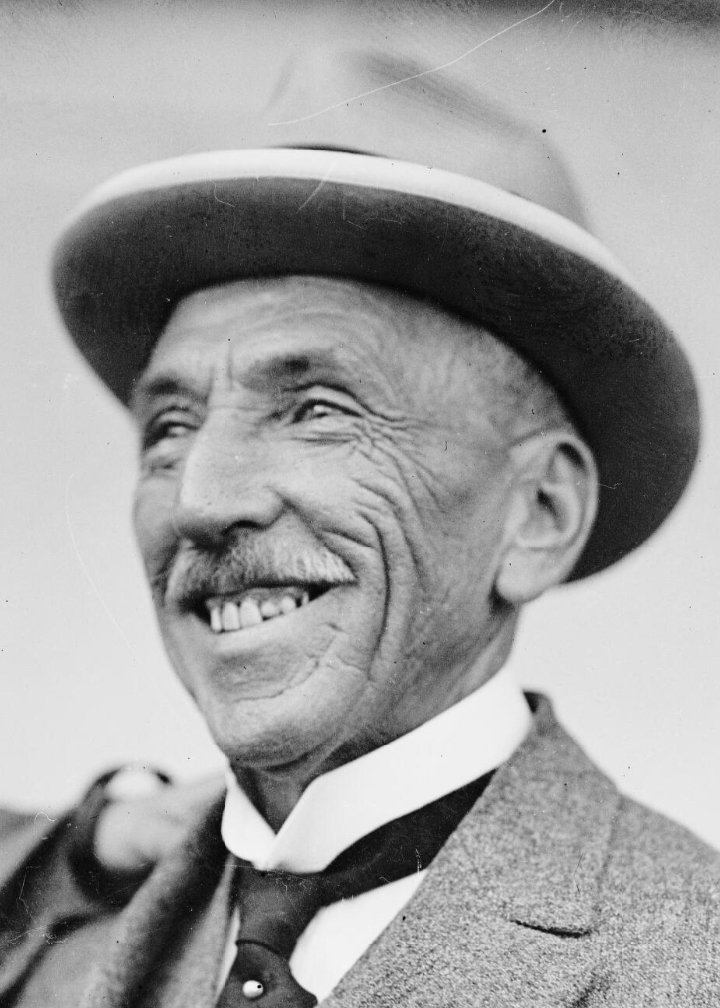
Billy Hughes
Former Prime Minister of AustraliaWikipedia
54
MENTIONS
15
EPISODES
15
PODCASTS
Search complete. 54 mentions across 15 episodes found for "Billy Hughes".
Oct 7, 2026

Mark CullyGUEST
The demographer at ANU, Charles Price, described it as a kind of miracle in the mid-50s, he used that phrase, and it kind of still is.
Mark CullyGUEST
So, Billy Hughes, who was the person who popularised the phrase, populate or perish, he would have been appalled at what happened in the 1950s.
Mark CullyGUEST
And even in So the government, so firstly the Chifley government, and then maybe we'll talk about the Menzies government after that.
Mark CullyGUEST
So the Chifley government, Chifley knew and Corwell knew that if they were to meet their target, so their target was for population to grow by 2% a year and for half of that to come from natural increase and half of that to come from migration.

speaker_0HOST
The first was Edward Manne, the representative for Perth.
speaker_0HOST
The second was a politician who I told you was going to be returning, the seventh Prime Minister of Australia, The Rat himself, Billy Hughes.
speaker_0HOST
While Hughes has been missing from the broad Australian picture since the early 1920s, his star had returned earlier in the year, as many in the Nationalist Party had called for him to be brought into the ministry, something Bruce had refused to do.
speaker_0HOST
Hughes, angered at the budget and Bruce's stance on industrial relations, crossed the floor, and in doing so, returned to high relevancy once more.
speaker_0HOST
The Nationalists lost 5.4% of the vote for 33.9% of the vote total, and lost 15 seats to hold 14 in total, while the Country Party won only 10% of the vote and won only 10 seats.
speaker_0HOST
Perhaps most devastating was Bruce himself losing his seat of Flinders to Labor's Francis Holloway, who got a 10.9% swing towards him, but won with only a 0.2% margin, or just under 700 votes.
speaker_0HOST
Finally, the Country Progressive Party held its one seat, and four Independents won seat, including Billy Hughes.
speaker_0HOST
The election result was a seismic shift in Australia's political scene, giving the Labor Party an outright majority in the Lower House, although the Upper House was still firmly held by the Coalition.

Ben RaueHOST
At the 1917 election, it was very much a two-horse race.
Ben RaueHOST
The Nationalists were a new party created by a merger of the Liberal Party and supporters of Billy Hughes, who had split from Labor over the issue of conscription.
Ben RaueHOST
Over 98% of votes were cast for either the Nationalists or Labor.
Ben RaueHOST
But in the following term, cracks began to form in the united anti-labor front.
Ben RaueHOST
Farmers groups in particular looked to run their own candidates independent of the Nationalists.
Ben RaueHOST
With farmers groups such as the Victorian Farmers Union looking to run candidates, we saw the familiar dance seen in first past the post systems on many occasions: two distinct groups who both want to defeat their common enemy but want something in return for withdrawing.
Ben RaueHOST
In early 1918, the National Farmers Organization formally asked Billy Hughes to support preferential voting, but the Prime Minister left for Europe without a reply.
Ben RaueHOST
A by-election for the Victorian seat of Flinders was due to be held in May 1918 after Sir William Irvine was appointed Chief Justice of the Supreme Court of Victoria.

CamHOST
Oh, amazing.
CamHOST
Billy Hughes.
CamHOST
Billy Hughes.
CamHOST
And he represents Australia at the Paris Peace Conferences.
CamHOST
And basically he's like, look, we're going to go in hard and we've got two things we want to negotiate on.
CamHOST
Look, who's closest to Samoa? It's New Zealand.
CamHOST
New Zealand gets Samoa.
CamHOST
So that was the bargaining chip that Billy Hughes took into Paris.

LiamHOST
And I'm your host, Jesse.
LiamHOST
Today's episode is titled The Conservative Ouroboros Deacon to Hughes.
LiamHOST
But before we proceed, a little housekeeping.
LiamHOST
Please check out Blue Sky.
1 HR 6 MINS LATER
LiamHOST
So, the Liberal comeback of 1913 was short-lived.
LiamHOST
They lost again in 1914, and Andrew Fisher was in for his third term, so...
LiamHOST
this is one of the hardest things to track in this period like people had such short terms that there's so many prime ministers that I often get their names mixed up but so Fisher's back in for a third term and Andrew Fisher after reclaiming office from opposition he basically he wasn't a well man he gave in to stress and he resigned in favour of his deputy that man was one William Morris Hughes a little digger Billy Hughes so you can't tell from this photo but he's a little fella I think he's like 5'2 he's very short All
Jesse BlackHOST
right.

Colin HiltonHOST
Uh, so I have a feeling that Arthur Meighen's pretty low down on that list.
Ben WaterworthHOST
Speaking of low down on the list, Australia had, uh, Billy Hughes, uh, [laughs] also known as-
Colin HiltonHOST
Just one
Ben WaterworthHOST
...
Ben WaterworthHOST
Fun fact about, uh-
Jamie LycoHOST
This is what happens when my wife's out of town
Ben WaterworthHOST
... [laughs] fun fact about Billy Hughes, uh, Australia's longest ever serving parliamentarian.
Ben WaterworthHOST
He was in the House of Representatives for 51 years-

David GruenUNKNOWN
Yeah.
Mark CullyGUEST
Um, it was Billy Hughes who popularized that phrase, but its, its first use was, um, by our third governor general in a speech in 1909, and that was very much in the context of, of Australia being over...
Mark CullyGUEST
I, I think the q- the quote has something about, you know, a, a- an army coming in through Port Darwin and taking over the, taking over the country.
Mark CullyGUEST
And that became a kind of dominant part of public discourse, for want of a better term, all the way through, uh, the, the 1920s and 1930s.

Matt FinchGUEST
Um, you know, when you look back Australia, like a hundred years ago, after the first world war, when they were forming the league of nations, Japan wanted a racial equality line in the league of nations.
Matt FinchGUEST
And it was Billy Hughes, admittedly then as part of the British dominion, but Billy Hughes was one of the most vociferous voices against having racial equality.
Matt FinchGUEST
He was a rat.
Peter LewisHOST
Yeah.

Joshua BlackGUEST
That's right.
Julian MorrowHOST
Now, Josh, one exception to the rule also was someone who really did have a colourful political career, Billy Hughes, you know, who worked his way through pretty well all the major parties in Australia and led Australia in a time of war.
Julian MorrowHOST
But the memoir that he published was described by one historian as frustratingly discreet, which doesn't sound like the sort of pull quote you'd put on the cover.
Julian MorrowHOST
No, no.
Julian MorrowHOST
Tell us about what Billy Hughes wrote and what that tells us about the genre at the time.
Joshua BlackGUEST
Yeah, absolutely.
Joshua BlackGUEST
I mean, the stories in that book are...
Joshua BlackGUEST
I mean, Billy Hughes was an incredible raconteur.

Josh BlackGUEST
That's right.
Julian MorrowHOST
Now, Josh, one exception to the rule also was someone who really did have a colourful political career, Billy Hughes, you know, who worked his way through pretty well all the major parties in Australia and led Australia in a time of war.
Julian MorrowHOST
But the memoir that he published was described by one historian as frustratingly discreet, which doesn't sound like the sort of pull quite you'd put on the cover.
Julian MorrowHOST
Yeah.
Julian MorrowHOST
No.
Julian MorrowHOST
Tell us about what Billy Hughes wrote and what that tells us about the genre at the time.
Josh BlackGUEST
Yeah, absolutely.
Josh BlackGUEST
I mean, the stories in that book are...
5 more episodes mention Billy Hughes.
Create an account to see the whole feed, search across every transcript, and follow the entities you care about.