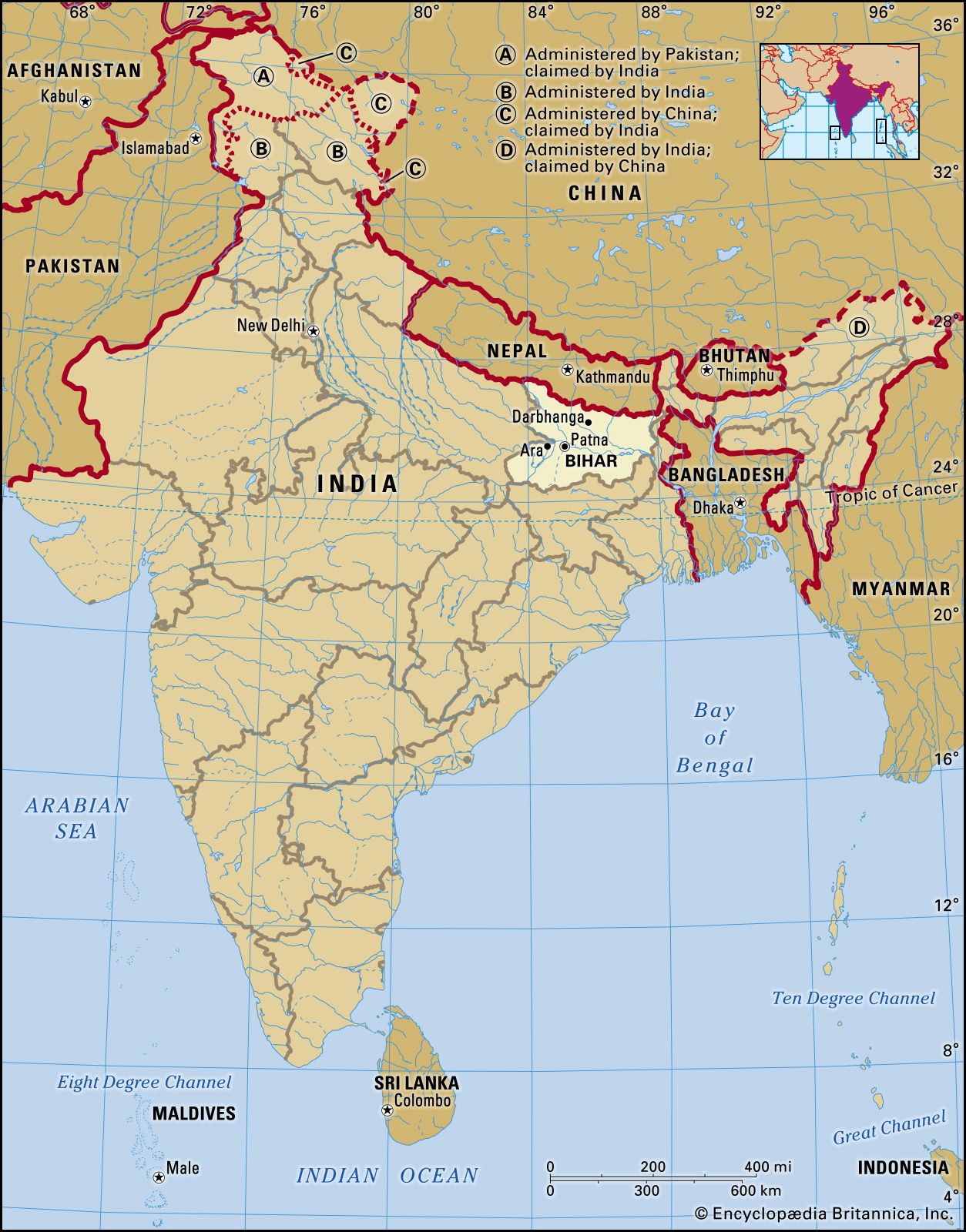
Bihar
State of IndiaWikipedia
292
MENTIONS
133
EPISODES
97
PODCASTS
Search complete. 292 mentions across 133 episodes found for "Bihar".
Oct 31, 2026

GwydionHOST
So what are the five? Tune in next time.
GwydionHOST
But what does this say? So the question is, what does the Bihar School of Yoga have to say about this in the 1970s? Okay, so Bihar School of Yoga, 1970s.
GwydionHOST
Bihar is where Jainism and Buddhism and presumably old school Patanjali yoga also, I mean, other present day states also.
GwydionHOST
That's not where the Himalayas are, but you know what I mean.
GwydionHOST
I mean,
GwydionHOST
Now I got to look at a map.
GwydionHOST
But anyway, I'm not going to worry about that.
GwydionHOST
So this is what the present-day Bihar School of Yoga, which was where the founder of the school of yoga in which I was trained, Mukti Yoga, Julie Rader, was trained in the Bihar School and influenced by Shiva Ray and a few other people.

AksharaHOST
Coming to the first story.
AksharaHOST
So one of our teammates told us an actual story about a young man from Bihar who works at a coffee shop in Bengaluru near where he stays.
AksharaHOST
When his shift ended, he slept on his scooter.
AksharaHOST
Now, there's no way to fully know why he sleeps there.
AksharaHOST
So in 1990-91, Karnataka's per capita income was 19% below the national average.
AksharaHOST
By 2023-24, it was 81% above it.
AksharaHOST
Bihar stood at just 32.8% of the national average.
AksharaHOST
Now, Bihar wasn't always without industry.

Ken OpaloGUEST
So on the one hand, I think the research in Kenya and Busia is part of the ground zero of the RCT movement.
Ken OpaloGUEST
together with Bihar, perhaps in India.
Ken OpaloGUEST
And what you see is that policymakers were not involved in the initial sort of investments in the research questions.
Ken OpaloGUEST
And so if policymakers are not involved at the beginning, they're less likely to sort of take on the evidence and run with it as far as policy implementation goes.

Christophe JaffrelotGUEST
Now, I think what they have in common is an amazing level of education, more education in the south than anywhere else, a sense of the civic culture, a real health system in some of these places, And now, which is even more, I think, important, the idea that the North is exploiting the South and that they are paying for the North.
Christophe JaffrelotGUEST
Why should they subsidize Bihar and Uttar Pradesh? So even Naidu is now thinking maybe...
Christophe JaffrelotGUEST
My real natural partners are in the South because at the end of the day, money matters.
Christophe JaffrelotGUEST
And if I am seen as betraying my state, my people, by being in the company of a party that is... extracting resources from the South to distribute this to rather incompetent governments in the North, that can boomerang.

Aadit KapadiaGUEST
One more team from Mumbai.
Aadit KapadiaGUEST
One more team from Purvanchal or Bihar, depending on whoever wants to invest.
Aadit KapadiaGUEST
One more team from the north of India.
Aadit KapadiaGUEST
Either Jammu, Kashmir, Himachal or Haryana.
Kushal MehraHOST
I don't like, I don't mind this actually.
Aadit KapadiaGUEST
Similar to what I said.
Aadit KapadiaGUEST
I was saying Bihar, but Ranchi I'm fine with.
Aadit KapadiaGUEST
That's fine.

speaker_0HOST
The weather system is highly likely to continue weakening between October 29 and 31.
speaker_0HOST
However, its remnants are expected to move northwards across central and eastern India, potentially bringing further heavy rainfall to parts of Chhattisgarh, Jharkhand, Bihar and eastern Uttar Pradesh.
speaker_0HOST
While the threat from strong winds will diminish, flooding and landslides are likely to remain significant threats to life.
speaker_0HOST
Densely populated, low-lying areas and communities near rivers are particularly vulnerable to flooding, with inadequate drainage infrastructure likely to exacerbate the impact of heavy rainfall.

Ajay DankarGUEST
So great to connect, you know, for that reason as well here.
Ajay DankarGUEST
But, you know, to answer your question, Laura, So I was born in a small town in Bihar in India.
Ajay DankarGUEST
My father was a gynecologist.
Ajay DankarGUEST
So we grew up literally in a doctor's colony.

Kailash SatyarthiGUEST
I decided that I will take him to his mother.
Kailash SatyarthiGUEST
So I drove and we went with many more children in Bihar, another state.
Kailash SatyarthiGUEST
I took that child to his village, but he could not recognize his own mother because when he was stolen, he was too small.
Kailash SatyarthiGUEST
And the mother also could not recognize him because she lost her eyesight.

Prachi MishraGUEST
And again, there's potential waiting to be leveraged in tourism, I think in several states in India.
Prachi MishraGUEST
I think one of the episodes we talked about Bihar, for example.
Prachi MishraGUEST
Tourism is really a low hanging fruit where we can push.
Prachi MishraGUEST
So it can be labor intensive manufacturing, it can be labor intensive services.

Neha BoraGUEST
And I say this because my party's history comes exactly from this struggle.
Neha BoraGUEST
My party's history comes from villages in Bihar, Dalit Tolas in Bihar, where entire villages were excluded from voting rights.
Neha BoraGUEST
They were either prevented from going and voting on the day of the voting, their ID cards collected, people voted in their stead with their ID cards and for the longest time they didn't vote, they had no right to vote.
Neha BoraGUEST
Even if they tried to step out of their villages and vote for the person that they wanted, they were butchered.
Neha BoraGUEST
Entire villages have been butchered in Bihar and not just in Bihar, throughout the country.
Neha BoraGUEST
What about the fact that even right now the kind of elections that go about in the country can you tell the difference from of one member of one grand party from the other can you tell the difference from these grand old parties the member of one party from the other party can you ask the people what do they stand for and have the people answer exactly what their idea is there's no you can you can hardly tell the difference between members of different political parties that's the problem that's I mean right now we are talking about saving democracy but democracy and constitution do not just have to be saved and upheld right now they have to be enriched for real democracy and constitutional morality to prevail and that is why when you talk about elections and what happens during elections the communist parties don't cater to sections of the society which I mean which have the capital and know-how of even who to vote for.
Neha BoraGUEST
That's how elections take place, right? When we do it in Bihar, on the election day, there are huge mobilizations from political parties they book buses they book trucks people come money is distributed you come vote we'll give you money even before that different things are distributed so just to ensure that people reach there we don't do that we don't take funding from capitalists and then go amongst the workers and say that we're going to fight them and I'm with
Shoaib DaniyalHOST
you on that there are a lot of flaws in the electoral system first pass the post money and so on but we have seen some people overcome them you spoke about caste we've had bahujan parties parties we have had a churn so i mean i totally get the point that the system is bad
123 more episodes mention Bihar.
Create an account to see the whole feed, search across every transcript, and follow the entities you care about.