Big Five personality traits
71
MENTIONS
28
EPISODES
24
PODCASTS
Search complete. 71 mentions across 28 episodes found for "Big Five personality traits".
Sep 14, 2026

Rick BeatonGUEST
There's sort of popular conversation and language, and then there's very specific scientific language.
Rick BeatonGUEST
So, for example, with personality, I'm a huge fan of the Big Five or the ocean.
Rick BeatonGUEST
All my neuroscience friends, like the guys that teach at the big universities and run the labs, are huge fans of it as well.
Rick BeatonGUEST
So we now know that We can measure five to six traits, whether it's the big five or the hexaco, which is the big five plus an H.
JoHOST
What are the big
Rick BeatonGUEST
five? First one is N, which measures our sympathetic and parasympathetic nervous system that is tied to how sensitive we are to stress.

Edward DuttonGUEST
...
Edward DuttonGUEST
the Big Five.
Hannah SpierHOST
Yeah.
Hannah SpierHOST
Which is, yeah, why we don't have so much information on.
Edward DuttonGUEST
It's, it, it-
Hannah SpierHOST
Yeah
Edward DuttonGUEST
... it's almost like things that don't fit into the other Big Five, they just chuck them into openness.
Hannah SpierHOST
They...

speaker_1HOST
What's fascinating here is that by analyzing that much data, they finally cracked the code.
speaker_1HOST
The researchers identified 1,260 specific genetic variants associated with the classic Big Five personality traits.
speaker_0HOST
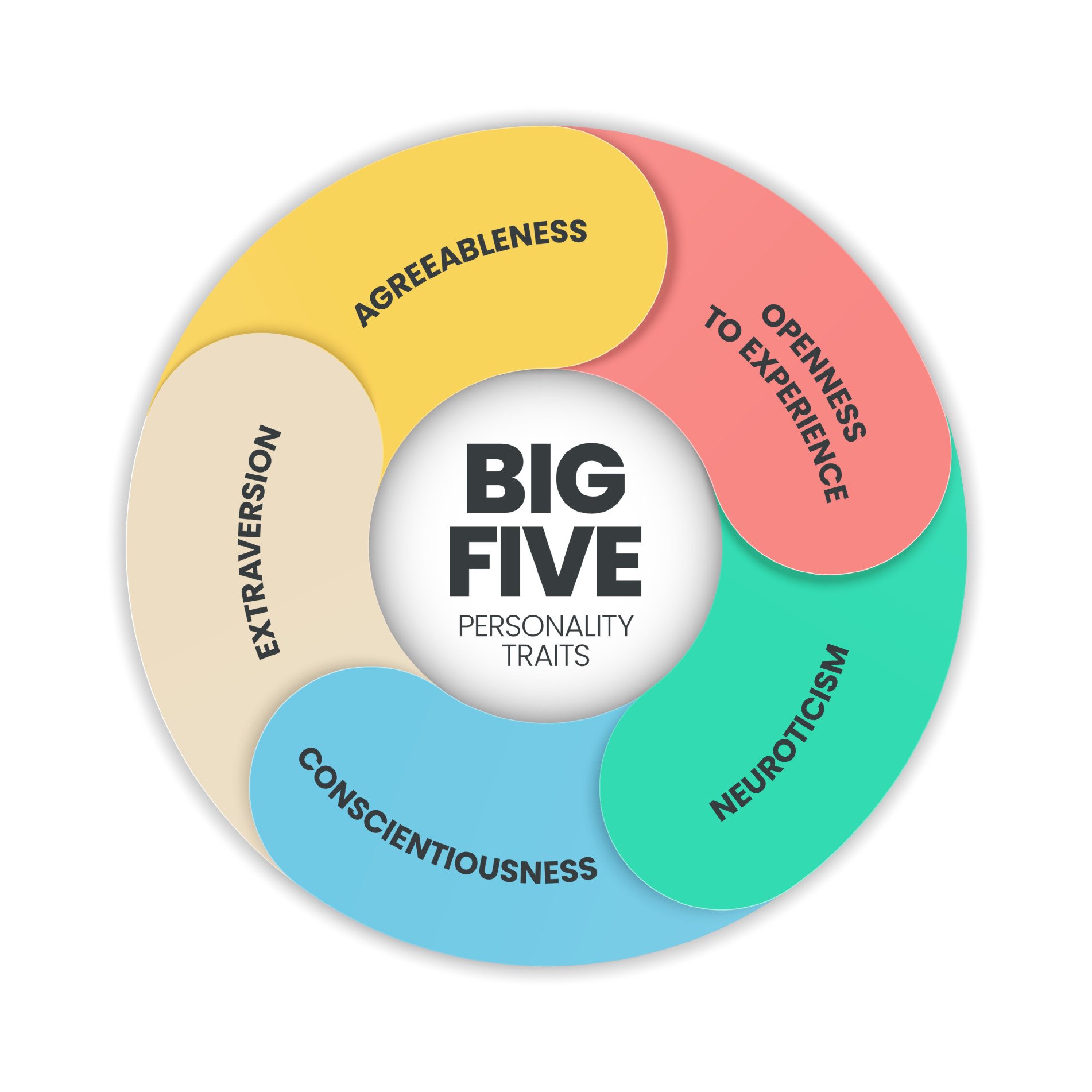
Okay, so that's extraversion, agreeableness, conscientiousness, neuroticism, and openness.
speaker_1HOST
Right, the Big Five.
speaker_1HOST
And out of those variants, 824 were completely novel discoveries.
speaker_1HOST
I mean, science had never linked them to personality before.
speaker_1HOST
Human behavior cannot be reduced to a single brain chemical.
speaker_0HOST
So what is actually happening in the brain then?

Mike MerrillHOST
Mm
Cathy BuckmanHOST
... which is also called the Big Five personality model, and that's the one I think we should talk about now.
Cathy BuckmanHOST
Mike, have you heard of this one?
Mike MerrillHOST
Oh, yeah.

Leslie JohnGUEST
We did some research on the big five, those big five personality traits, ocean, see if I can remember them off the top of my head, openness to experience, conscientiousness, extroversion, agreeableness, and neuroticism.
Leslie JohnGUEST
And we found that one of these is super predictive of the willingness to open up.
Leslie JohnGUEST
And it's not the one that I thought.
30 MINS LATER
Leslie JohnGUEST
Right.
Leslie JohnGUEST
Yes.
Leslie JohnGUEST
So this is a question that I'm also obsessed with, which is, are there personalities, some more revealing personalities or less revealing? And we did some research on the big five, those big five personality traits, ocean, see if I can remember them off the top of my head, openness to experience, conscientiousness, extroversion, agreeableness, and neuroticism.
Leslie JohnGUEST
And we found that one of these is super predictive of the willingness to open up.
Leslie JohnGUEST
And it's not the one that I thought.

MelissaHOST
I've used Acumax Index.
MelissaHOST
There's also things like the Big Five Personality Traits Test.
MelissaHOST
How is Enneagram a little different than those tests?
Judy CravenGUEST
ton about those tests, but from what I know about them, you know, they're really accurate.

Olga KhazanGUEST
That, like, you kind of get up and you have, like, these, like, little patterns that you fall into, and that's sort of, like, your, quote-unquote, "natural personality."
Sean IllingHOST
So we have what people call the Big Five personality traits, neuroticism, extroversion, agreeableness, which you just mentioned, openness to experience, and conscientiousness.
Sean IllingHOST
Are these categories generally accepted in the field of psychology, and, and, and how useful do you find them?
Olga KhazanGUEST
They are generally accepted.
Olga KhazanGUEST
This is-- That's now, like, if you read a personality study, it will be most likely based on the Big Five, so things like Enneagram and Myers-Briggs are not generally accepted.
Olga KhazanGUEST
That said, they are imperfect.
Olga KhazanGUEST
Um, there are some cultures that have, uh, traits that are Very important in those cultures that the big five doesn't really pick up as much.
Olga KhazanGUEST
Meanwhile, things like openness, um, it's sort of a catch-all.

Arthur BrooksHOST
Uh, this is an article from Psychological Assessment from, um, from Lewis Goldberg from 1992.
Arthur BrooksHOST
This is a classic article called "The Development of Markers for the Big Five Factor Structure." In other words, it's how can you numerically measure, um, personality if you're interested in that.
Arthur BrooksHOST
So I took the test, and sure enough, I scored the 96th percentile, which means that some freakish 4% of the, of the population is actually more extroverted than me.
Arthur BrooksHOST
Um, but that kinda makes sense.
13 MINS LATER
Arthur BrooksHOST
So neuroticism, which has always existed, there have always been people who are anxious and, and depressed, is something that, that is dramatically deleterious for human happiness and well-being, life satisfaction, obviously.
Arthur BrooksHOST
But they're increasing.
Arthur BrooksHOST
People are becoming more neurotic, and there's a ton of interesting studies on this that show that people under thirty-five have become significantly higher on the neuroticism, on the N dimension of the big five-factor personality traits than they've been in the past.
Arthur BrooksHOST
This especially exploded not just after two thousand and eight, but during COVID, which compounded all the problems through loneliness and isolation for everybody, by the way.

Lisa ZawrotnyHOST
So understanding your own inner and outer motivation, along with how your personality shapes what's sustainable for you, is critical to design habits in the best way for you.
Lisa ZawrotnyHOST
And in this episode, I use the big five personality traits, also known as OCEAN, O-C-E-A-N, because it represents each of the traits.
Lisa ZawrotnyHOST
The traits are openness, conscientiousness, extroversion, agreeableness, and neuroticism.
Lisa ZawrotnyHOST
And don't be scared by those words.

Eliot Tucker-DrobSOUNDBITE_SPEAKER
One of the things that our study underscores is that there's not just one gene for extroversion or one gene for neuroticism.
Eliot Tucker-DrobSOUNDBITE_SPEAKER
Our, our estimates are that it's probably closer to twenty thousand variants per each of the big five.
Katie RiddleCORRESPONDENT
The big five refers to five broad dimensions psychologists use to describe personality: openness, conscientiousness, extroversion, agreeableness, and neuroticism.
Katie RiddleCORRESPONDENT
Although personality can change, these traits tend to remain relatively stable during adulthood.
Katie RiddleCORRESPONDENT
Katie Riddle, NPR News.
18 more episodes mention Big Five personality traits.
Create an account to see the whole feed, search across every transcript, and follow the entities you care about.