bfloat16 floating-point format
20
MENTIONS
11
EPISODES
11
PODCASTS
Search complete. 20 mentions across 11 episodes found for "bfloat16 floating-point format".
Sep 17, 2026

Doug BlackHOST
And what will that mean? Just better results, greater efficiencies, which as we know is a huge issue right now, or both, or what will be the result of that?
John GustafsonGUEST
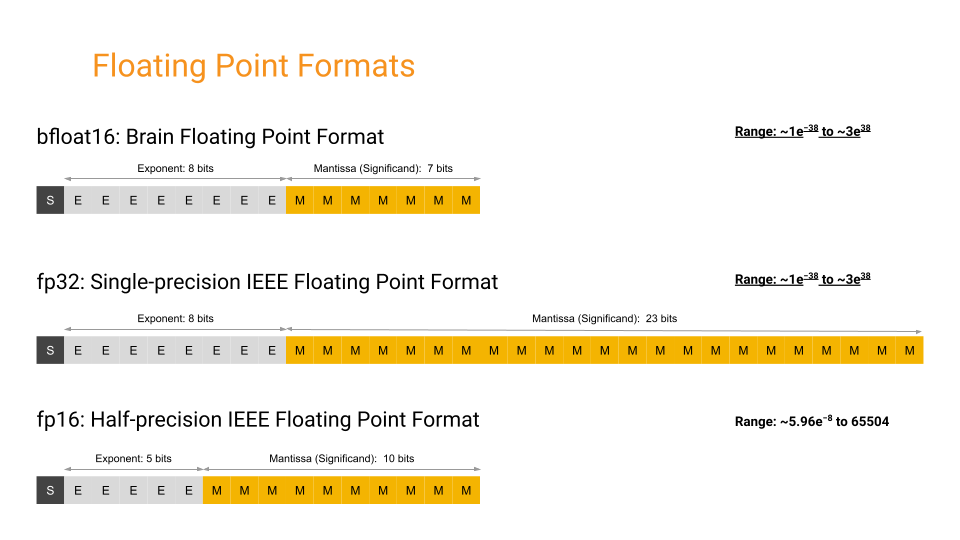
Right now, I think the large language models are being mostly trained on 16-bit, mostly Google's BFloat 16, if you're familiar with that.
John GustafsonGUEST
It looks like a 32-bit float with the bottom bits kind of sawed off like a shotgun.
John GustafsonGUEST
That gives you enough dynamic range, but it's not really ideal for...

Nick KuhnHOST
There was a...
Nick KuhnHOST
I did try with the BF16, the full format.
Nick KuhnHOST
It's a little slower, but FP8's a little faster, less degradation, but...
Nick KuhnHOST
Eventually, I'm sure someone will come up with a Blackwell tune like the NVF P4 format.

speaker_0HOST
If you are doing standard supervised fine-tuning of an eight billion parameter model, you configure four-bit QLoRA array.
speaker_0HOST
Because the thirty ninety and forty ninety are Ampere and Ada Lovelace architectures, the source says you must set BF16 true to use native bfloat16 precision.
speaker_1HOST
Right.
speaker_1HOST
That's crucial.
speaker_1HOST
Bfloat16 allocates more bits to the exponent, offering a much wider dynamic range, which prevents training spikes from overflowing the data type.
speaker_0HOST
But because the older T4 physically doesn't have the hardware to process the bfloat16 exponent structure natively, the source says you must force standard float sixteen.
speaker_0HOST
You set FP16 true and BF16 false.
speaker_0HOST
If you don't do this, the GPU has to emulate bfloat16 in software, which causes massive crippling performance penalties.

Type Three AudioNARRATOR
Note, though, that none of these are necessary for justifying that any existing open model satisfies the definition.
Type Three AudioNARRATOR
Packing Bits Together Gemma activations are BF16, 16-bit, so we can pack 2 per 32-bit word.
Type Three AudioNARRATOR
Then, for operations like reductions, the first level of gates can perform the reduction on 4 operands at once, instead of 2.
Type Three AudioNARRATOR
So, we can do such reductions at depth log k, 1 instead of depth log k. Fusing gates together.
Type Three AudioNARRATOR
To implement a sliding attention block, we first compute the Q, K, and V projections.
Type Three AudioNARRATOR
Each output coordinate is a dot product over the D equals 1,152 input coordinates.
Type Three AudioNARRATOR
The inputs are BF16 activations, so two pack into each 32-bit word, and the multiplications by e-constant weights fuse into the first level of gates.
Type Three AudioNARRATOR
Depth log 1152-1 is equal to 10.

denolfeHOST
The post examined how different levels of quantization impact the performance of the QEN 3.827B model.
denolfeHOST
The author tested models with 8-bit, 4-bit, 2-bit, and 1-bit quantizations using various benchmarks and found that 4-bit models performed similarly to the full BF16 model, but 1-bit models degraded to random guessing levels.
denolfeHOST
Longer tasks and reasoning efforts affected model results, especially at the 2-bit level, but 4-bit quantization remains effective for most tasks and fits within consumer GPU memory.
denolfeHOST
The study also discussed costs, hardware considerations, and the nonlinear damage caused by extreme quantization levels.

Norm JouppiGUEST
But, but it actually worked.
Norm JouppiGUEST
Uh, so when we developed TPUs, uh, we could run programs in BF16 that had run on CPUs, which were being used at the time.
Dave PattersonMODERATOR
B- BF16 is the whacked, the, the chopped IEEE 32-bit one we-
Norm JouppiGUEST
Right.
Dave PattersonMODERATOR
Yeah.

speaker_0HOST
It only requires four steps.
speaker_0HOST
And then for each one, they've also released a BF16 variant and an FP8 variant.
speaker_0HOST
For example, for the turbo FP8 variant, you can see that the transformer model is only like 6.7 gigabytes in size.
speaker_0HOST
So this should be able to fit on most consumer GPUs.

Julian GoldieHOST
Now let's talk hardware because this is what makes Carnes interesting for people who aren't running data centers.
Julian GoldieHOST
The full BF16 checkpoint is around fifty-five gigabytes, but Carnes also ships in GGUF format, which means you can run quantized versions on consumer hardware.
Julian GoldieHOST
Here's how the sizes break down.
Julian GoldieHOST
Q-four_k_m is fifteen point six six gigabytes, smallest recommended.
1 more episode mentions bfloat16 floating-point format.
Create an account to see the whole feed, search across every transcript, and follow the entities you care about.