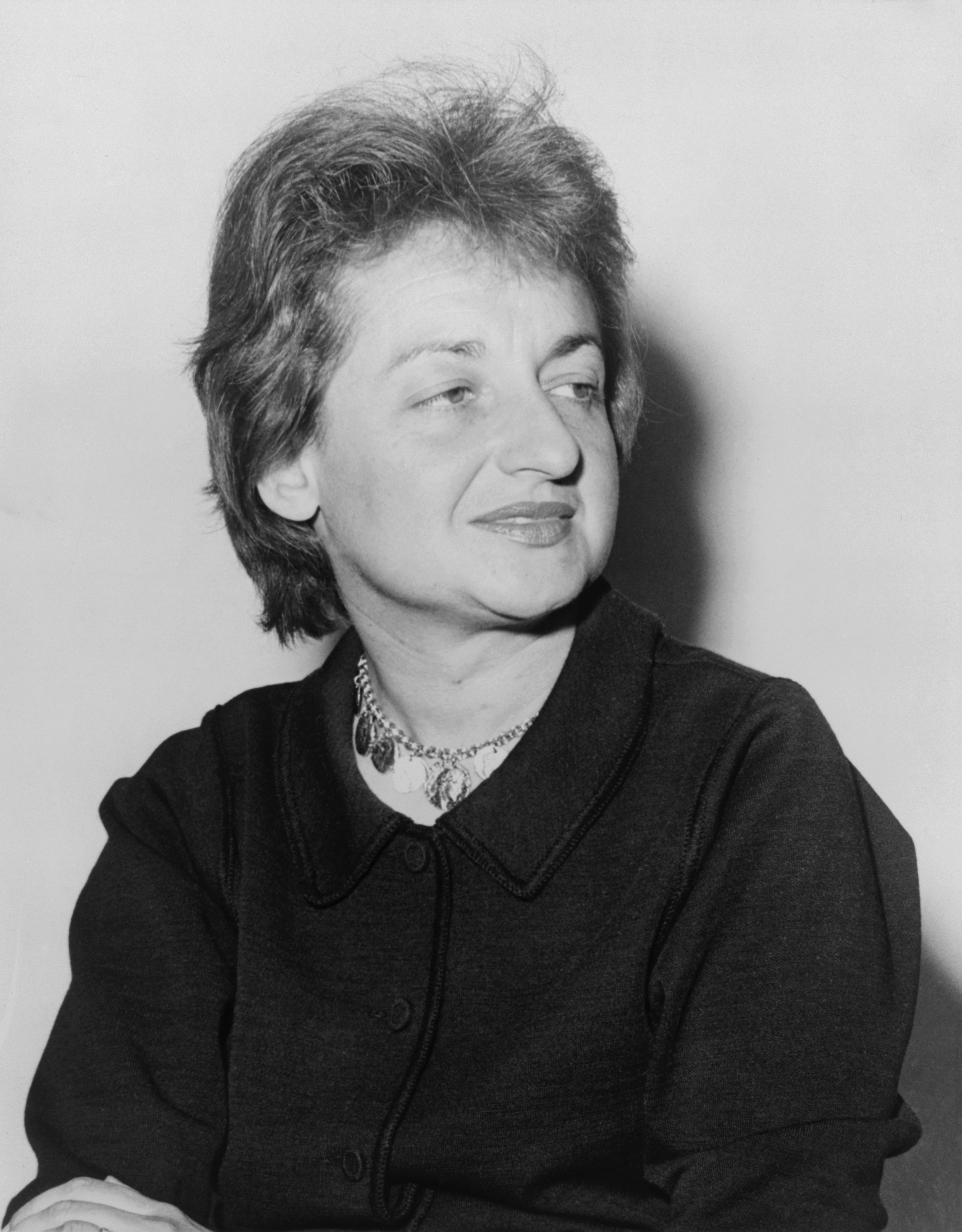
Betty Friedan
American writer and activistWikipedia
108
MENTIONS
62
EPISODES
59
PODCASTS
Search complete. 108 mentions across 62 episodes found for "Betty Friedan".
Oct 27, 2026

Suzette LindemuthGUEST
programs that really enhanced people's lives, and that led me into senior services.
Suzette LindemuthGUEST
And then in about 1987, when I started the company, and then we moved into a different era of delivery of assisted living and long-term care services for elderly, I read a book by Betty Friedan called The Fountain of Age.
Suzette LindemuthGUEST
And she's such a wonderful researcher, and she really talked about community.
Suzette LindemuthGUEST
And at the time, there was a lot of information about community building and how communities were really critical to enhance the quality of life.

BrookeHOST
Oh, ka-chow.
JakeHOST
In 1963, Betty Friedan published a book called The Feminine Mystique, which is a mile marker in feminist history.
JakeHOST
It's way beyond the scope of this episode to do it justice and talk about it.
JakeHOST
But Dobson would say that it argued that women should reject being housewives because it's unsatisfying.
JakeHOST
They should enjoy sex.
JakeHOST
A lot of his saying like people want to be housewives anymore is like very clearly in response to Betty Friedan and The Feminine Mystique.
JakeHOST
No one actually burned bras at any feminist protests that there's documented cases of.
JakeHOST
But there were a series of high-profile feminist protests around this time as well.

Saskia ColletteHOST
And then a new book dropped, one that would become legendary in the annals of feminism.
Patricia IrelandGUEST
Betty Friedan wrote a book, and it was one of those seminal books, The Feminine Mystique.
Patricia IrelandGUEST
It was written from her perspective as an upper middle class white woman.
Patricia IrelandGUEST
She was writing from the perspective of married women who ended up kind of in a dead-end position and didn't know why they were frustrated, didn't understand what it was that, you know, hey, I've got this wonderful life.
14 MINS LATER
Saskia ColletteHOST
Patricia Ireland took office as the president of the National Organization for Women on December 15, 1991.
Saskia ColletteHOST
Over the course of 24 years, she had gone from Pan Am stewardess to the spearhead of the biggest feminist group in the United States.
Saskia ColletteHOST
But she still saw flaws in the approach of certain members of the institution, like its co-founder, Betty Friedan.
Patricia IrelandGUEST
I was no longer a flight attendant.

JohnHOST
Back in the movie, Jack and Marion meet as Jack's on his way to see the president about Margie Captree's death, which the administration is trying to use as emotional leverage to push through Captree's nomination.
JohnHOST
He's chatting with Jack's old editor about it, Angela, played by Jacqueline Brooks as a sort of amalgam of Washington Post publisher Catherine Graham and prominent feminist Betty Friedan, and brings up an FCC license approval she's looking for right after asking her to change her paper stance on the Captree nomination.
JohnHOST
As in the present, the FCC is clearly being used as a cudgel to extract favorable coverage from the news media, even though theoretically this is illegal and unconstitutional.
JohnHOST
But the president frames it as repayment of the favor Angela did him.

Adryana CortezHOST
Just as the Vietnam War escalated in 1964, the American student protest movement was ignited.
Adryana CortezHOST
These Marxist college radicals would link arms with the new feminist movement, led by Betty Friedan.
Betty FriedanSOUNDBITE_SPEAKER
The war between the sexes could become an arm of God if we don't get on with our revolution.
Betty FriedanSOUNDBITE_SPEAKER
But if we do get on with it and we restructure society to make equality really possible, then I think the war between the sexes will end and for the first time we will have possible true human sexual liberation.

Michael OsborneHOST
All right.
Michael OsborneHOST
Uh, I wrote feminist mystique named after Betty Friedan and here's why.
Michael OsborneHOST
Um, That moment you're talking about inside the actor's studio, that's not the only time he talks about the relationship to women in his life.
Michael OsborneHOST
He was close with his mother and he's very close with his grandmother because she was in some ways looking out for him, especially after his dad abandoned him.
Michael OsborneHOST
I thought it was interesting that he's married for most of his life, that there is somebody behind the scenes in both instances who we don't know a ton about.
Michael OsborneHOST
I also thought, and this is why I was quoting the Betty Friedan book, Feminist Mystique.
Michael OsborneHOST
So there's something mysterious there.
Michael OsborneHOST
He also talks about the importance of getting in touch with his feminine side, which I found really interesting for him as an actor because he's not somebody who I see as being in touch with his feminine side.

Eric KahnHOST
And I've heard this from so many Christians.
Eric KahnHOST
No, but like Betty Friedan was right.
Eric KahnHOST
Women were miserable in the 60s.
Eric KahnHOST
Betty Friedan lived in a posh house on the Hudson River, beat her husband and had a servant.
Eric KahnHOST
And guess who paid for all of it?
Brian SauvéHOST
He did.

speaker_19SOUNDBITE_SPEAKER
And that's all hidden under the idea that the reason that men and women make different amounts of money is because of their gender.
speaker_20SOUNDBITE_SPEAKER
In those early days of the women's liberation movement, which started really with Betty Friedan's Feminine Mystique and the mid-1960s, their buzzword was liberation.
speaker_20SOUNDBITE_SPEAKER
And you have to ask yourself, what did they want to be liberated from? And I think the only answer is they wanted to be liberated from home, husband, family and children.
speaker_20SOUNDBITE_SPEAKER
Their fundamental fantasy is that God goofed in making us of two different kinds, two different genders.

Erika AhernHOST
Think Hunger Games, Hillary Clinton, and Believe All Women.
Erika AhernHOST
At this point, we were beyond Betty Friedan's wildest dreams.
Erika AhernHOST
Gender parity was coming for medicine, law, and the entertainment industries.
Erika AhernHOST
The women were strong, and the men were good-looking.

Veronica HoytGUEST
Then you had some other writers in that mix.
Veronica HoytGUEST
You had Betty Friedan.
Veronica HoytGUEST
She wrote, so she published in the early 1960s.
Veronica HoytGUEST
And that was in English and that was American.
Veronica HoytGUEST
And that was at a more popular level.
Veronica HoytGUEST
So she really was influenced by Germaine Greer and her writing in the academic space.
Veronica HoytGUEST
And I think Betty Friedan really popularized Germaine Greer.
Veronica HoytGUEST
And then that book again became a bestseller.
52 more episodes mention Betty Friedan.
Create an account to see the whole feed, search across every transcript, and follow the entities you care about.