Bessarabia
Region in MoldovaWikipedia
34
MENTIONS
18
EPISODES
17
PODCASTS
Search complete. 34 mentions across 18 episodes found for "Bessarabia".
Oct 21, 2026

speaker_3NARRATOR
The Visigoths, whose tribal name was the Thervings, lay more to the south, in what are now the countries of Moldavia, Wallachia, and southern Hungary.
speaker_3NARRATOR
The Ostrogoths, or tribe of the Gruthungs, lay more to the north and east, in Bessarabia, Transylvania, and the Dniester Valley.
speaker_3NARRATOR
But a totally unexpected series of events were now to show how prescient Constantine had been, in rearing his great fortress capital to serve as the central place of arms of the Balkan peninsula.
speaker_3NARRATOR
About the year A.D. 372 the Huns, an enormous Tartar horde from beyond the Don and the Volga, burst into the lands north of the Yuksin and began to work their way westward.

Owen GreyGUEST
It was already a nation state, an independent sovereign state when it entered the First World War.
Owen GreyGUEST
And it was augmented by Transylvania, the Banat and Bukravina from Austria-Hungary, also Bessarabia from Russia, and the southern de Bruxelles it had secured from Bulgaria in the Second Balkan War.
Owen GreyGUEST
What that meant was that Romania was effectively facing three different foes in post-First World War Europe, Hungary, Bulgaria, and Russia.
Owen GreyGUEST
Czechoslovakia was mostly preoccupied with Germany and Austria-Hungary.
Owen GreyGUEST
He put off joining that kind of tripartite arrangement.
Owen GreyGUEST
But ultimately, events in Austria, Hungary and Russia convinced him to sign and take it as the thing that was best on offer by this point in 1921.
Owen GreyGUEST
Or the winter of 2021, the Russians are beating the white Russian forces in the Ukraine and had come up to the border on Bessarabia.
Owen GreyGUEST
In Austria-Hungary, the ex-emperor Charles Habsburg was trying to retake the throne.

Owen GreyGUEST
It was already a nation state, an independent sovereign state when it entered the First World War.
Owen GreyGUEST
And it was augmented by Transylvania, the Banat and Bukravina from Austria-Hungary, also Bessarabia from Russia, and the southern de Bruxelles it had secured from Bulgaria in the Second Balkan War.
Owen GreyGUEST
What that meant was that Romania was effectively facing three different foes in post-First World War Europe, Hungary, Bulgaria, and Russia.
Owen GreyGUEST
Czechoslovakia was mostly preoccupied with Germany and Austria-Hungary.
Owen GreyGUEST
He put off joining that kind of tripartite arrangement.
Owen GreyGUEST
But ultimately, events in Austria, Hungary and Russia convinced him to sign and take it as the thing that was best on offer by this point in 1921.
Owen GreyGUEST
Or the winter of 2021, the Russians are beating the white Russian forces in the Ukraine and had come up to the border on Bessarabia.
Owen GreyGUEST
In Austria-Hungary, the ex-emperor Charles Habsburg was trying to retake the throne.

Jacob GoldsteinHOST
Sam Zemurray was born Schmuel Zemurray, uh, in the Russian Empire in 1877.
Jacob GoldsteinHOST
Was it Russia? Kind of, it was Bessarabia, I believe.
Robert SmithHOST
Hmm.
Jacob GoldsteinHOST
This is a time and place where there are no bananas.

Caesar SearchingerSOUNDBITE_SPEAKER
No wonder, for that Paris treaty of 1856 sealed Russia's most ignominious modern defeat in the Crimean War.
Caesar SearchingerSOUNDBITE_SPEAKER
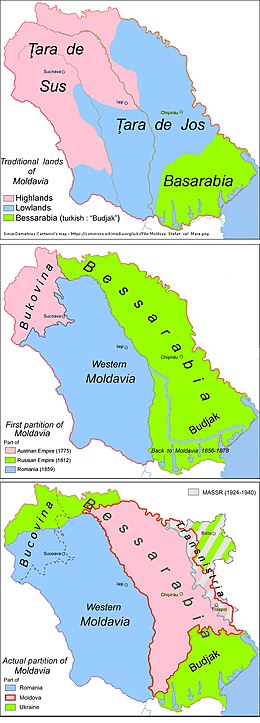
The great powers, France and Britain, at that time made her give up control of the Danube Delta and to cede southern Bessarabia to Turkey.
Caesar SearchingerSOUNDBITE_SPEAKER
What is more, Russia had to pledge herself to keep no fleet in the Black Sea and build no fortifications on its shores.
Caesar SearchingerSOUNDBITE_SPEAKER
As I said, an ignominious defeat.
Caesar SearchingerSOUNDBITE_SPEAKER
Not till after the World War, the First World War, was the Danube really internationalized under a commission possessing diplomatic rights and flying its own flag.
Caesar SearchingerSOUNDBITE_SPEAKER
All the riparian states, plus Britain, France, and Italy, were represented.
Caesar SearchingerSOUNDBITE_SPEAKER
Not so Russia, for Russia had again lost Bessarabia, this time to Romania, and was therefore not a Danubian power.
Caesar SearchingerSOUNDBITE_SPEAKER
Today she is, and all the other Danubian states are either wholly or partly controlled by her.

MaddieHOST
The war was devastating, but when it ended, Romania emerged substantially larger.
MaddieHOST
Transylvania, Basarabia, Bucovina became part of what became known as Greater Romania, Romania Mare.
MaddieHOST
The U.S. State Department's historical overview describes Romania after World War I as receiving substantial territories populated by Romanians, including Transylvania, Basarabia, and Bucovina.
StephenHOST
So, Romania came out of World War I larger, but certainly not problem-free.
MaddieHOST
Oh, exactly.
MaddieHOST
Then things became even worse.
MaddieHOST
In 1940, General Ion Antonescu became the country's dominant ruler.
MaddieHOST
Romania eventually entered World War II alongside Nazi Germany in 1949, in part seeking the recover Basarabia in northern Bucovina, which the Soviet Union had annexed in 1940.

InkelNARRATOR
Nevertheless, the whole government of Yekaterinoslav, as well as the government of Kherson, belong to the coherent Ukrainian national territory.
InkelNARRATOR
G, in Bessarabia, the Ukrainian territory is bounded by the Romanian territory.
InkelNARRATOR
Here the frontier line is very irregular and runs towards northwest as far as the frontier of the Austrian Empire.
InkelNARRATOR
Many Romanian enclaves are situated on the coherent Ukrainian territory, while on the other hand, many Ukrainian enclaves, over 145,000 Ukrainians, are to be found on the Romanian national territory.
InkelNARRATOR
For the coherent Ukrainian territory, only two districts of Bessarabia come into question: the district of Akkerman, with a relative Ukrainian majority, about 27% Ukrainians, 10% Russians, 5% Jews, 16% Germans, over 16% Romanians, 21% Bulgarians, 4% Turks.
InkelNARRATOR
And the district of Khotyn, with an absolute Ukrainian majority, over fifty-three percent Ukrainians, over six percent Russians, about sixteen percent Jews, about twenty-four percent Romanians.
InkelNARRATOR
The frontier line runs over Izmail, over the mouth of the Dniester, then up the Dniester as far as the Dubossary, to reach the watershed between the Pruth and the Dniester, and to leave Bessarabia at Novosieltsi.
InkelNARRATOR
This is the Ukrainian national territory within the former Russian Empire.

speaker_2HOST
The melody has its own travel itinerary, and it needed no passport.
speaker_2HOST
In the 1880s, Shmuel Cohen, a Jewish immigrant from Bessarabia living in Rishon Lezion, fitted Imber's words to a tune he remembered from a Moldavian or Romanian folk song.
speaker_2HOST
That tune belongs to a musical family heard across Europe.
speaker_2HOST
Its famous classical cousin appears in Bejishk Smetana's symphonic poem Voltava, commonly called the Moldau from Mavlast.

Kerry AdamsNARRATOR
Two, the Ukraine of the left bank of the Dnieper, Chernihiv, Poltava, Kharkov, southwest Kursk, and Voronezh, and the region of the Don Cossacks to the Sea of Azov.
Kerry AdamsNARRATOR
Three, on both sides of the Dnieper lies the steppe Ukraine, comprising Katernoslav, Kherson, and the eastern parts of Bessarabia and Taras.
Kerry AdamsNARRATOR
Four, North Caucasus, adjacent to the region of the Don Cossacks, comprising Kuban and the eastern parts of the Stavropolskoye and Tersk governments.
Kerry AdamsNARRATOR
In all these districts, Ukrainians form from 76 to 99% of the total population, the rest being Jews, Poles, and lastly, Russians.
8 more episodes mention Bessarabia.
Create an account to see the whole feed, search across every transcript, and follow the entities you care about.