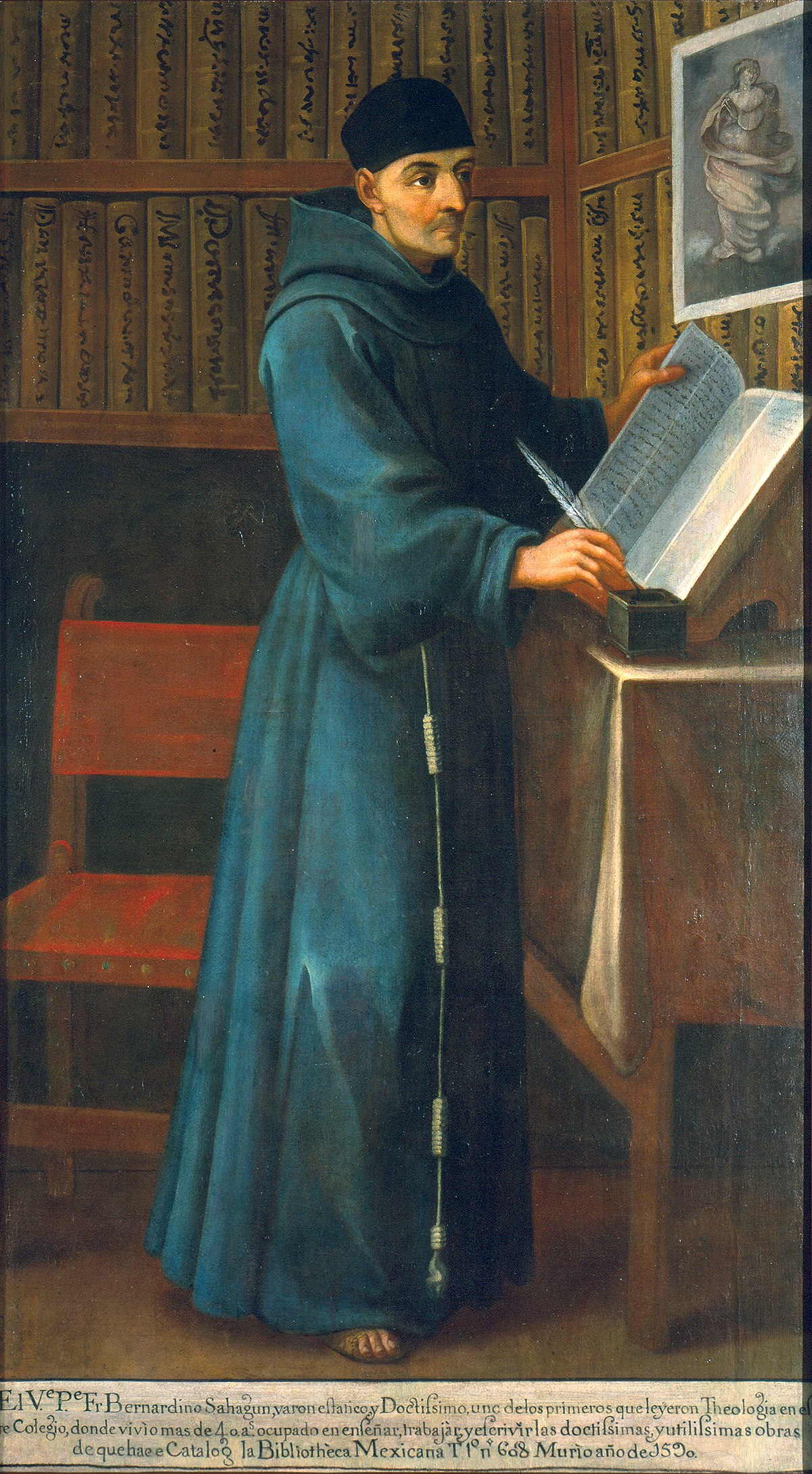
Bernardino de Sahagún
MissionaryWikipedia
7
MENTIONS
6
EPISODES
6
PODCASTS
Search complete. 7 mentions across 6 episodes found for "Bernardino de Sahagún".
Oct 8, 2026

speaker_1HOST
They were understood as a public, cosmic forewarning of impending war, destruction, and social disaster.
TolbertoHOST
This direct connection between the wailing woman and catastrophic civilizational collapse was formally codified in Book Twelve of the Florentine Codex, Historia General de las Cosas de Nueva España, compiled between fifteen forty-five and fifteen ninety by Franciscan friar Bernardino de Sahagún, alongside bilingual Nahua scholars from Tlatelolco.
TolbertoHOST
The Codex records eight major omens that reportedly appeared in the decade preceding the arrival of the Spanish, signaling the destruction of the Mexica world.
TolbertoHOST
The sixth omen explicitly describes a spectral woman whose voice echoed through the waterways and plazas of Tenochtitlan at night.

Andrew M. HenryHOST
But in this video I'll be focusing primarily on the Mexica when they ruled the Valley of Mexico roughly between 1300 to 1521 when it fell to Spanish invaders.
Andrew M. HenryHOST
Much of what we know about Aztec religion comes from 16th century Spanish sources, like those composed by Bernardino de Sahagún, a Franciscan friar and missionary who wrote huge studies on Aztec culture while living in Mexico.
Andrew M. HenryHOST
His work, the Florentine Codex, is an important ethnographic study based on reports from native informants and includes a bunch of illustrations made by indigenous artists.
Andrew M. HenryHOST
If you've done even a brief study into the Aztecs, you've almost certainly seen some of the images from the Florentine Codex.
Andrew M. HenryHOST
So, to be accurate, most of this video focuses on large scale, state religion of the Mexica, or what the scholar of Mesoamerican religion, David Carrasco, calls the mystical military religion of the Aztec warrior class.
Andrew M. HenryHOST
This includes the sacrifices conducted by elite priests at their temples and the mythology recorded by their educated nobility.
Andrew M. HenryHOST
So, keep in mind while watching this video that we are examining a relatively narrow slice of time, a relatively narrow slice of Aztec society, filtered through the lens of Catholic writers like Bernardino de Sahagún.
Andrew M. HenryHOST
And with all of those caveats, let's get into it.

NickHOST
Our richest source, the Florentine Codex, is a perfect example.
NickHOST
Created during the 16th century under Franciscan Bernardino de Sahagún, it involved extensive collaboration with Nahua elders, intellectuals, scribes, and painters, and its 12 books preserve extraordinary information about gods, ceremonies, calendrical divination, omens, rhetoric, rulers, merchants, medicine, plants, animals, and the conquest itself.
NickHOST
Yet Sahagún was also a Christian missionary who wanted to understand indigenous religion partly so Christianity could replace it.
NickHOST
The resulting work therefore preserves enormous amounts of Nahua knowledge under simultaneously filtering that knowledge through a colonial Christian project.

Kae SprungHOST
People used them to carry other foods, fish, insects, beans, squash, or chili sauces.
Kae SprungHOST
Now, Bernardino de Sahagún was a 16th century Spanish friar and ethnographer.
Kae SprungHOST
He documented that indigenous peoples of Tenochtitlan ate zacali, AKA tortillas, with almost everything.
Kae SprungHOST
So while nobody in 500 BCE was calling them tacos, the practice of wrapping food in tortillas is thousands of years old.

speaker_9NARRATOR
The document carrying that account deserves a place in the telling.
speaker_9NARRATOR
Bernardino de Sahagún's Florentine Codex was assembled after the Spanish conquest, with the work of indigenous informants, writers and artists.
speaker_9NARRATOR
Its twelve books contain far more than a collection of entertaining divine adventures.
speaker_9NARRATOR
Their pages preserve descriptions of ceremonies, occupations, plants, animals, illness, speech, and the conquest itself.

LaurieHOST
The only reason we have any remaining records of the pre-Spanish conquest is because some of the other Spanish monks had other ideas.
LaurieHOST
A fellow Franciscan friar named Bernardino de Sahagún had the novel idea that your missionary efforts might work better if you bothered to learn something about the people you were trying to convert.
LaurieHOST
And to that end, he recruited many elders and students to write down and illustrate the Florentine Codex, which is 2,500 pages of information on the Nahuatl language, culture, religion, and history.
LaurieHOST
Sahagún, bless him, had it written in both Spanish and Nahuatl.