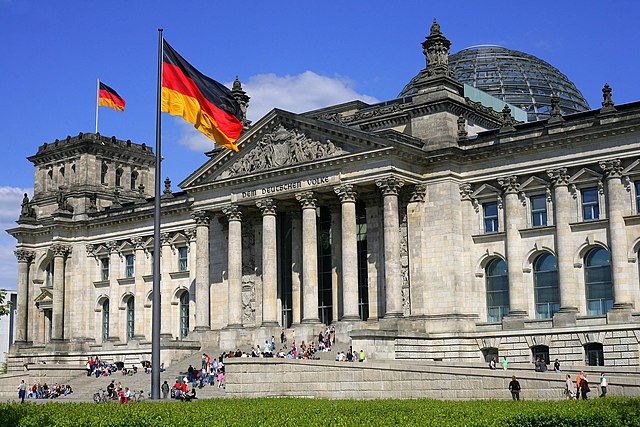
Berlin
Capital of GermanyWikipedia
10k
MENTIONS
2.3k
EPISODES
1.7k
PODCASTS
Search complete. 10271 mentions across 2297 episodes found for "Berlin".
Oct 26, 2026

Moshe MaimonGUEST
And also, similarly, he was a big Askin.
Moshe MaimonGUEST
He was living in Germany, I think in Berlin, or Hamburg, sorry, in Hamburg.
Moshe MaimonGUEST
And he was very, very Isaac in Germany, where Agudde came from.
Moshe MaimonGUEST
He was very Isaac in Agudde.

Ryan GirduskyHOST
We have seen sometimes when European politics and what happens in Europe impacts America, specifically 2015, what happened there was as impactful as what happened on our own border, because there were images of migrants flooding into Europe by the boatloads of millions of Muslims and Africans flooding into Europe illegally, crossing over bridges and crossing over, over, over, over, over walls and construction to stop them.
Ryan GirduskyHOST
You had the mass rapes of German girls in Berlin on New Year's Eve that one year.
Ryan GirduskyHOST
And then you had the mass terrorist attacks that were all over Belgium and Paris and I'll never forget it.
Ryan GirduskyHOST
There was an episode of The View where Sunny Hostin, who is like the most racist person on television today.

AlistairHOST
they would
WillHOST
never do Berlin or Munich.
WillHOST
It has to be something very German sounding.
AlistairHOST
It's got to be something you can really get your teeth and lips around.

Itzchak MaghenGUEST
i think i think two things one i don't think you have to fake that you're successful you know having caring about your self-image and presenting yourself properly just it's a service to yourself Right.
Itzchak MaghenGUEST
Doesn't mean you have to go buy a fake Rolex and, you know, walk around in Berlin with the Ritz, you know, with a fake, you know, glass of whatever, you know, aged whiskey.
Itzchak MaghenGUEST
Right.
Itzchak MaghenGUEST
You don't have to do that.
Itzchak MaghenGUEST
you know, to, to the point of being social and communicative is, is important.
Itzchak MaghenGUEST
You know, I, I tell people I'm an introvert and people laugh at me because I'm traveling and taking meetings back to back at the markets and putting myself out there.
Itzchak MaghenGUEST
And I've always been a lot more of a quiet person and just to myself, you know, I'd rather go camping in Sequoia than be at a club at four in the morning in Berlin, you know, both are great in their own ways.
Itzchak MaghenGUEST
Right.

Derek DeStephenGUEST
But by 1961, us air force in Europe was at absolute center at the absolute center of cold war tension.
Derek DeStephenGUEST
The Berlin crisis erupted in 61.
Derek DeStephenGUEST
Then the wall, when the wall went up and that, that posting and Germany in that precise moment was at the sharpest edge of the cold war confrontation.
Derek DeStephenGUEST
This makes the air force commendation medal during and after this tour, nearly certain, um, During that time so it's also putting in when these medals would have been awarded based on his tour and when he was there so so there's the probability you know of that happening and then.

AymanUNKNOWN
I'm from Pakistan, and I've been living here for a few years for my master's program.
AymanUNKNOWN
I just graduated from the Hertie School of Governance here in Berlin.
AymanUNKNOWN
I wanted to ask you a question, Dr. Sanyanish there.
AymanUNKNOWN
Given your time as a minister in Pakistan, and now at a global health leadership position.
7 MINS LATER
Ricardo Baptista LeiteHOST
Okay.
Ricardo Baptista LeiteHOST
All right.
Ricardo Baptista LeiteHOST
So, the question came from Honorable Akua Dansua, who is not only a former member of parliament, former ambassador of Ghana here in Berlin, and an esteemed member of the Unite Parliamentarians Network, and her question is very important.
Ricardo Baptista LeiteHOST
Because we need parliaments to be active for many reasons.

Pete QuiñonesHOST
In the last third of the 19th century, indeed, wholesale baptisms constantly occurred.
Pete QuiñonesHOST
but we have reliable figures for the last two or three decades only, and I am therefore inclined to doubt the statement of Jacob Frommer that towards the end of the 20s and last century, something like half the Jews of Berlin had gone over to Christianity.
Pete QuiñonesHOST
Equally improbable is the view of Dr. Vermeer, rabbi in Munich, who, in a paper which he recently read, stated that altogether 120,000 Jews had been baptized in Berlin.
Pete QuiñonesHOST
The most reliable figures we have are all against such a likelihood.
Pete QuiñonesHOST
According to these, it was in the 90s that apostasy on a large scale first showed itself, and even then the highest annual percentage never exceeded 1.28 in 1905, while the average percentage per annum since 1895 was 1.
Pete QuiñonesHOST
Nevertheless, the number of Jews in Berlin who from 1873 to 1906 went over to Christianity was not small.
Pete QuiñonesHOST
Their total was 1,869, precisely.
Pete QuiñonesHOST
The tendency to apostasy is stronger among Austrian Jews, especially among those in Vienna.

Morgan SchulzHOST
Although not Hamburg.
Morgan SchulzHOST
That's more like Berlin.
Morgan SchulzHOST
I heard Hamburg's
Katherine FahsbenderHOST
just like mid.

speaker_0NARRATOR
Hello and welcome to the American Council on Germany's weekly Kaffeepause.
speaker_0NARRATOR
This is a podcast for anyone who wants to know what's abuzz in Berlin.
speaker_0NARRATOR
Each week, Steve Sokol, the president and CEO of the ACG, speaks with a journalist based in Germany to talk about the issues shaping German politics, business, and the transatlantic relationship.
Steve SokolHOST
Hello, my name is Steve Sokol and I'm the President of the American Council on Germany and I'd like to thank you for joining us for today's Café Pause.
Steve SokolHOST
Today we're trying something a little bit different.
Steve SokolHOST
The Café Pause is generally an opportunity to check in with a German or an American journalist based in Berlin to talk about the political mood and the current developments in Germany.
Steve SokolHOST
But some of our Kaffeepause fans in Germany have said that they would also be interested in a format that unpacks U.S. politics.
Steve SokolHOST
And that's what we will try to do today.

Pete QuiñonesHOST
In the last third of the 19th century, indeed, wholesale baptisms constantly occurred.
Pete QuiñonesHOST
but we have reliable figures for the last two or three decades only, and I am therefore inclined to doubt the statement of Jacob Frommer that towards the end of the 20s and last century, something like half the Jews of Berlin had gone over to Christianity.
Pete QuiñonesHOST
Equally improbable is the view of Dr. Vermeer, rabbi in Munich, who, in a paper which he recently read, stated that altogether 120,000 Jews had been baptized in Berlin.
Pete QuiñonesHOST
The most reliable figures we have are all against such a likelihood.
Pete QuiñonesHOST
According to these, it was in the 90s that apostasy on a large scale first showed itself, and even then the highest annual percentage never exceeded 1.28 in 1905, while the average percentage per annum since 1895 was 1.
Pete QuiñonesHOST
Nevertheless, the number of Jews in Berlin who, from 1873 to 1906, went over to Christianity was not small.
Pete QuiñonesHOST
Their total was 1,869, precisely.
Pete QuiñonesHOST
The tendency to apostasy is stronger among Austrian Jews, especially among those in Vienna.
2,287 more episodes mention Berlin.
Create an account to see the whole feed, search across every transcript, and follow the entities you care about.