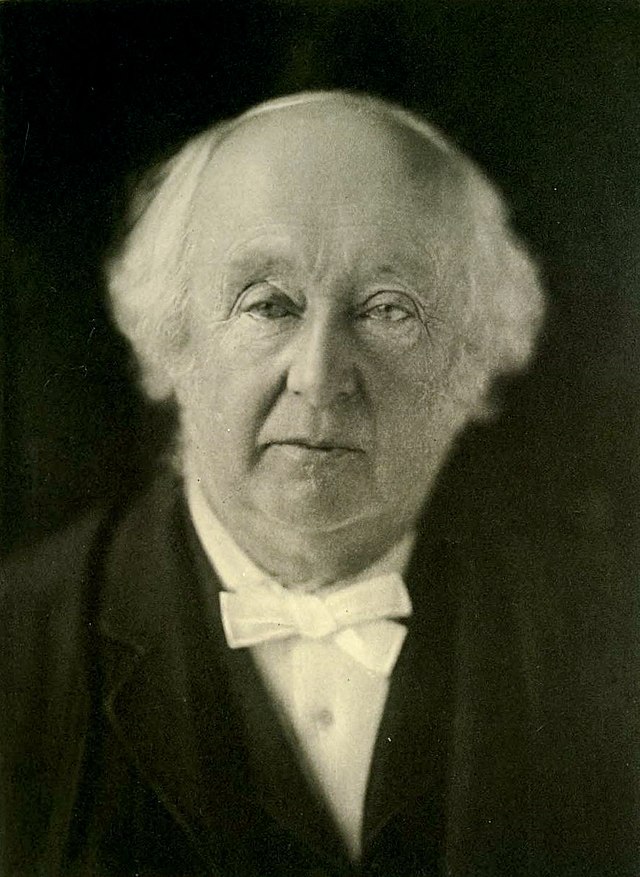
Benjamin Jowett
WriterWikipedia
197
MENTIONS
27
EPISODES
13
PODCASTS
Search complete. 197 mentions across 27 episodes found for "Benjamin Jowett".
Oct 27, 2026

Chad KimHOST
And you quoted in Taught by God, Maybe I've heard this quote, maybe I hadn't.
Chad KimHOST
I feel like I'd heard the name Benjamin Jowett.
Chad KimHOST
So there's this quote, Scripture has one meaning, the meaning which it had in the mind of the prophet or evangelist who first uttered or wrote.
Chad KimHOST
The true use of interpretation is to get rid of interpretation.
33 MINS LATER
Brandon D. SmithGUEST
They are not trying to move forward to something else.
Brandon D. SmithGUEST
They're trying to retrieve what was lost.
Brandon D. SmithGUEST
Um, and so I think, you know, obviously this is, we shouldn't do this in the historical world, but if you could go back and ask Luther, I would assume that Luther would much more, would find much more agreement with Augustine than he would Benjamin Jowett.
Brandon D. SmithGUEST
Right.

speaker_3ADVERTISER
Go to Wayfair.com today.
Geoffrey EdwardsNARRATOR
Aion by Plato Translated by Benjamin Jowett Introduction This is a LibriVox recording.
Geoffrey EdwardsNARRATOR
All LibriVox recordings are in the public domain.
Geoffrey EdwardsNARRATOR
For more information, or to find out how you can volunteer, please visit LibriVox.org.
12 MINS LATER
Geoffrey EdwardsNARRATOR
His allusion to his embellishments of Homer, in which he declares himself to have surpassed Metrodorus of Lamsacus and Stesimbrotus of Thassos, seems to show that, like them, he belonged to the allegorical school of interpreters.
Geoffrey EdwardsNARRATOR
The circumstance that nothing more is known of him may be adduced in confirmation that of the argument that this truly platonic little work is not a forgery of later times.
Geoffrey EdwardsNARRATOR
End of introduction Ion by Plato Translated by Benjamin Jowett PERSONS OF THE DIALOGUE SOCRATES ION Socrates Welcome, Ion.
Geoffrey EdwardsNARRATOR
Are you from your native city of Ephesus? Ion.

Geoffrey EdwardsNARRATOR
and no wonder for their art is a part of the great art of enchantment and hardly if at all inferior to it and whereas the art of the enchanter is a mode of charming snakes and spiders and scorpions and other monsters and pests this art acts upon dicasts and ecclesiasts and bodies of men for the charming and consoling of them do you agree with me yes he said i think that you are quite right whither then shall we go i said and to what art shall we have recourse i do not see my way he said but i think that i do i replied and what is your notion asked cleinias i think that the art of the general is the one the possession of which is most likely to make a man happy i do not think that he said why not i said the art of the general is surely an art of hunting mankind what of that i said why he said no art of hunting extends beyond hunting and capturing and when the prey is taken they cannot use it but the huntsman or fisherman hands it over to the cook and the geometricians and astronomers and calculators who all belong to the hunting class for they do not make their diagrams but only find out that which was previously contained in them they i say not being able to use but only to catch their prey hand over their inventions to the dialecticians to be applied by them if they have any sense in them good i said fairest and wisest cleinias and is this true certainly he said just as a general when he takes a city or a camp hands over his new acquisition to the statesman for he does not know how to use them himself or as the quail-taker transfers the quails to the keeper of them if we are looking for that art which is to make us blessed and which is able to use that which it makes or takes the art of the general is not the one and some other must be found crito and do you mean to say socrates that the youngster said that soc are you incredulous crito crito indeed i am for if he said that i am of opinion that he needs neither euthydemus nor any one else to be his instructor soc perhaps i may have forgotten and ctesippus was the real answerer crito ctesippus nonsense soc all i know is that i heard these words and that they were not spoken either by euthydemus or dionysodorus i dare say my good crito that they may have been spoken by some superior person that i heard them i am certain crito yes indeed socrates by some one a good deal superior as i should be disposed to think But did you carry the search any further, and did you find the art which you were seeking? Part 2 of Eusedamos by Plato.
Geoffrey EdwardsNARRATOR
Translated by Benjamin Jowett.
Geoffrey EdwardsNARRATOR
This LibriVox recording is in the public domain.
Geoffrey EdwardsNARRATOR
Recording by Jeffrey Edwards.

speaker_0NARRATOR
271.
speaker_0NARRATOR
Ionian, by Plato and translated by Benjamin Jowett is part of Hacker Noon's book blog post-series.
speaker_0NARRATOR
272.
speaker_0NARRATOR
Does God Exist? An Essay Concerning Humane Understanding, Volume 2, Book 4, Chapter 10, by John Locke is part of Hackernoon's book blog post-series.
29 MINS LATER
speaker_0NARRATOR
Literature Every great people has a character of its own, which it manifests and perpetuates in a variety of ways.
speaker_0NARRATOR
420.
speaker_0NARRATOR
Ion by Benjamin Jowett, Table O.F. Lincoln by Plato as part of Hacker Noon's book blog post series.
speaker_0NARRATOR
421.
Geoffrey EdwardsNARRATOR
For more information, or to volunteer, please visit LibriVox.org. Recording by Geoffrey Edwards.
Geoffrey EdwardsNARRATOR
Sophist by Plato, translated by Benjamin Jowett.
Geoffrey EdwardsNARRATOR
Persons of the dialogue, Theodorus, Thaetetus, Socrates, an Eleatic stranger whom Theodorus and Thaetetus bring with them, the younger Socrates, who is a silent auditor.
Geoffrey EdwardsNARRATOR
Theodorus, Here we are, Socrates, true to our agreement of yesterday, and we bring with us a stranger from Elea, who is a disciple of Parmenides and Zeno, and a true philosopher.
50 MINS LATER
Geoffrey EdwardsNARRATOR
End of Part One of Sophist.
Geoffrey EdwardsNARRATOR
Recording in memory of Mitchell Edwards.
Geoffrey EdwardsNARRATOR
Part Two of Sophist by Plato, translated by Benjamin Jowett.
Geoffrey EdwardsNARRATOR
This LibriVox recording is in the public domain.

Jeffrey EdwardsNARRATOR
For you do not believe a word of what has been said.
Jeffrey EdwardsNARRATOR
but come now give me an answer to this question are not certain things useful to the builder when he is building a house crit they are soc and would you say that those things are useful which are employed in house-building stones and bricks and beams and the like and also the instruments with which the builder built the house the beams and stones which they provided and again the instruments by which these were obtained crit it seems to me that they are all useful for building soc and is it not true of every art that not only the materials but the instruments by which we procure them and without which the work could not go on are useful for that art crit certainly soc and further the instruments by which the instruments are procured and so on going back from stage to stage ad infinitum are not all these in your opinion necessary in order to carry out the work crit we may fairly suppose such to be the case soc and if a man has food and drink and clothes and the other things which are useful to the body would he need gold or silver or any other means by which he could procure that which he now has crit i do not think so soc then you consider that a man never wants any of these things for the use of the body crit certainly not soc and if they appear useless to this end are they not always to appear useless for we have already laid down the principle that things cannot be at one time useful and at another time not in the same process crit but in that respect your argument and mine are the same for you maintain if they are useful to a certain end they can never become useless whereas i say that in order to accomplish some results bad things are needed and good for others soc but can a bad thing be used to carry out a good purpose crit i should say not soc and we call those actions good which a man does for the sake of virtue crit yes soc but can a man learn any kind of knowledge which is imparted by word of mouth if he is wholly deprived of the sense of hearing crit certainly not i think soc and will not hearing be useful for virtue if virtue is taught by hearing and we use the sense of hearing in giving instruction crit yes soc and since medicine frees the sick man from his disease that art too may sometimes appear useful in the acquisition of virtue e g when hearing is procured by the aid of medicine crit very likely soc but if again we obtain by wealth the aid of medicine shall we not regard wealth as useful for virtue crit true soc and also the instruments by which wealth is procured crit certainly soc then you think that a man may gain wealth by bad and disgraceful means and having obtained the aid of medicine which enables him to acquire the power of hearing may use that very faculty for the acquisition of virtue crit yes i do soc but can that which is evil be useful for virtue crit no soc it is not therefore necessary that the means by which we obtain what is useful for a certain object should always be useful for the same object for it seems that bad actions may sometimes serve good purposes the matter will be still plainer if we look at it in this way if things are useful towards the several ends for which they exist which ends would not come into existence without them how would you regard them can ignorance for instance be useful for knowledge or disease for health or vice for virtue crit never soc and yet we have already agreed have we not that there can be no knowledge where there has not previously been ignorance nor health where there has not been disease nor virtue where there has not been vice crit i think that we have soc but then it would seem that the antecedents without which a thing cannot exist are not necessarily useful to it otherwise ignorance would appear useful for knowledge disease for health and vice for virtue critias still showed great reluctance to accept any argument which went to prove that all these things were useless i saw that it was as difficult to persuade him as according to the proverb it is to boil a stone so i said let us bid good-bye to the discussion since we cannot agree whether these things are useful and a part of wealth or not but what shall we say to another question which is the happier and better man he who requires the greatest quantity of necessaries for body and diet or he who requires only the fewest and least the answer will perhaps become more obvious if we suppose some one comparing the man himself at different times to consider whether his condition is better when he is sick or when he is well crit that is not a question which needs much consideration soc probably i said every one can understand that health is a better condition than disease but when have we the greatest and the most various needs when we are sick or when we are well crit when we are sick soc and when we are in the worst state we have the greatest and most especial need and desire of bodily pleasures crit true soc and seeing that a man is best off when he is least in need of such things does not the same reasoning apply to the case of any two persons of whom one has many and great wants and desires and the other few and moderate for instance some men are gamblers some drunkards and some gluttons and gambling and the love of drink and greediness are all desires crit certainly soc but desires are only the lack of something and those who have the greatest desires are in a worse condition than those who have none or very slight ones certainly i consider that those who have such wants are bad and that the greater their wants the worse they are soc and do we think it possible that a thing should be useful for a purpose unless we have need of it for that purpose crit no soc then if these things are useful for supplying the needs of the body we must want them for that purpose crit that is my opinion soc and he to whom the greatest number of things are useful for his purpose will also want the greatest number of means of accomplishing it supposing that we necessarily feel the want of all useful things crit it seems so soc the argument proves then that he who has great riches has likewise need of many things for the supply of the wants of the body for wealth appears useful towards that end and the richest must be in the worst condition since they seem to be most in want of such things and ever by plato Translated by Benjamin Jowett.
Jeffrey EdwardsNARRATOR
Read by Jeffrey Edwards.
Jeffrey EdwardsNARRATOR
Metacoordinated by Anne Boulay.
speaker_0ADVERTISER
BetMGM operates pursuant to an operating agreement with iGaming Ontario.
speaker_1NARRATOR
Part one of the introduction to Plato's Republic, translated by Benjamin Jowett.
speaker_1NARRATOR
The Republic of Plato is the longest of his works with the exception of the laws, and is certainly the greatest of them.
speaker_1NARRATOR
There are nearer approaches to modern metaphysics in the Philibus and in the Sophist.
18 MINS LATER
speaker_1NARRATOR
To Plato himself, the inquiry, what was the intention of the writer, or what was the principal argument of the Republic, would have been hardly intelligible, and therefore had better be at once dismissed.
speaker_1NARRATOR
End of introduction, part one.
speaker_1NARRATOR
Part two of the introduction to Plato's Republic, translated by Benjamin Jowett.
speaker_1NARRATOR
Is not the Republic the vehicle of three or four truths which, to Plato's own mind, are most naturally represented in the form of the state? Just as in the Jewish prophets, the reign of Messiah, or the day of the Lord, or the suffering servant, or people of God, or the son of righteousness with healing in his wings, only convey, to us at least, their great spiritual ideals.
speaker_4NARRATOR
For more information or to volunteer, please visit LibriVox.org.
speaker_4NARRATOR
Politics by Aristotle, translated by Benjamin Jowett.
speaker_4NARRATOR
Book One, Section One through Five.
speaker_4NARRATOR
Book One, Section One.
17 MINS LATER
speaker_4NARRATOR
End of Chapter 1, Section 1 through 5 Book 1, Section 6 through 9 of Politics by Aristotle This is a LibriVox recording.
speaker_4NARRATOR
All LibriVox recordings are in the public domain.
speaker_4NARRATOR
For more information, or to volunteer, please visit LibriVox.org Politics by Aristotle Translated by Benjamin Jowett Book 1, Section 6 through 9 Section 6 But that those who take the opposite view have, in a certain way, right on their side may be easily seen.
speaker_4NARRATOR
For the words slavery and slave are used in two senses.
Chiquito CrastoNARRATOR
Meno by Plato.
Chiquito CrastoNARRATOR
Translated by Benjamin Jowett.
Chiquito CrastoNARRATOR
Introduction This dialogue begins abruptly with a question of Meno, who asks whether virtue can be taught.
Chiquito CrastoNARRATOR
Socrates replies that he does not as yet know what virtue is, and has never known anyone who did.
29 MINS LATER
Chiquito CrastoNARRATOR
End of introduction.
Chiquito CrastoNARRATOR
Read for you by Chiquito Crasto, Birmingham, Alabama.
Chiquito CrastoNARRATOR
read for you by chiquito crosto mino by plato translated by benjamin jowett section two on the ideas of plato plato's doctrine of ideas has attained an imaginary clearness and definiteness which is not to be found in his own writings The popular account of them is partly derived from one or two passages in his dialogues, interpreted without regard to their poetical environment.
Chiquito CrastoNARRATOR
It is due also to the misunderstanding of him by the Aristotelian school, and the erroneous notion has been further narrowed and has become fixed by the realism of the schoolmen.

Geoffrey EdwardsNARRATOR
Cratylus by Plato.
Geoffrey EdwardsNARRATOR
Translated by Benjamin Jowett.
Geoffrey EdwardsNARRATOR
Part one.
Geoffrey EdwardsNARRATOR
Persons of the dialogue: Socrates, Hermogenes, Cratylus.
39 MINS LATER
Geoffrey EdwardsNARRATOR
Recording in memory of Mitchell Edwards.
Geoffrey EdwardsNARRATOR
Part 2 of Cratylus by Plato.
Geoffrey EdwardsNARRATOR
Translated by Benjamin Jowett.
Geoffrey EdwardsNARRATOR
This LibriVox recording is in the public domain.
17 more episodes mention Benjamin Jowett.
Create an account to see the whole feed, search across every transcript, and follow the entities you care about.