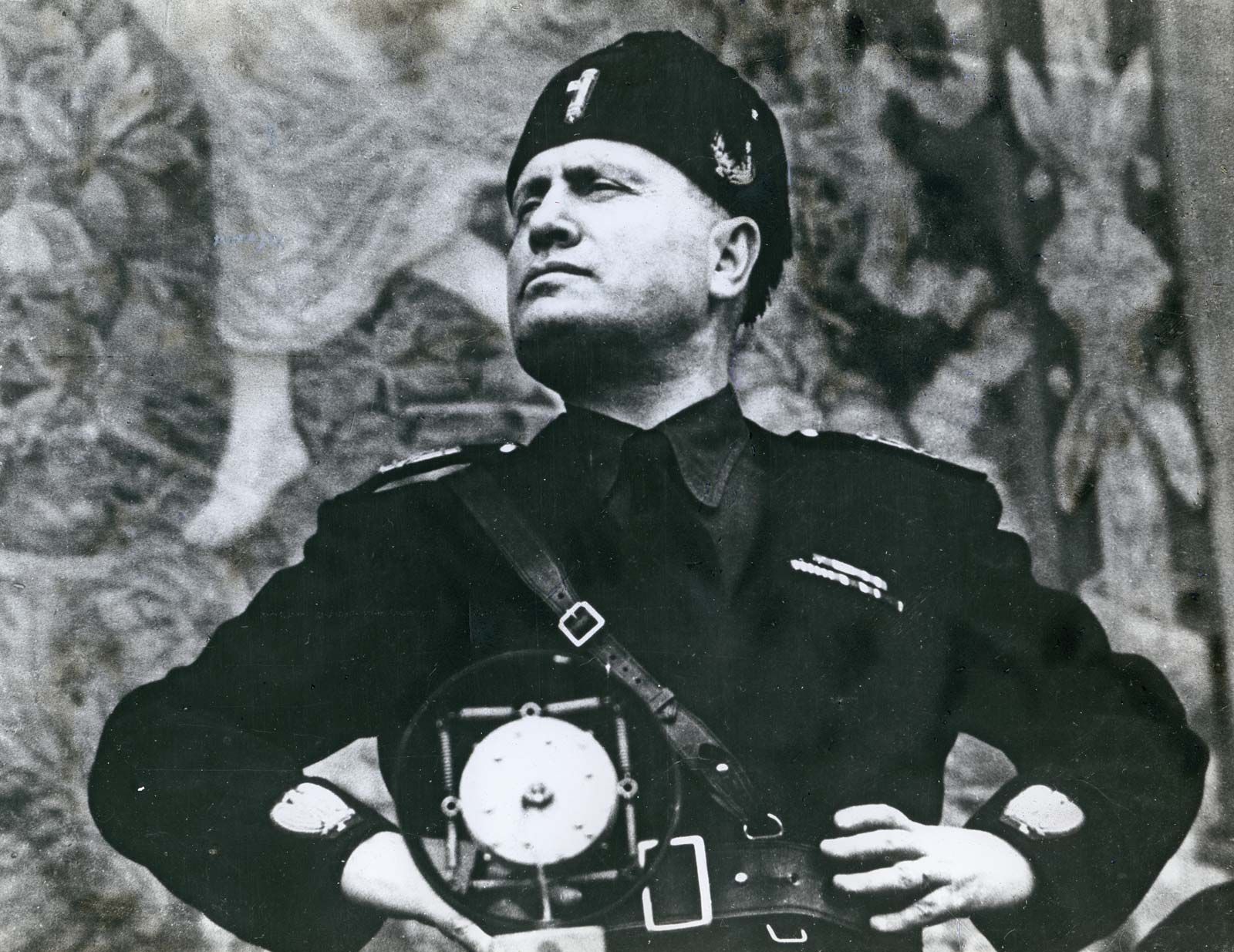
Benito Mussolini

Benito Mussolini

Journalist and former DuceWikipedia

Search complete. 1423 mentions across 665 episodes found for "Benito Mussolini".

Sep 11, 2026

Jennifer WelchHOST
15:36
Well, why are they thinking about this? Because deep down they know, "I'm exploiting people.
Jennifer WelchHOST
15:42
I am doing something really, really immoral, and I need a place where I can go hide from everybody when they figure it out." And so people that do this, throughout the history, and I think in Ruth's book, Strongmen, she talks about how they all get fixated on these safe spaces, whether it's Gaddafi, Mussolini, or Hitler.
Jennifer WelchHOST
16:01
And now these oligarchs, because we have a form of government that values rich people over public safety, they are now thinking, "Oh, I need to have a safe space too." So it's just, it's really daunting, but I will, I need to give credit where credit is due.
Jennifer WelchHOST
16:17
Bernie Sanders is out there always beating the drum.
Paulina BorsookGUEST
32:29
[laughs]
Ted SchilowitzHOST
32:29
How much of this is Ayn Rand? How much of this is like, um, some kind of Mussolini thing, and how much of it is like kind of this innate primal desire to be like a dictator or a king? Like, what's your view? What's driving the-
Paulina BorsookGUEST
32:42
I, I think, I think it's more, um, techno-fascism as a term didn't exist then.
Paulina BorsookGUEST
32:48
What I saw more was the, um, cypherpunk crypto anarchist kind of thing.
Brad OlsenGUEST
20:49
They did not find any of that after the war.
Brad OlsenGUEST
20:52
So if you got the money, you can start funding corporations, starting new ones, buying these huge tracts of land for your micro-nations, and even bringing down their high-tech UFO, uh, backward-engineered technology that, uh, Hermann Oberith, who was a paperclip Nazi in America, when asked, "How did Germany become so advanced so quickly?" He said, "Well, we had help from our friends from above." Pretty much indicating that they were not only using the crashed discs that they got from the Black Forest area of Germany in the 1933, but also an intact UFO that went down, uh, in the Lombardy region of Italy in the late 1930s that Mussolini turned over to the German engineers.
Tyler KiwalaHOST
21:46
Right.
Brad OlsenGUEST
21:46
So they were able to use these craft to very rapidly advance, and that is what, uh, most researchers now would agree were the craft that, um-
Thomas777GUEST
106:47
But I'm talking, when I say figurehead, I mean in terms of outward appearances.
Thomas777GUEST
106:54
One of Hitler's challenges with balancing Italian demands on the Balkans, and specifically Croatia, in order to placate Mussolini, over, among other things, the murder of Dolfus and the subsequent Anschluss and other things.
Thomas777GUEST
107:11
Early on, he agreed to cede the Dalmatian coast to Italy, at least as a sphere of influence and an event of general war as a territorial imperative that they would be permitted to capture.
Thomas777GUEST
107:30
This caused intense resentment in Zagreb, but Hitler realized it was a necessary evil.
Thomas777GUEST
107:40
Now, Pavlovich, having spent so many years in Italy and having courted really since 1932-33 alliance with the Italian fascists, he was kind of Mussolini.
Thomas777GUEST
107:56
He wasn't Mussolini's man, as is sometimes alleged, in Zagreb, but he was Italian.
Thomas777GUEST
108:02
And frankly, when it became clear that Italy was going to do Croatia, it was kind of like this exploitable asset that was brought published in the National Socialist camp so firmly.
Thomas777GUEST
108:18
Canaris' adjutant was a he was an officer by name of, uh, LaHausen.
NateHOST
48:11
Great man shit.
NateHOST
48:12
The problem is you don't get your name on the currency when you're, uh, you know, someone like Hitler or Mussolini, right? You go down in history, but your name gets pried off.
NateHOST
48:22
You go down.
NateHOST
48:23
That's about
speaker_1NARRATOR
24:14
This meant that photographs of him wearing lederhosen, the short trousers worn particularly in Bavaria and Austria, were not widely distributed, despite Hitler's praising of traditional German garb and the fact that he was in fact captured wearing them in a photo dating to around 1930.
speaker_1NARRATOR
24:36
Elsewhere, the Führer was critical of the Italian dictator Benito Mussolini, being photographed swimming or surrounded by women.
speaker_1NARRATOR
24:46
Yet the most persistent element of the photographic censorship that Hoffmann was ordered to impose was the injunction that Hitler should never be photographed wearing glasses.
speaker_1NARRATOR
24:57
The Nazi leader had developed problems with his eyesight during the First World War, as he came into contact with mustard gas.

6 MINS LATER

speaker_1NARRATOR
31:03
Hoffmann's continuing promotion during these years reflected his close relationship with Hitler.
speaker_1NARRATOR
31:10
Hitler often visited the Hoffmann household in Berlin.
speaker_1NARRATOR
31:15
It is important to remember that the Nazi dictator had been an unsuccessful artist himself in his youth, and that after becoming leader of Germany he continued to display a strong interest in art and architecture.
speaker_1NARRATOR
31:30
in line with this he surrounded himself with many figures like hoffmann and the architect albert speer who subsequently became one of the foremost ministers in the german government when he visited hoffmann's household the pair would drink tea into the late hours and converse about photography and art Hoffmann even tried to convince Hitler to have a drink with him on occasion, but Hitler, who was not a teetotaller, but almost never drank alcohol, did not often acquiesce.
ThomasGUEST
106:26
Nora, uh, Feternik were, uh, were, were ciphers.
ThomasGUEST
106:32
Uh, they both wielded tremendous power and clout, but I'm talking when I say figurehead, I mean, in terms of outward appearances, um, One of Hitler's challenges with balancing Italian demands on the Balkans, and specifically Croatia, in order to placate Mussolini over, among other things, the murder of Dolfus and the subsequent Anschluss and other things, Early on, he'd agreed to cede the Dalmatian coast to Italy, at least as a sphere of influence and an event of general war as a territorial imperative that they would be permitted to capture.
ThomasGUEST
107:16
This caused intense resentment in Zagreb, but Hitler realized it was a necessary evil.
ThomasGUEST
107:26
Now, Pavelic, having spent so many years in Italy and having courted, really, since 1932-33, alliance with the Italian fascists, he was kind of Mussolini.
ThomasGUEST
107:43
He wasn't Mussolini's man, as is sometimes alleged, in Zagreb, but he was Italian.
ThomasGUEST
107:49
And frankly, when it became clear that Italy was going to do Croatia, it was kind of like this exploitable aspect of it.
ThomasGUEST
107:57
published in the National Socialist camp so firmly.

19 MINS LATER

ThomasGUEST
126:36
He was very good at this.
William HitchcockGUEST
7:32
Yes.
William HitchcockGUEST
7:32
I mean, one of the things that I talk about at some length in the book is when fascism first came on the scene in 1922 with Mussolini's March on Rome, Many American elites welcomed him and thought, gosh, this Mussolini fellow is a fascinating character.
William HitchcockGUEST
7:47
Fascism, as he describes it, is simply trying to govern an unruly Italian country that's always been broken and backward.
William HitchcockGUEST
7:54
Let's let this guy give it a shot.
William HitchcockGUEST
8:33
driving in a dictator.
William HitchcockGUEST
8:35
But no, so fascism was popular... much later than is comfortable to admit.
William HitchcockGUEST
8:42
But that was Mussolini's version.
William HitchcockGUEST
8:44
Hitler's version of it, of course, more racialist and exterminationist was not popular.
Waleed AliGUEST
32:10
Time of Monsters is a reference to the way I start and end the essay, I guess, which is around this quote that everyone is attributing to Gramsci, the...
Waleed AliGUEST
32:20
Italian Marxist philosopher who was in prison under Mussolini for a long period of time and wrote all these prison notebooks.
Waleed AliGUEST
32:26
Anyway, he said something that people quote as, along the lines of, the old order is dying, the new one is not yet born, now is the time of monsters.
Waleed AliGUEST
32:36
And he never said that.
Alan LearHOST
28:41
I don't know if perhaps at the start of the 20th century when Melville Dewey was doing this and all of his drugs, they were a closer bond, but they don't seem particularly aligned at the moment.
Alan LearHOST
28:52
I think we all know that basically the underlying Western philosophy of the United States... is the one that was written by a certain Giovanni Gentile and Benito Mussolini in their book The Principle of Fascism.
Alan LearHOST
29:11
Canada and all that's about, I must admit.
Mark HutchinsonGUEST
29:13
Yeah.

655 more episodes mention Benito Mussolini.

Create an account to see the whole feed, search across every transcript, and follow the entities you care about.

We value your privacy

We use cookies to understand how you use our platform and to improve your experience. Click “Accept All” to consent, or “Decline non-essential” to opt out of non-essential cookies. Read our Privacy Policy.