Bell X-1
Rocket-powered aircraftWikipedia
48
MENTIONS
19
EPISODES
8
PODCASTS
Search complete. 48 mentions across 19 episodes found for "Bell X-1".
Oct 11, 2026

Tail DraggerHOST
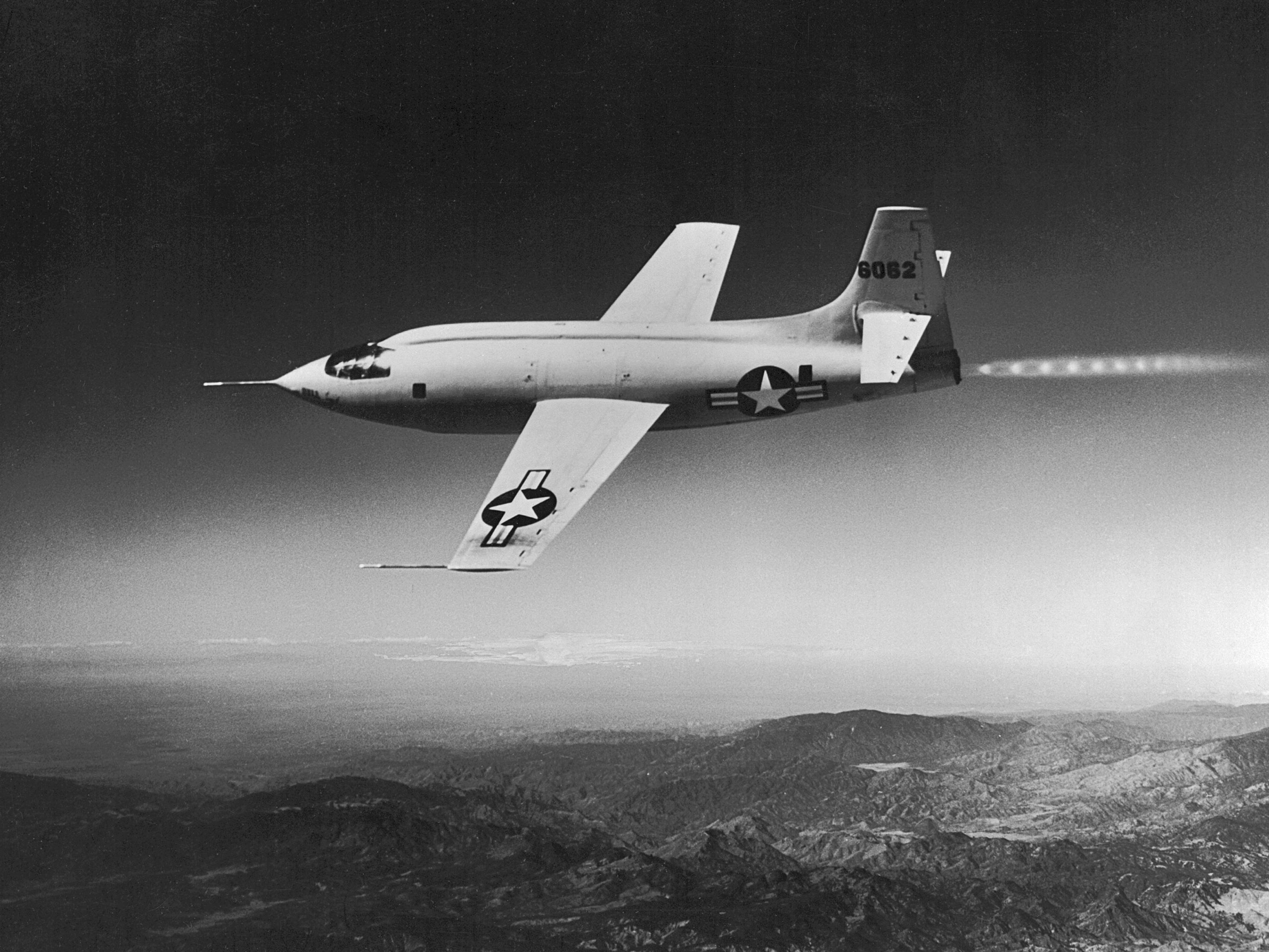
The United States Army Air Forces had contracted Bell Aircraft of Buffalo, New York, to build something they designated the XS-1, Experimental Sonic-One.
Tail DraggerHOST
It would later become simply the X-1.
Tail DraggerHOST
The name was changed because someone in the program worried that the word sonic in the designation might attract questions from people who weren't supposed to be asking them.
Tail DraggerHOST
Bell brought in an aeronautical engineer named Robert Woods, who made a decision that sounds simple in retrospect but was far from obvious at the time.
Tail DraggerHOST
Ballistics experts had measured and documented it thoroughly.
Tail DraggerHOST
The bullet shape was stable past Mach 1.
Tail DraggerHOST
Woods and his team said, "If this shape works for a projectile, let's find out if it works for an airplane." The X-1 was tiny, about thirty-one feet long.
Tail DraggerHOST
Wingspan just under twenty-nine feet, pure rocket propulsion, burning ethyl alcohol and liquid oxygen through four chambers.

CarlHOST
The program was originally intended to create a family of experimental aircraft not intended for production beyond the limited number of each design built solely for flight research.
CarlHOST
The first X-plane, the Bell X-1, was the first rocket-powered airplane to break the sound barrier on October 14, 1947.
CarlHOST
X-planes have set numerous milestones since then, both crewed and unpiloted.
CarlHOST
This is all the way back to right after World War II.
Tail DraggerHOST
She wanted to break the sound barrier.
Tail DraggerHOST
Yeager had done it in 1947 in the Bell X-1.
Tail DraggerHOST
A handful of military test pilots had followed, all of them in purpose-built research aircraft on military programs.
Tail DraggerHOST
Cochran wanted to do it in a production fighter, an F-86 Sabre.

TowerHOST
The YB-49 wandered.
TowerHOST
Chuck Yeager, who flew the aircraft after his record-setting flight in the Bell X-1, described it as extremely difficult to hold on heading for a precision bomb run.
TowerHOST
Some accounts indicate he recommended against it for operational service on precisely that basis.
TowerHOST
There were also structural questions that nobody had answered.
TowerHOST
Edwards has a particular place in aviation history.
TowerHOST
It's where Chuck Yeager broke the sound barrier in the Bell X-1 in October of nineteen forty-seven.
TowerHOST
It's where the X-15 flew to the edge of space across the late nineteen fifties and into the sixties, setting speed and altitude records that stood for decades.
TowerHOST
It's where the lifting body research aircraft that influenced the space shuttle's unpowered glide approach were tested.
Tail DraggerHOST
She had asked Chuck Yeager to serve as her instructor for the program.
Tail DraggerHOST
Yeager, who had been the first person to officially break the sound barrier six years earlier in the Bell X-1, flew alongside her in a second aircraft to advise on the approach and the transit through the barrier.
Tail DraggerHOST
By that point, he considered her one of the most talented and determined pilots he had ever encountered.
Tail DraggerHOST
Yeager was not a man who handed out compliments carelessly.
Tail DraggerHOST
He flew out of Muroc Army Airfield, which would later become Edwards Air Force Base, out in the Mojave Desert, where they were pushing the edge of what airplanes could do every single day.
Tail DraggerHOST
He was there on October 14, 1947, when a young Air Force captain named Chuck Yeager climbed into the Bell X-1 and took a shot at the sound barrier.
Tail DraggerHOST
Hoover flew chase that day in a Lockheed P-80 Shooting Star, watching from alongside as Yeager accelerated through Mach 1 and changed aviation history.
Tail DraggerHOST
The two men were friends, rivals in the best sense, both product of the same generation of pilots who had come out of the war with young eyes and no fear.

Kevin O'KeefeHOST
He broke the sound barrier on October 14th, 1947.
Kevin O'KeefeHOST
He flew this rocket-powered Bell X-1 faster than the speed of sound over California.
Kevin O'KeefeHOST
His orange airplane was carried by this larger aircraft, and it was released so he could begin this powered test.
Kevin O'KeefeHOST
Near the speed of sound, airflow changes can create dangerous control problems, and earlier aircraft had encountered serious difficulty.

Josh GelernterHOST
And its speed record is 4,520 miles an hour, by far the fa- I think the, uh, almost twice as fast as the, um, speed record for the, for an air-breathing plane, which is the SR-71 at, like, 23.
Dan GelernterHOST
Do you really want to say, uh, greatest plane of all time? I mean, X-plane, because the Bell X-1 is pretty great, and it did-
Josh GelernterHOST
Well, yeah, I would, I-
Dan GelernterHOST
...
Josh GelernterHOST
I think the X-15 may be the most beautiful plane of all time also.
Dan GelernterHOST
The X-15 is a very beautiful plane.
Dan GelernterHOST
I personally prefer the Bell X-1.
Dan GelernterHOST
It's more curvy.
TowerHOST
The X designation is what NASA and the Air Force use when they're standing at the edge of the possible.
TowerHOST
The X-1 was Chuck Yeager's Bell aircraft that broke the sound barrier above this same Mojave Desert in 1947.
TowerHOST
The X-15 flew above 300,000 feet and reached Mach 6.7 in the 1960s.
TowerHOST
The X-59 is currently flying low-boom supersonic test missions, trying to reshape the sonic boom signature so that supersonic flight over populated areas might one day be permitted.
TowerHOST
Isaacman wants more of that.
TowerHOST
He has been explicit about the need for the United States to reclaim leadership in high-speed and hypersonic research at a moment when other nations are investing heavily in those same areas.
TowerHOST
The gap between the X-15 in the 60s and the next serious American crewed high-speed research program is, frankly, a long one.
TowerHOST
Into that context, you have an SR-71 quietly disappearing from the ramp at the center of American high-speed flight research.
9 more episodes mention Bell X-1.
Create an account to see the whole feed, search across every transcript, and follow the entities you care about.