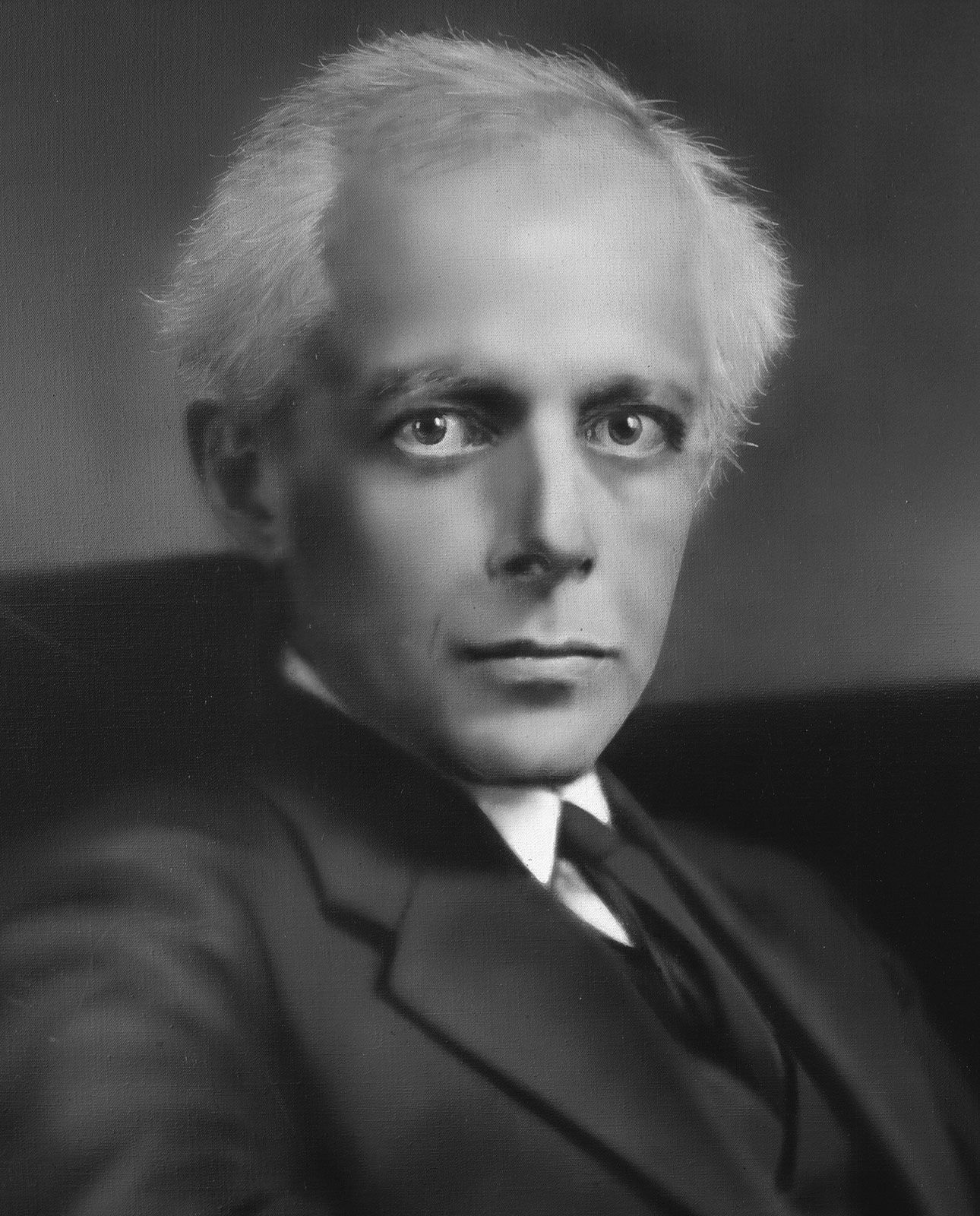
Béla Bartók
Hungarian composer and pianistWikipedia
49
MENTIONS
38
EPISODES
33
PODCASTS
Search complete. 49 mentions across 38 episodes found for "Béla Bartók".
Nov 4, 2026

John BirgeHOST
Not content with just a superb venue for chamber music, Mrs. Coolidge diligently commissioned new works to be played there.
John BirgeHOST
The list of important chamber pieces her foundation commissioned is impressive and includes Bartok and Schoenberg string quartets, the original chamber versions of Copland's Appalachian Spring, Stravinsky's Apollo Ballets, and modern works by American composers as diverse as Samuel Barber, Milton Babbitt, George Crumb, and John Corigliano.
John BirgeHOST
Mrs. Coolidge was herself an amateur composer and accomplished pianist.
John BirgeHOST
Her passion for music and enthusiasm for the creation of new works was all the more remarkable considering that, tragically, she herself battled deafness from her mid-30s.

PamHOST
Their Smith & Sniff podcast is one of the UK's most popular car shows and And now the pair are bringing their unique brand of freewheeling and frequently hilarious chat to Stamford Corn Exchange for an evening of conversation, audience questions and inexplicable detours through a range of topics even they won't see coming.
PamHOST
And this is, say, on Tuesday 10th November, 7.30pm start and prices are £26.50. And if classical music is more your thing, then on Wednesday 25th November at 7.30pm in Peterborough Cathedral, you can experience world-class live classical music as you've never imagined it in Britain's Sinfonia's spectacular, immersive and welcoming concert format with the ticket system being pay-what-you-can from just £6.00. from iconic music you'll know and love, to add to playlist new favourites, surround sound playlist, presents Handel's Zadok the Priest and Arrival of the Queen of Sheba, Allegri's Miserere, Prokofiev's Dance of the Nights from Romeo and Juliet, Ennio Morricone's Cinema Paradiso Suite, stomping sets from folk star Will Pound, and music by Bartok, Eriks Essenval's Grieg, Morten Lauridsen, Ravel, Carolyn Shaw, Teleman, and many more.
JillHOST
So, also at the Cathedral, but on the 12th of November, and starring John Owen Jones, the record-breaking West End and Broadway star, the show is Voices of Valjean, and it's an unforgettable evening of powerhouse vocals and iconic musical theatre.
JillHOST
This spellbinding show brings together three extraordinary West End stars, each having conquered one of the most legendary roles in musical theatre – Jean Valjean in Les Miserables.

Joseph BohigianHOST
He has worked closely with many composers on the interpretation of their piano works, with John Adams, Louis Andresen, Tan Dunn, Arvo Peert, Friedrich Schewski, and Sir John Tavener.
Joseph BohigianHOST
Van Raat is also a specialist in the music of the maverick Dutch composer Erik Lotiekiews, whose music combines the structural discipline of Mozart, Ravel, and Bartók, while embracing the freedom of jazz and the pulse of American minimalism.
Joseph BohigianHOST
On Sunday, November 15th, 2026, Van Raap will give a recital of Lotikius' music alongside the work of American Dutch composer Heather Pinkham at Littlefield Concert Hall, Mills College at Northeastern University in Oakland, California.
Joseph BohigianHOST
Welcome to the podcast, Rolf.

Jared BowenHOST
Oh, wow.
Merryl GoldbergGUEST
But in real life, even if you were a musician, you would look at this and think, well, It's an unsophisticated Baby Schoenberg or, you know, Bartok.
Merryl GoldbergGUEST
But it's not out of the realm of reality, of real music.
Jared BowenHOST
And

Jed DistlerHOST
Although Stephen probably was best known for his interpretations of the core Austro-German repertoire in the works of Brahms and Schubert and especially Beethoven, he did play a wide range of music.
Jed DistlerHOST
His close artistic and personal association with Martha Argerich yielded many memorable collaborations that included works of Rachmaninoff and Bartok, for example.
Jed DistlerHOST
But more importantly for our purposes, Stephen Kovacevic left behind a large discography.
Jed DistlerHOST
He started out recording for the EMI label in the 1960s, for whom he did, I think, two, perhaps three LPs for that label in the 60s.
6 MINS LATER
Jed DistlerHOST
Anyway, this world premiere recording with Alexander Gibson conducting, as I said, remains the only recording of the Richard Rodney Bennett Concerto and Stephen Kovacevic's on scintillating form.
Jed DistlerHOST
So that's my third recommendation.
Jed DistlerHOST
My fourth recommendation... is music of Bartok while we are still in the 20th century.
Jed DistlerHOST
He played Bartok with great passion and authority.

MikeHOST
He made his European debut at Wigmore Hall in 1961 with Beethoven's Diabelli Variations and Berg's Sonata.
MikeHOST
Kovacevic was widely admired for his recordings and performances of Beethoven, Schubert, Bartók, and Brahms.
MikeHOST
And I remember a lot of the Beethoven recordings.
MikeHOST
He collaborated with many leading musicians, including Jacqueline Dupre and Martha Argerich, and later worked as a conductor.

Zeth LundyHOST
The Spirit of Eden was inspired by Miles Davis' In a Silent Way and Bitches Brew.
Zeth LundyHOST
It was inspired by Bela Bartok and Claude Debussy.
Zeth LundyHOST
The songs are like unhurried and they're sprawling and they are seemingly improvised at times, but you get this overwhelming sense of space and time and place, more so in Spirit of Eden than Laughingstock.
Zeth LundyHOST
Laughingstock is like a tighter version of Spirit of Eden.

Julia Dixon EvansCORRESPONDENT
And they're going to perform pieces together as like a... super group, as well as a couple of pieces that like will spotlight each of the orchestras.
Julia Dixon EvansCORRESPONDENT
And there's work by Bartok, Ravel, Prokofiev.
Julia Dixon EvansCORRESPONDENT
And then one of my personal favorite pieces of classical music, it's Respighi's Pines of Rome, such like this sparkling little song.
Julia Dixon EvansCORRESPONDENT
And I first heard this when I was a teenager in a symphony.
28 more episodes mention Béla Bartók.
Create an account to see the whole feed, search across every transcript, and follow the entities you care about.