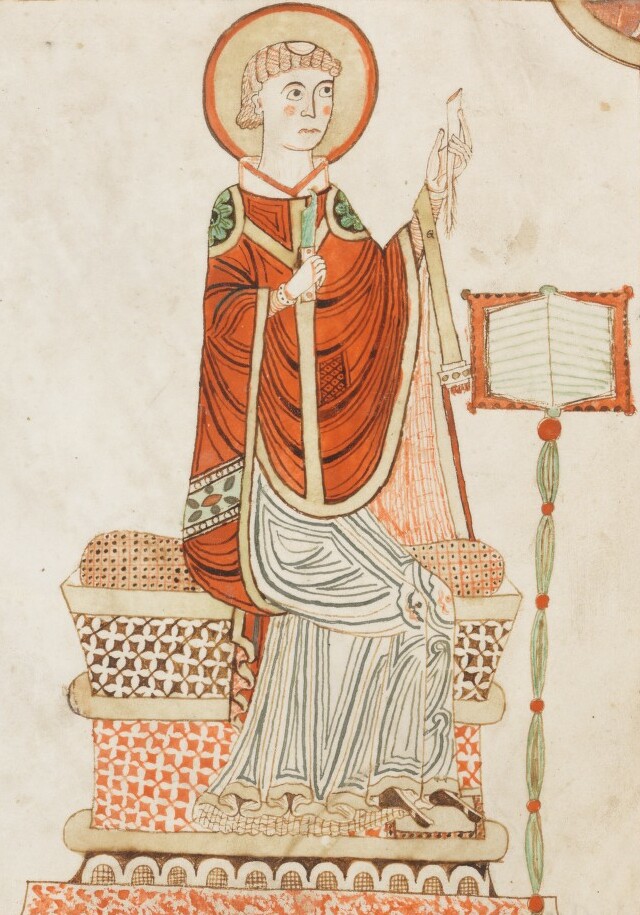
Bede
English authorWikipedia
431
MENTIONS
162
EPISODES
64
PODCASTS
Search complete. 431 mentions across 162 episodes found for "Bede".
Oct 8, 2026

Christine RuckerNARRATOR
There was no destruction of heroic poetry through the conversion of the English, but new themes were at once brought in to compete with the old ones.
Christine RuckerNARRATOR
Bede was born 672, within fifty years of the baptism of King Edwin of Northumbria, 625, and Bede is able to tell of the poet Cædmon of Whitby, who belonged to the time of the Abbess Hild, between 658 and 670, and who put large portions of the Bible history into verse.
Christine RuckerNARRATOR
Cædmon, the herdsman, turning poet late in life by a special gift from heaven and devoting himself exclusively to sacred subjects, is a different sort of minstrel from that one who is introduced in Beowulf singing the lay of Finisburh.
Christine RuckerNARRATOR
His motive is different.
Christine RuckerNARRATOR
Anglo-Saxon poetry, which had been heathen, Teutonic, concerned with traditional heroic subjects, was drawn into the service of the other world without losing its old interest.
Christine RuckerNARRATOR
Hence comes, apart from the poetical value of the several works, the historical importance of Anglo-Saxon poetry as a blending of Germania, the original Teutonic civilization, with the ideas and sentiments of Christendom in the 7th century and after.
Christine RuckerNARRATOR
Probably nothing of Saedman's work remains except the first poem, which is paraphrased in Latin by Bede, and which is also preserved in the original Northumbrian.
Christine RuckerNARRATOR
But there are many Bible poems, Genesis, Exodus, and others, besides a poem on the Gospel history in the Saxon language of the continent.

Patrick WymanHOST
A guy named Gildas wrote a spectacularly apocalyptic text called De Excidio Britanniae, On the Ruin of Britain, that provides a basic outline of migration and violent conquest.
Patrick WymanHOST
Our major source is Bede, often called the Venerable Bede, who wrote a magisterial history in the early 8th century CE.
Patrick WymanHOST
He has little to say about the 5th and 6th centuries, probably because very few people were writing in what would become England at all at the time.
Patrick WymanHOST
Much has been made of very little when it comes to telling a textual story of this age.

Francis PryorNARRATOR
Do you suppose a boatload of Anglo-Saxon royal family came sailing up the Deben and thought, whoopee, this is the place for me, got off the boat and set up their kingdom here?
Helen GeakeGUEST
The origin myths that we have, recorded by people like Bede, do seem to indicate that in the 5th century boatloads of royalty did row up and think, well, I will create my kingdom here.
Helen GeakeGUEST
But we just don't have any archaeological evidence to back that up at all.
Helen GeakeGUEST
What seems much more likely is that...
31 MINS LATER
Francis PryorNARRATOR
It was only in later centuries that the complex details of this process were transformed into a captivating story.
Francis PryorNARRATOR
History books can be dangerous things, especially when they're brilliantly written.
Francis PryorNARRATOR
In 731, a Tyneside monk named the Venerable Bede finished his Ecclesiastical History of the English People, which still forms the basis of modern history lessons.
Francis PryorNARRATOR
But Bede, like all historians, had his own particular axe to grind.

Richard HingleyGUEST
in the library, where other libraries were in the early medieval period.
Richard HingleyGUEST
We know some of the texts survived because of Gildas and Bede, who actually had access to some knowledge derived from classical accounts of Britain.
Richard HingleyGUEST
Bede certainly had quite a lot.
Richard HingleyGUEST
So I think if you were Bede and you were going to York... you'd know it had been a very important Roman place.
Richard HingleyGUEST
Some of the stories that come out, some of the sort of mythical histories, which I really particularly like about towns, may be common stories that are told by people who aren't really very well educated.
Richard HingleyGUEST
And there are plenty of people like that in the medieval period.

Gretel le MaîtreHOST
By the conversion of Edwin, Christianity gained the support of the most powerful of the English kings.
Gretel le MaîtreHOST
Bede reckons him, along with Ella, Ethelbert and Redwald, among the seven kings who were recognised as superior in kingdoms beyond their own dominions.
Gretel le MaîtreHOST
and says that he exercised authority over all the kingdoms of the Britons and of the English except Kent, where it is said he did not require submission on account of his marriage with Ethelbur.
Gretel le MaîtreHOST
Yes, I suppose that you don't need to submit to your father-in-law because submission is assumed the point of marriage, I imagine.
Gretel le MaîtreHOST
It seems, before Edwin's conversion, to have been his ally as well as one of his subordinates, for Edwin's first wife was, it will be remembered, a Mercian lady.
Gretel le MaîtreHOST
this alliance may have led to his war with the west saxons the neighbours and constant enemies of the mercens and he defeated them and forced them to acknowledge his superiority in northumbria his rule was strict and orderly to a degree hitherto unknown among the english Travelling became safe.
Gretel le MaîtreHOST
The roads which the Romans had carried over the wild moorlands and through the thick forests of the north were again frequented and Bede records that in his time it was a common saying that in Edwin's reign a woman with her newly born child might cross the island from sea to sea and none would do her harm.
Gretel le MaîtreHOST
Bede of course was very you know wanting to sell edwin because he was considered as a wonderful king because he became a christian so with all this remember that obviously william hunt was writing a long time ago and he was giving his own views and the views of others and there's a lot there's there's some inaccuracies and there are also lots of personal views but anyway i'm sure you've worked all that out Edwin was careful for his people even in small matters, and caused posts to be set up at the springs along the high roads, each with a brass cup hung upon it for the use of travellers, and such was the love or fear that men had of him that these cups were neither injured nor stolen.

Ted PajackiHOST
Medieval singers used the Guedonian hand as a way to learn to read music.
Ted PajackiHOST
Bede taught monks to calculate the date of Easter through finger reckoning.
Ted PajackiHOST
Renaissance readers in the West and the East consulted images and palmistry treatises to define fortunes in the lines of their hands.
Ted PajackiHOST
mnemonics, calculation, teaching, divination.

TedNARRATOR
Medieval singers used the Guidonian hand as a way to learn to read music.
TedNARRATOR
Bede taught monks to calculate the date of Easter through finger reckoning.
TedNARRATOR
Renaissance readers in the West and the East consulted images and palmistry treatises to define fortunes in the lines of their hands.
TedNARRATOR
Mnemonics, calculation, teaching, divination.

LizHOST
So he named them.
LizHOST
For midsummer, he chose Litha, and for the spring equinox Ostara, both reaching back to old Anglo-Saxon month names that a monk called Bede had written down in the eighth century.
LizHOST
And for the autumn equinox, he chose Mabon.
LizHOST
Why Mabon? Kelly wanted the autumn festival to carry the feeling of the Greek story of Persephone, the daughter of the harvest goddess Demeter, taken down into the underworld, while her mother's grief turned the whole earth cold and barren until she was returned.

John MoffattHOST
For Bonaventure, this is prefigured by the rainbow in the Noah story, sign of the eternal covenant.
John MoffattHOST
We can see Bonaventure doing systematically what Eusebius and Bede did as an incidental embellishment of their narratives.
John MoffattHOST
On a larger scale, the Tanakh narrative of the punishment of sinful kingdoms comes into its own.
John MoffattHOST
This time, it is the fate of the northern kingdom of Israel rather than the end of Judah that is significant.

Paul GarnerHOST
Mm-hmm
Todd WoodHOST
... um, Bede, for example, comes to mind.
Paul GarnerHOST
Yeah.
Todd WoodHOST
Bede the Venerable.
Paul GarnerHOST
Yeah.
Todd WoodHOST
Um, I mean, Genesis 1 through 11 was basically treated as a kind of a historical record, so.
152 more episodes mention Bede.
Create an account to see the whole feed, search across every transcript, and follow the entities you care about.