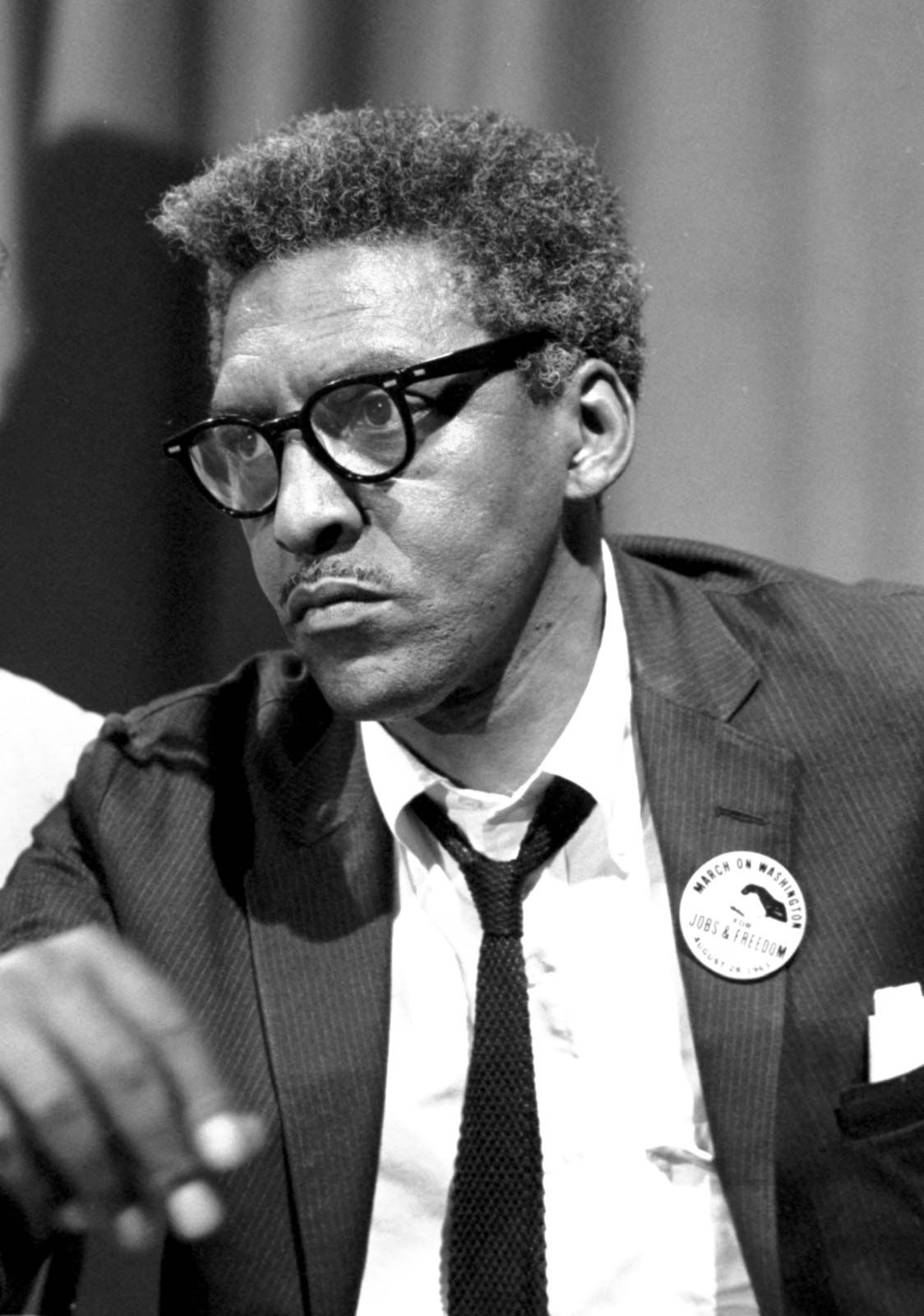
Bayard Rustin
American political activistWikipedia
42
MENTIONS
28
EPISODES
26
PODCASTS
Search complete. 42 mentions across 28 episodes found for "Bayard Rustin".
Nov 25, 2026

Adolph ReedGUEST
Actually, this is partly what gave birth to black power ideology, the contention that whites would try to dominate organizations that were multiracial and blacks had to have their own thing.
Adolph ReedGUEST
In writing about that, again, kind of recently, it hit me that, well, insofar as we understand the conflict in black politics in the mid-1960s as one between the Rustin and the Randolph supposedly class-first tendency and the race-conscious nation-building, grandparents of Afro-pessimism tendency that kind of mapped onto commitment to a politics based on redistribution and pursuit of a politics that centered on recognition.
Adolph ReedGUEST
And what that meant was that the black power rights didn't really care about, for instance, the freedom budget and the programs of a downward economic trend.
Adolph ReedGUEST
redistribution, they were much more focused on being in control of the agencies that administered whatever the work of the programs were.
26 MINS LATER
Vivek ChibberHOST
And you see among their colleagues, their white colleagues, that this is avidly and actively pursued as the pursuit of racial justice rather than the pursuit of class advantage by the people who are best positioned to do it.
Vivek ChibberHOST
So what you see is that there have been or could have been two contending visions of what racial justice is.
Vivek ChibberHOST
One coming out of the impulse of the wing of the civil rights movement that King and Rustin and Randolph represent in the final days, which the poor people's movement, and now saying that, okay, this race justice can only be furthered if it becomes a part of a... broader drive for social justice, both for practical reasons, because black working class is still about 8% of the total working class, and it's going to have to need the assistance of the white working class if it wants to improve itself, but also a moral vision that why should we hive ourselves off from the rest of humanity? Black suffering is awful, but it's no more awful than white suffering, and our suffering should enliven us and sensitize us to any old suffering.
Vivek ChibberHOST
And that's a beautiful vision.

Adolph ReedGUEST
Actually, this is partly what gave birth to black power ideology, the contention that whites would try to dominate organizations that were multiracial and blacks had to have their own thing.
Adolph ReedGUEST
In writing about that, again, kind of recently, it hit me that, well, insofar as we understand the conflict in black politics in the mid-1960s as one between the Rustin and the Randolph supposedly class-first tendency and the race-conscious nation-building, grandparents of Afro-pessimism tendency that kind of mapped onto commitment to a politics based on redistribution and pursuit of a politics that centered on recognition.
Adolph ReedGUEST
And what that meant was that the black power rights didn't really care about, for instance, the freedom budget and the programs of a downward economic trend.
Adolph ReedGUEST
redistribution, they were much more focused on being in control of the agencies that administered whatever the work of the programs were.
26 MINS LATER
Vivek ChibberHOST
And you see among their colleagues, their white colleagues, that this is avidly and actively pursued as the pursuit of racial justice rather than the pursuit of class advantage by the people who are best positioned to do it.
Vivek ChibberHOST
So what you see is that there have been or could have been two contending visions of what racial justice is.
Vivek ChibberHOST
One coming out of the impulse of the wing of the civil rights movement that King and Rustin and Randolph represent in the final days, which the poor people's movement, and now saying that, okay, this race justice can only be furthered if it becomes a part of a... broader drive for social justice, both for practical reasons, because black working class is still about 8% of the total working class, and it's going to have to need the assistance of the white working class if it wants to improve itself, but also a moral vision that why should we hive ourselves off from the rest of humanity? Black suffering is awful, but it's no more awful than white suffering, and our suffering should enliven us and sensitize us to any old suffering.
Vivek ChibberHOST
And that's a beautiful vision.

Robert KestenGUEST
Learn about Martin Luther King's work and the people behind him.
Robert KestenGUEST
Bayard Rustin, for example, a gay man who was forced out of the civil rights movement because of his sexual orientation.
Robert KestenGUEST
But Bayard Rustin is the person who negotiated so black Americans could work in all white unions and get job opportunities and job security.
Robert KestenGUEST
And then he moved into the civil rights movement.
Robert KestenGUEST
And he was the one who organized Martin Luther King's March on Washington for jobs, where he gave the, I have a dream speech.

Larry ElderHOST
He was the one who helped Thurgood Marshall in prosecuting the case that became the case that struck down separate but equal.
Larry ElderHOST
Bayard Rustin, whose life was depicted in a movie that the Obamas produced.
Larry ElderHOST
Bayard Rustin was both black and gay, and it was his idea to have this march on Washington.
Larry ElderHOST
It was his idea to recruit a young preacher named MLK to speak, who, by the way, initially resisted.
Larry ElderHOST
But because of Bayard Rustin, he agreed to speak there.
Larry ElderHOST
It was Bayard Rustin's idea to have this march on Washington, D.C.
Larry ElderHOST
He was a staunch proponent of Israel and believed that the fate of Israel was tied to the fate of the world.
Larry ElderHOST
There's a book called Scar of Race came out several years ago.

Larry ElderHOST
He was the one who helped Thurgood Marshall in prosecuting the case that became the case that struck down separate but equal.
Larry ElderHOST
Bayard Rustin, whose life was depicted in a movie that the Obamas produced.
Larry ElderHOST
Bayard Rustin was both black and gay, and it was his idea to have this march on Washington.
Larry ElderHOST
It was his idea to recruit a young preacher named MLK to speak, who, by the way, initially resisted.
Larry ElderHOST
But because of Bayard Rustin, he agreed to speak there.
Larry ElderHOST
It was Bayard Rustin's idea to have this march on Washington, D.C.
Larry ElderHOST
He was a staunch proponent of Israel and believed that the fate of Israel was tied to the fate of the world.
Larry ElderHOST
There's a book called Scar of Race came out several years ago.

Paul PrescodGUEST
This was a clear understanding.
Paul PrescodGUEST
Even going through the 60s, you can go on YouTube right now, find some fascinating debates with Bayard Rustin and Malcolm X about nationalism versus essentially democratic socialism.
Paul PrescodGUEST
So this has always been a divide.
Paul PrescodGUEST
I think we should just be honest that just like any other group, there are divisions among ideology among black people.

Taimur Ali AhmedNARRATOR
lasting influence on black Americans also defies Meany's portrait of enduring racial bias.
Taimur Ali AhmedNARRATOR
The black press avidly covered his satyagrahas, and civil rights pioneers like Bayard Rustin, who mentored Martin Luther King Jr. in nonviolent resistance, traveled to India to walk in the Mahatma's footsteps.
Taimur Ali AhmedNARRATOR
Reducing the man who inspired Dr. King's generation to a lifelong racist, even a half-hearted one, is a serious distortion of history.
Taimur Ali AhmedNARRATOR
Meany concludes by acknowledging that Guha's book makes a strong case that Gandhi was one of the greatest political leaders in history, adding that there are harder conversations to be had, implying that Gandhi's racism and prejudices need to be confronted.

Ramachandra GuhaGUEST
And then, of course, a boycott is organized, a collective strike.
Ramachandra GuhaGUEST
And in the early days of that strike, two admirers of Gandhi, a black called Bayard Rustin and a white called Glenn Smiley are sent by the Fellowship of Reconciliation to work with King.
Ramachandra GuhaGUEST
And they tell King more about Gandhi.
Ramachandra GuhaGUEST
And then he starts reading more and encounters several Americans who had visited Gandhi in the 30s and 40s and lived with Gandhi and were inspired by him.

Tiffany LewisGUEST
And it declared plainly that Zionism is not racism.
Tiffany LewisGUEST
BASIC was co-founded by Bayard Rustin and A. Philip Randolph, Martin Luther King Jr.'s right-hand men and the co-organizers of the March on Washington.
Tiffany LewisGUEST
The group faded after they died.
Tiffany LewisGUEST
Randolph in 1979, Rustin in 1987.
18 more episodes mention Bayard Rustin.
Create an account to see the whole feed, search across every transcript, and follow the entities you care about.