Battle of Midway
BattleWikipedia
43
MENTIONS
31
EPISODES
28
PODCASTS
Search complete. 43 mentions across 31 episodes found for "Battle of Midway".
Sep 18, 2026

Bruce McCandless IIIGUEST
There was the Battle of the Coral Sea, and he had gone stateside at the time, was on leave.
Bruce McCandless IIIGUEST
And then there was Midway, and he and other officers on the San Francisco managed to follow the news of the Battle of Midway.
Bruce McCandless IIIGUEST
by radio dispatches, and they had a big map, and they were plotting the course of the battle.
Bruce McCandless IIIGUEST
They're probably in CIC, the Combat Information Center, I would imagine.
CraigHOST
Yeah, absolutely.
CraigHOST
The one if you wanted to miss one, for sure.
CraigHOST
But they got to witness firsthand the Battle of Cape Esperance, which is Not talked about as much as, you know, let's say the Battle of Midway, but it's an extremely interesting battle involving, of course, Admiral Scott, who is commanding from San Francisco.
CraigHOST
Just for my listeners, the vessel was lacking the SG surface search radar systems that some of the other ships had, the Boys and the Helena.

Tail DraggerHOST
Now here's where it gets interesting.
Tail DraggerHOST
In June of 1942, while the Battle of Midway was still fresh in everyone's mind, a Japanese naval pilot named Tadayoshi Koga was flying zero cover during an attack on Dutch Harbor in the Aleutian Islands.
Tail DraggerHOST
His engine was damaged, possibly by anti-aircraft fire, and he attempted a forced landing on Akutan Island.
Tail DraggerHOST
The terrain caught his gear in the soft tundra, the nose went over, and Koga was killed in the rollover.

Juan NaulaNARRATOR
However, it is hard to justify large numbers of Japanese troops embarking in suicidal attacks, or rather, in the Japanese government including Hideki Tojo, in sanctioning such attacks, when those in power in Japan knew full well the war against America was lost from relatively early on.
Juan NaulaNARRATOR
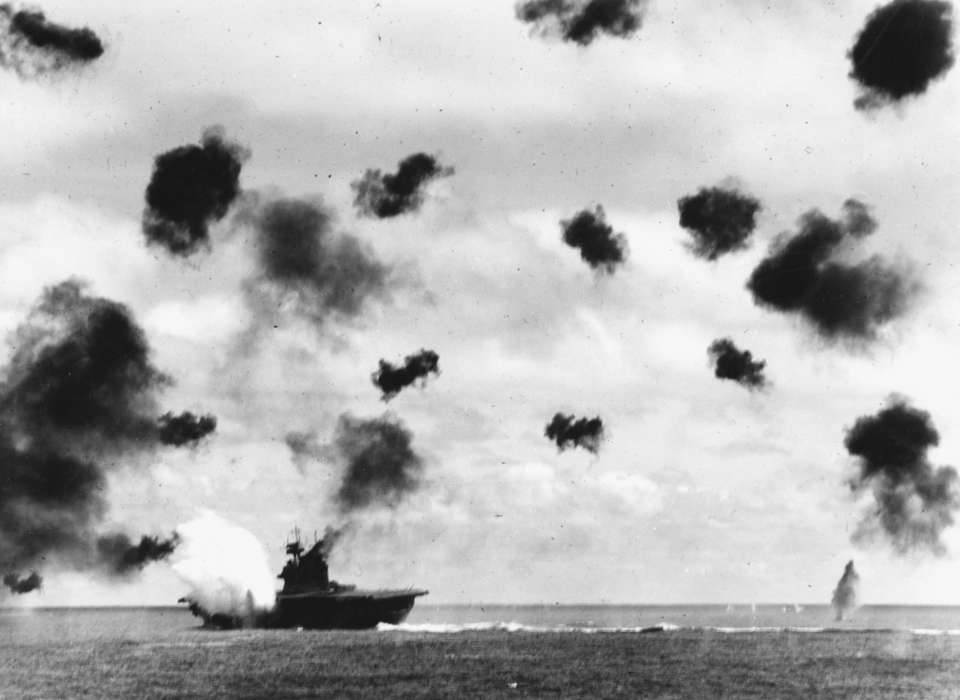
The first and possibly the largest hammer blow the Japanese suffered before 1945 then came in the South Pacific in June of 1942 at the Battle of Midway when the United States Pacific Fleet effectively destroyed the Japanese first carrier striking force that lost all four of its largest aircraft carriers along with 248 aircraft and over 3,000 personnel during the battle.
Juan NaulaNARRATOR
This defeat is widely considered to be the turning point of the Pacific War, as the whole Japanese war effort in World War II depended on naval and air supremacy, which in a relatively short period of time it proved to be unable to bring about.
Juan NaulaNARRATOR
Therefore, the bravery and fanaticism of its armies and soldiers was made relevant after the Battle of Midway, as the United States was from then on able to attack any Japanese territory with overwhelming forces without effective reply.
Juan NaulaNARRATOR
Instead of taking back all of the Japanese gains, the Americans saw the best route to victory in taking back a series of strategically vital islands in the Eastern Pacific, which came to be known as island hopping, that would eventually bring their naval and air forces within striking distance of the Japanese home islands.
Juan NaulaNARRATOR
After the defeat at Midway, the Japanese navy attempted to prevent the scale of the losses it had incurred from becoming public knowledge, and staggeringly, even Tojo himself was not informed of the disaster for nearly two weeks after the last Japanese carrier had disappeared below the waves.

MattHOST
Nimitz believed he could target the Central Pacific and effectively hit the Japanese from both sides.
MattHOST
And victories at the Battle of Midway and the Coral Sea proved this just might be a viable strategy for us.
MattHOST
Nimitz himself was out for blood.
MattHOST
He planned this, like, island hopping concept, where he dodged a lot of the Japanese military, hit island after island after island, and was on his way to Okinawa.

John PolomyGUEST
You could create one ship, an aircraft carrier, with the ability to initiate a strike package from the air from a standoff location.
John PolomyGUEST
And basically, once the Japanese carriers were sunk, I believe several of them, I think it was the Battle of Midway, it was, I can't remember, Coral Sea, I think, And the Japanese industrial base wasn't able to keep up.
John PolomyGUEST
And so all they had was a service fleet.
John PolomyGUEST
So you had the Marianas, Turkey, Shu, whatever.

Aaron BennettNARRATOR
The site provided an excellent harbor and numerous positions for airfields.
Aaron BennettNARRATOR
The devastating enemy carrier and plane losses at the Battle of Midway, 3-6 June 1942, had caused Imperial General Headquarters to cancel orders for the invasion of Midway, New Caledonia, Fiji and Samoa, but plans to construct a major seaplane base at Tulagi went forward.
Aaron BennettNARRATOR
The location offered one of the best anchorages in the South Pacific and it was strategically located, 560 miles from the New Hiberties, 800 miles from New Caledonia, and 1,000 miles from Fiji.
Aaron BennettNARRATOR
The outposts at Tulagi and Guadalcanal were the forward evidences of a sizable Japanese force in the region, beginning with the 17th Army, headquartered at Rabaul.

Hugh WhiteGUEST
really, until the Japanese saw them off in 1941, and their place was taken by America.
Hugh WhiteGUEST
So ever since European settlement, except for those months between Pearl Harbor and the Battle of Midway, either Britain or America has been the dominant power, the world's strongest economy, the dominant global naval power, the strongest power in our part of the world, and our great mates.
Hugh WhiteGUEST
So we have never before had to try to make our way in an Asia which is no longer dominated and made safe for us.
Hugh WhiteGUEST
by an English-speaking great and powerful friend, as Menzies called them.

Jared DiamondGUEST
There was also the role of luck that undid him.
Jared DiamondGUEST
In the Battle of Midway, when all of the Japanese fleet and their four big aircraft carriers sailed the Midway, we did not have battleships then.
Jared DiamondGUEST
We had three aircraft carriers, and Yamamoto's fleet could easily have wiped out our aircraft carriers, but...
Jared DiamondGUEST
the pilot McCloskey.
Tail DraggerHOST
Now here's where it gets interesting.
Tail DraggerHOST
The Battle of Midway was not supposed to go the way it went.
Tail DraggerHOST
By the spring of 1942, the Imperial Japanese Navy had been running nearly unchecked across the Pacific and Indian Oceans for six months.
Tail DraggerHOST
The Philippines, Wake Island, Guam, Singapore, Burma, the Dutch East Indies, Japanese carrier aviation had ranged as far as Ceylon in the west and threatened Hawaii in the east.

Jim NortonHOST
He goes, I want to talk
Dan SoderGUEST
about the Battle of the Midway.
Jim NortonHOST
When he did, I don't know if I told you, but when he did Down and Dirty, he was like my musical director on HBO.
Dan SoderGUEST
Four episodes.
21 more episodes mention Battle of Midway.
Create an account to see the whole feed, search across every transcript, and follow the entities you care about.