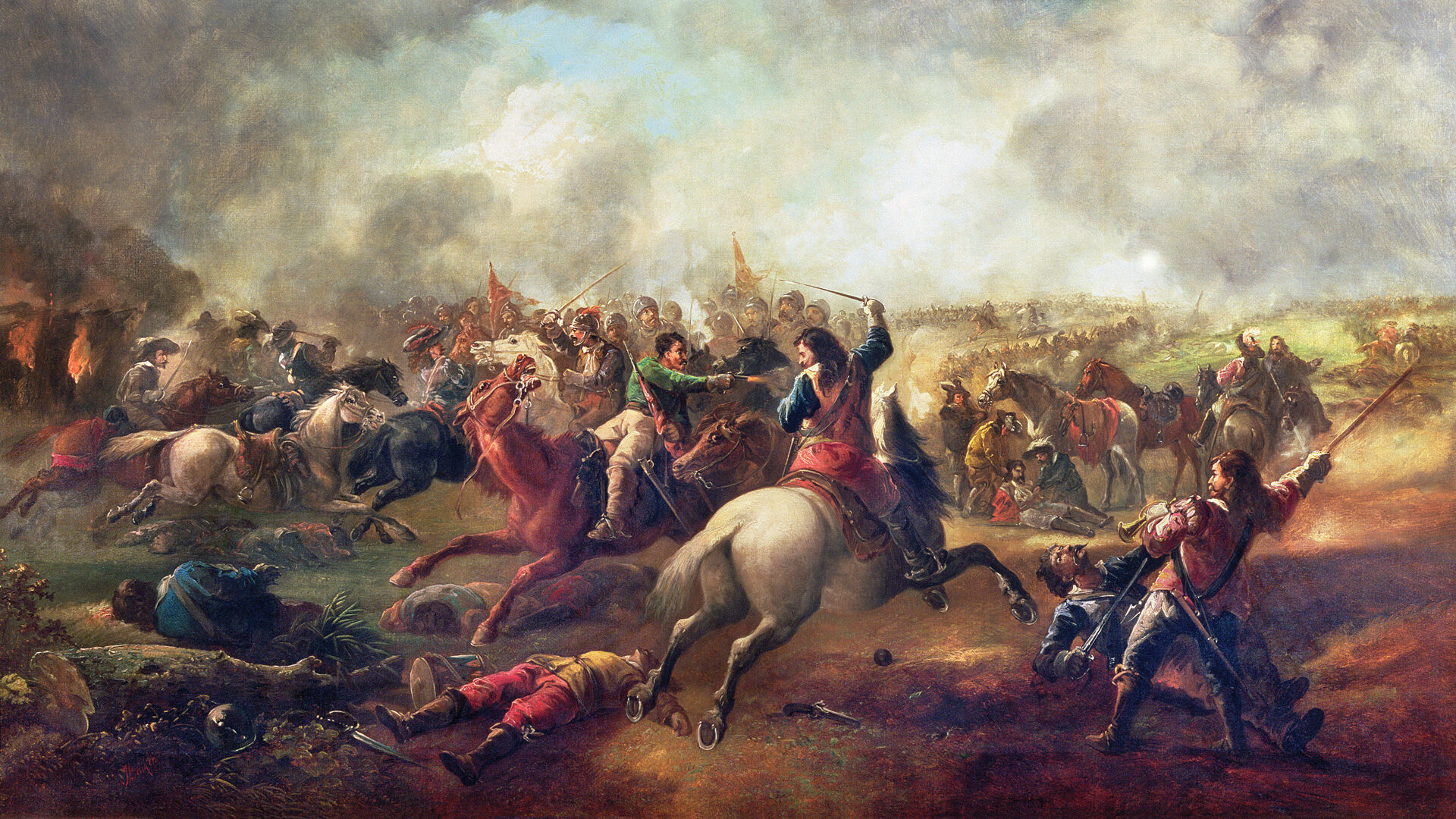
Battle of Marston Moor
BattleWikipedia
43
MENTIONS
17
EPISODES
15
PODCASTS
Search complete. 43 mentions across 17 episodes found for "Battle of Marston Moor".
Oct 27, 2026

Pamela NagamiNARRATOR
No soldier in the struggle in which Cromwell was engaged could be a soldier in nothing more.
Pamela NagamiNARRATOR
The men who fought at Marston Moor on the parliamentary side had been civilians two years before, and hoped to be civilians again before many more years had passed.
Pamela NagamiNARRATOR
Upon them, as well as upon the statesmen that guided the course of events from Westminster, the war acted as a dissolvent of old ideas and the originator of new ones.
Pamela NagamiNARRATOR
its first result had been to draw yet closer the bonds of the stricter Puritanism.
Pamela NagamiNARRATOR
That price was the solemn league and covenant which imposed upon England the Presbyterian system of church discipline with its accompanying rigidity of doctrine.
Pamela NagamiNARRATOR
There are moments of crisis when fresh battalions appear to be the one thing needful.
Pamela NagamiNARRATOR
Though the crisis passed away with Marston Moore, Presbyterianism did not pass away.
Pamela NagamiNARRATOR
It was there at least in a threatening shape, though as yet not embodied in parliamentary legislation.

Ellery DavidsonNARRATOR
Tennyson End of chapter 95
Diana Schmidt MarstonNARRATOR
Chapter 96 of the Ontario Readers Fourth Book Recorded for LibriVox.org by Diana Schmidt Marston Moor A Cavalier Song To horse, to horse, Sir Nicholas! The clarion's note is high; To horse, to horse, Sir Nicholas! The big drum makes reply.
Diana Schmidt MarstonNARRATOR
Ere this hath Lucas marched With his gallant cavaliers, And the bray of Rupert's trumpets Grows fainter in our ears.
Diana Schmidt MarstonNARRATOR
To horse, to horse, Sir Nicholas! White Guy is at the door, And the raven wets his beak O'er the field of Marston Moor.
Diana Schmidt MarstonNARRATOR
Up rose the Lady Alice From her brief and broken prayer, And she brought a silken banner down The narrow turret stair.
Diana Schmidt MarstonNARRATOR
O many were the tears That those radiant eyes had shed, As she traced the bright word Glory In the gay and glancing thread.
Diana Schmidt MarstonNARRATOR
Sweet, we will find our money-bags, and freight a ship for France, And mourn in merry Paris for this poor land's mischance.
Diana Schmidt MarstonNARRATOR
For if the worst befall me, why, better axe and rope, Than life with Lenthal for a king and Peters for a pope.

Pamela NagamiNARRATOR
But Rupert, bold and dashing in fight, thought little of a bloodless success, and hurried Newcastle, half against his will, to a decisive battle.
Pamela NagamiNARRATOR
At Marston Moor the Scots gave way before the charge of the Royalist cavalry, but Cromwell restored the fight.
Pamela NagamiNARRATOR
It had all the evidence, he wrote, of an absolute victory obtained by the Lord's blessing upon the godly party principally.
Pamela NagamiNARRATOR
We never charged, but we routed the enemy.
Pamela NagamiNARRATOR
God made them as stubble to our swords.
Pamela NagamiNARRATOR
The north of England was at last in the hands of the parliamentary commanders, but Marston Moor had not been a Presbyterian victory.
Pamela NagamiNARRATOR
Cromwell's Ironsides, as they were well termed, had decided the fight.
Pamela NagamiNARRATOR
Such a result was not likely to be favorable to the views of the dominant party at Westminster.

speaker_0NARRATOR
The British and Irish Civil Wars are famous for battles fought on land, such as Marston Moor, and sieges such as Bristol.
speaker_0NARRATOR
But this was also a war of often difficult amphibious warfare, with forces landing on the islands surrounding the mainland and in the distant Caribbean seas.
speaker_0NARRATOR
In the first programme of a two-part series, distinguished historian and author Dr David J. Appleby discusses the often perilous landings on the Isle of Man, the Scillies and the Channel Islands with publisher Mike Gibbs.

Pamela NagamiNARRATOR
Infantry dared not cross open country save under a cavalry escort, and on the field of battle, a commander to whom nothing but cavalry remained could, without difficulty, overpower a commander to whom nothing but infantry remained.
Pamela NagamiNARRATOR
It was thus that in 1644, Marston Moor was won, but that the battle was brought to this pass was the special merit of Cromwell.
Pamela NagamiNARRATOR
The royal horse drove the parliamentary horse of the right wing off the field.
Pamela NagamiNARRATOR
The parliamentary horse under Cromwell on the left wing also drove the royal horse opposed to it off the field.
Pamela NagamiNARRATOR
A man's character may develop as he is called to act under new circumstances, but it never suffers a radical change.
Pamela NagamiNARRATOR
No soldier in the struggle in which Cromwell was engaged could be a soldier and nothing more.
Pamela NagamiNARRATOR
The men who fought at Marston Moor on the parliamentary side had been civilians two years before, and hoped to be civilians again before many more years had passed.
Pamela NagamiNARRATOR
Upon them, as well as upon the statesmen that guided the course of events from Westminster, the war acted as a dissolvent of old ideas, and the originator of new ones.

Lindsay HolidayHOST
But demon and amongus, or just a fiercely loyal pet, Boy turned out to be merely mortal.
Lindsay HolidayHOST
In 1644, before the Battle of Marston Moor, Prince Rupert tied Boy up so that he could remain safe in camp.
Lindsay HolidayHOST
But the dog broke free of his collar and chased after his master.
Lindsay HolidayHOST
The battle went very badly for the cavaliers, and Boy was killed in the fight.

Nancy Cochran-GerkinNARRATOR
Meantime the Scots had invaded England and the parliament had largely increased their forces in the hope of a decisive engagement but the king refused battle and gained time.
Nancy Cochran-GerkinNARRATOR
In the north Prince Rupert made some progress and brought on the battle of Marston Moor where the victory was gained by Cromwell after all had been regarded as lost by the other parliamentary generals.
Nancy Cochran-GerkinNARRATOR
On the other hand the king gained an important advantage in the west country over Essex and his army.
Nancy Cochran-GerkinNARRATOR
The trial and execution of Laud who died in the beginning of the following year obeying the king rather than his rebellious lords was a terrible sign to the house of Ragland of what the Presbyterian party was capable of.

Pamela NagamiNARRATOR
Their mother Christiana remained in England, and her house was a meeting place of the royalist party, by whom she was fully trusted.
Pamela NagamiNARRATOR
Their cousin, the Earl of Newcastle, commanded the King's forces in the north, and when his army, then led by Prince Rupert, was crushed at Marston Moor, he left England and reached Paris in the spring of 1645.
Pamela NagamiNARRATOR
He stayed there three years, and his presence was no doubt important to Hobbes.
Pamela NagamiNARRATOR
His wife repeats a conversation between them at which Newcastle spoke skeptically of witchcraft, and according to her suggested a passage to the same effect in the Leviathan.
Pamela NagamiNARRATOR
At Naseby this object was accomplished.
Pamela NagamiNARRATOR
From a military point of view, Naseby was but a repetition of Marston Moor.
Pamela NagamiNARRATOR
A second time Cromwell, after defeating the cavalry opposed to him, pulled up and turned upon the king's infantry, which was left unguarded by horse.
Pamela NagamiNARRATOR
The victory enabled Cromwell to urge Parliament to grant liberty of conscience for the honest men who had fought to such a purpose.
25 MINS LATER
Pamela NagamiNARRATOR
He was intolerant of everything opposed to the highest and most spiritual religion, and of the forms which he thought choked and hindered its development.
Pamela NagamiNARRATOR
With a strong arm, he pronounced a distinct negative to everything persistently antagonistic to what he regarded as the interest of the people of God.
Pamela NagamiNARRATOR
After the Battle of Marston Moor, he reported with the highest approbation the dying words of one of his officers.
Pamela NagamiNARRATOR
One thing lay on his spirit, that God had not suffered him to be any more the executioner of his enemies.

speaker_4GUEST
And this really was one of the things that had bothered him, this army that was shadowing him.
speaker_4GUEST
And in actual fact, by doing this, he very nearly removed the need for the action at Marston Moor.
speaker_4GUEST
Unfortunately, they were not able to communicate this to Rupert and Newcastle in time.
Tony RobinsonNARRATOR
The course of the war had changed significantly.
Tony RobinsonNARRATOR
Driven on still by the urgent tone of the King's letter, his army set off as quickly as it could in pursuit of the parliamentarian forces.
Tony RobinsonNARRATOR
It was not long before he caught up with their rearguard on a Yorkshire moor on the afternoon of the 1st of July, 1644.
Tony RobinsonNARRATOR
The Battle of Marston Moor, the decisive battle of the English Civil War, was now only hours away.
Tony RobinsonNARRATOR
On a freezing January day in 1649, the executioner's axe ended the reign and the life of King Charles I.
7 more episodes mention Battle of Marston Moor.
Create an account to see the whole feed, search across every transcript, and follow the entities you care about.