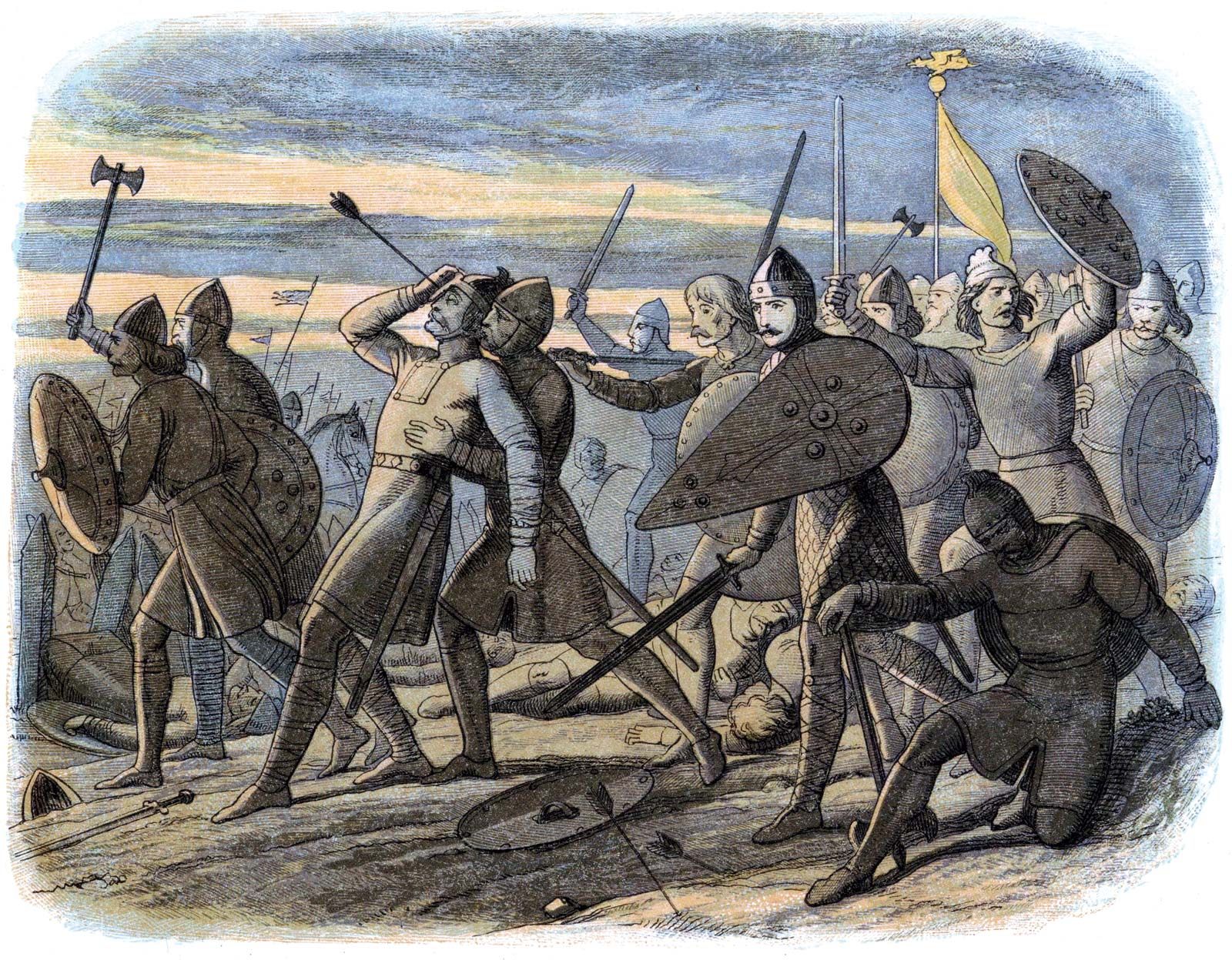
Battle of Hastings
BattleWikipedia
207
MENTIONS
120
EPISODES
104
PODCASTS
Search complete. 207 mentions across 120 episodes found for "Battle of Hastings".
Nov 6, 2026

Saul DavidHOST
Alfred.
Patrick BishopHOST
And Harold didn't die from an arrow in his eye at the Battle of Hastings.
Patrick BishopHOST
That was another one.
Patrick BishopHOST
Okay, now Gerard, who's an old friend of the podcast, writing from New Zealand, he greets us as always with Kia Ora.

LiamHOST
Numbers one.
LiamHOST
In what year did the Battle of Hastings take place?
JakeHOST
1066.
JakeHOST
Get it done.

speaker_2NARRATOR
Harold, son of the late Godwin, Earl of Kent, and brother of Queen Edith, at once laid claim to it, on the pretense that it had been bequeathed to him by St. Edward.
speaker_2NARRATOR
William, Duke of Normandy, also made a similar claim, on a similar pretense, and soon after landing in England with an army, in support of his pretensions, he defeated and killed Harold in the memorable Battle of Hastings, and thus at one blow became master of the kingdom.
speaker_2NARRATOR
A faint but unavailing attempt was made to support the claims of Edgar, but it was soon abandoned as hopeless, and the dark clouds of misfortune again gathered round the Princess Margaret and her family.
speaker_2NARRATOR
Her brother, finding nothing but humiliations in store for him if he remained in England, prepared to return to Hungary with his mother and his sister Margaret.
speaker_2NARRATOR
Christina, it seems, had by this time left her family to follow the life of a nun.
speaker_2NARRATOR
Margaret then, with her mother and brother, sailed from England, a few months after the Battle of Hastings, intending again to claim the hospitality of the Hungarian court.
speaker_2NARRATOR
Providence, however, had very different designs for the refugees.
speaker_2NARRATOR
A storm overtook them on their short sea voyage.

Peter StaveleyGUEST
So that basically was the essence of it.
Peter StaveleyGUEST
So this particular man who, I mean, I can let you know who it is if you wish, and we can get onto it later, but he was around, as you say, about, well, during and after the Battle of Hastings.
Peter StaveleyGUEST
So I have Robin Hood's birth at around sort of 1058, that sort of period, and he's operating from sort of 1080 to 1100, essentially.
Peter StaveleyGUEST
So, again, he goes in the balance as a man who operated for 20-odd years, yet most of the characters that people have dug up in the past have only really surfaced for a year or two and have been involved in insurrections against various kings and things, which is not really what Robin Hood was about at all.

Jeff WoodHOST
And they allowed individuals to specialize in work and generate more value for everyone around them.
Jeff WoodHOST
But what is value? This is a picture of one small section of the Bayeux Tapestry, which depicts the Battle of Hastings in 1066 between the Anglo-Saxons and the Normans.
Jeff WoodHOST
My dad says we can trace our family on his side back to this piece of history.
Jeff WoodHOST
The conquering of the Anglo-Saxons in England by William the Conqueror and the Normans was done by sailing across the English Channel, an important mode of transportation at the time.

Chris WilliamsonGUEST
What would be fun to see? I mean, the...
Chris WilliamsonGUEST
One of the days of like the Battle of Hastings, like something sick from like medieval England, I think would be really cool.
Chris WilliamsonGUEST
Like some 1066 stuff.
Chris WilliamsonGUEST
I think that'd be really fun.

speaker_2NARRATOR
part one of exeter by sydney heath THE CITY just as the five cities of colchester lincoln york gloucester and st albans stand on the sites and in some fragmentary measure bear the names of five roman municipalities so isca dum non iorum now exeter appears to have been a cantonal capital developed out of one of the great market centres of the celtic tribes and as such it was the most westerly of the larger romano-british towns the legendary history of the place both temporal and ecclesiastical goes far back to the days when for a late posterity it is difficult to separate fact from fable it is however quite established that here was the capital of the domnonii the british tribe whose dominions included both devonshire and cornwall and who named their capital caerwysk the city of the waters with the coming of the saxons the river the roman isca became the exa and the city was called exencasta modified in due course to exeter in point of position on a mound rising from the river it was a splendid site for a fortress in the days of hand-to-hand warfare and the military value of the site lent support to the statement of some writers that the romans utilised the british fortifications and built a castle in few places of its fize can one fee so clearly the extent of the old walled town while the difpofition and formation of its outer ring of houfes on the lower flopes of the mound fhew very clearly the limits of the mural circumvallation before the city burft afunder its tight-fitting belt of ftone within which for the fafety of its populace it had been imprifoned for centuries climb the higher parts for a bird's-eye view of the city and the scene is entrancing we look down upon the calm flowing aix threading its way through the valley till it debouches at exmouth on the river-side beneath us is the quay with coasting schooners and barges moored alongside and sundry bales of merchandise heaped upon the wharf as though the people were playing at commerce to remind the world at large that exeter was once an important port although some ten miles from the river's mouth but the x in a quiet way has much to boast of in the nature of beauty and romance particularly where it flows past the wooded grounds of powderham castle the devonshire seat of the great courtenay family truly there is much to redeem modern exeter and make it interesting over and above its historical atmosphere yet with comparatively few vestiges of age the city has an historical past in both a religious and a military sense she has played a part in the annals of england and more than one ancient document in the library of the dean and chapter bears testimony to her honour her valour and her glory it is a city which has the impress of many ages and many minds stamped upon it here each influence military from the roman legions ecclesiastical from the saxon prelates feudal from the norman lords has sunk deeply into the land and has affected the general plan of the numerous buildings as it has moulded the slowly succeeding phases of the civic and the religious life It is no mere dream of the early ages, no sentimental reverie of medievalism.
speaker_2NARRATOR
it is enough to go through the streets noting the remnants of the ancient walls the brutal strength of the surviving fragment of the castle the sheltered position of the tidal basin the many churches dedicated to the honour of saxon saints the proud beauty and massiveness of the cathedral if one would realize not the fancies of the artist and the poet but the hard facts of history that made the ancient days so great and which have caused our own days to be so full of their memories as compared with the sister counties of cornwall and dorset devonshire is not particularly well represented in memorials of the roman occupation although an immense number of roman coins have been unearthed at various times coins however unless found with definite structural remains indicate presence rather than a settled occupation for large quantities of the roman coinage must have continued in circulation long after the last of the legions of imperial rome had departed from british shores the few roman antiquities of exeter that have been found are important in a comparative sense although they contrast poorly in structural character with those of our other romano-british towns it has been held that not only were the foundations of the city walls roman but part of the existing remains of the rougemont castle have also been assigned to this period mr l davidson was of opinion that the old church tower of st mary major now removed exhibited traces of roman work and foundations presumed to be roman were noted by him as having been found at the corner of castle street and high street in st mary arches street bedford circus market street south street and mint lane in eighteen thirty six more definite structural remains were found in high street consisting of a family sepulchral vault seven feet square arched over and containing five coarse cinerary urns arranged in niches around its interior this was discovered behind the three tons inn and during the same year at a great depth below the site of the county bank a low arched chamber was found in which were a quantity of bones of men and animals no exonian find however exceeds in interest the discovery in eighteen thirty three of a bath and tessellated pavement behind the deanery walls in south street the walls were of heavy tree stone and brick and the original pavement was of black and white tessary set in concrete associated remains of a thirteenth century encaustic tile pavement indicates the use of the old roman bath a thousand years or so after it had been made several other tessellated pavements are recorded as having been found in pancras lane on the site of bedford circus and on the north side of the cathedral near the speke chapel in eighteen thirty six a small bronze figure of julius caesar now in the british museum about three inches in height was dug up during the removal of some walls in the westgate quarter of the city the only recorded find of a military weapon is the bronze hilt of a dagger unearthed in south street in eighteen thirty three this is of more than passing interest as it bears the name of its owner i mefiti eo fris which has been read thus servii omarchi mefiti tribuni equitam frisiorum servius omercius mefitus tribune of the frisians the antiquary leland mentions two roman inscriptions as built into the city wall near southern hay but they are gone and besides the inscribed dagger we have only a seal of severius pompeius and sundrys graffiti or funereal pottery in the way of literary relics of roman exeter the poverty of devonshire in memorials of the roman period is shown by the fact that outside exeter there are not a dozen places in the county which have yielded roman vestigia other than coins in nine twenty six the britons were driven from exeter by athelstan who banished them into cornwall and fixed the river tamar as their boundary athelstan was one of the greatest benefactors the city has had for in addition to increasing the fortifications by means of a massive wall flanked by towers he built a castle on the red mount now known as rougemont castle although very little of this now remains a portion of the ruins is generally known as athelstan's tower and has a window with a triangular head which is certainly of saxon style and date in nine hundred and thirty two athelstan rebuilt the monastery of our lady and st peter staffing it with monks of the benedictine order and presenting them with the reputed relics of st sidwell a saint who is still somewhat of a puzzle to ecclesiologists a few years later the monastery was plundered by the danes when the monks beat a hasty retreat but returned in nine hundred and sixty eight on the entreaty of king edgar a mint was shortly established here wherein the first coins were struck naming athelstan king of england the danes made continuous raids in the neighbourhood but were decisively defeated by the west countrymen in ten o one at pinhoe a few miles from exeter from that time until the treacherous massacre of the danes in wessex upon st price's day in ten o two by ethelred this part of the country was comparatively free from their inroads but gunnhilde the sister of swegan king of denmark being among the slain this king came to avenge her death he sailed up the aix burning and plundering the villages on its banks and for four years his army marched in every direction across wessex and was at length induced to withdraw on being paid a wergeld war-tax which was the first levied on exeter after the battle of hastings gytha the mother of harald took refuge in exeter and leofric the bishop offered to render homage to william as royal suzerain but the conqueror would have no half-hearted submission so exeter closed its gates to the normans it held out for eighteen days when the military science of the normans and particularly the skill they showed in undermining the walls caused it to surrender the resistance won the besiegers respect and brought unusually good terms from so ruthless a victor as william the lives of the garrison were spared gytha was allowed to seek safety by sea and it has been said that the victorious troops were withdrawn from the city gates to prevent them from claiming the licentious privileges so generally granted to their followers by the norman kings as is fitting for its county town the first entry in the devonshire doomsday deals with exeter in which city it is recorded the king had two hundred and eighty five houses rendering customary jews the generally debased character of the coinage of the time led to various expedients being adopted by the exchequer for securing approximately accurate payment of a specified sum of money among other things the entries in doomsday ftate that in the total this city of exeter renders eighteen pounds for annum of thefe baldwin the sheriff has fix pounds by weight and affay and colvin has of them twelve pounds by tail for the fervice of queen this entry as significant for one pound or twenty shillings meant one pound or twelve ounces troy of silver and when money was payable by weight twenty shillings were not taken as the equivalent of one pound unless they fully weighed one pound in this instance it is observable that the portion of the customary dues rendered for the two hundred and eighty five houses which went to the exchequer was collected by the sheriff under the strictest rules of weight and assay whereas the portion allotted to the widow of edward the confessor was received by the tale only the authorities took care that the sheriff collected the full amount due to the crown but did not trouble themselves about the ex queens share it has been affirmed that it was by the normans that the fairs of england were moulded into the shape with which we are most familiar at exeter in twelve seventy six in reply to a writ of quo it was satisfactorily shown that the rights of the city its fee farm rent and its farms dated from pre-conquest days the privileges and emoluments attached to fairs in large towns were very great during the time allotted to them the citizens were often debarred from selling anything whereas strangers could vend their wares during the fair but at no other period of the year in cosin's reminiscences of exeter eighteen seventy seven we are told how at exeter on the occasion of the lammas fair a procession yet perambulates the city one man bearing a pole with a gigantic stuffed glove at the top of it the latter being subsequently hung out at the guildhall many of england's reigning sovereigns have visited the city among them being edward the fourth and richard the third henry the seventh came thither on seventh of october fourteen ninety seven on the suppression of perkin warbeck's rebellion when that rebel had attempted to capture the city the rebels were brought here before the king bareheaded and with halters round their necks and after they had pleaded for mercy henry pardoned them on his departure the king presented the civic authorities with a sword and cap of maintenance both of which are still carried before the mayor and corporation on occasions of state the citizens of exeter have always been noted for their staunch loyalty to the reigning house with the consequence that many rights and privileges have been granted to it the city motto semper fidelis was conferred by queen elizabeth in recognition of the contributions both of men and money made to the fleet that vanquished the spanish armada that the motto was merited is evident when we recall the fact that with the exception of frobisher and cavendish practically the whole of the leading seamen who chased the spanish ships along the channel were born in the land of the tamar the tevi and the dart during the early part of the civil war the citizens were divided in their sympathies some supporting the parliament and others the king but the city soon fell into the hands of the former In 1643, however, Sir Ralph Hopton, the famous Royalist General, marched on Exeter with a force made all the more formidable for siege purposes by the cannon he had previously captured at Halton.
speaker_2NARRATOR
immediate capture of the city by the royalist forces was expected the mercurius aulius of first june sixteen forty three remarking that if the old observation be of any credit that cats and mice do commonly forsake a ruinous and decaying house that city exeter is not like to continue long in the rebel's hands proud and rebellious city was assaulted and captured by the royalist forces under prince maurice on fourth september sixteen forty three after a siege lasting sixteen days and a full account of its fall appeared in the issue of the mercurius aulius of eighth september in may sixteen forty four queen henrietta maria took up her abode in the city at bedford house where on sixteenth june of the same year the princess henrietta was born in the following month charles i came to see his little daughter and again in september when he appointed thomas fuller vicar of broad windsor in dorset as chaplain to the princess queen who had retired to exit her as a safe place for her confinement soon afterwards had to leave there suddenly on the approach of a parliamentary army in command of the earl of essex her majesty's easiest way to france was by sea and to prevent this cromwell had sent a fleet to torbay to intercept her should she attempt to leave england by that route finding this road closed she made for falmouth from which port she got safely away during the siege by fairfax the inhabitants of the city suffered considerably owing to the food supplies being intercepted one day a flight of larks came into the town which were says fuller as welcome as quails in the wilderness the birds were so numerous that notwithstanding the prevailing famine they were sold for twopence a dozen of this miraculous event wrote fuller i was not only an eye but a mouth witness the city capitulated on thirteenth april sixteen forty six among the conditions of surrender being that the cathedral should be spared and the garrison accorded the honours of war after the landing of william of orange at brixham in sixteen eighty eight he marched through the county to exeter and entered the city by its western gate he proceeded direct to the cathedral and took his seat in the bishop's throne with his chaplain burnet near him a few of the prebendaries and choristers attended the service but when burnet began to read the prince's declaration after the singing of the te deum they hurriedly departed the bishop thomas lamplugh had proceeded to james on hearing that the dutch had landed and was rewarded with the archbishopric of york he afterwards assisted at william the third coronation the dean of exeter had also left the city and the deanery was prepared for the prince's reception george the third was the last english sovereign to stay in exeter and he also resided at the deanery although the cathedral is the main attraction modern exeter has to offer to the tourist a walk through the historic old city will reveal the fact that in addition to some highly interesting old churches it possesses a not inconsiderable number of ancient buildings at the same time there has been an appalling amount of destruction some of it apparently of an unnecessary kind as the recent dismantling of the beautiful old courtyard in the rear of bampfylde house the city residence of the pultimore family the visitor who arrives at exeter either by the great western or the south-western railway the station of the latter being the more central of the two can soon reach the busy and picturesque high street by way of queen street one of the broadest thoroughfares in the city the most interesting building in high street and one that in this respect ranks next to the cathedral is the guildhall with a portico projecting over the pavement it is probably one of the oldest municipal buildings in the country for in thirteen thirty we find that the guildhall was again in a ruinous condition and it was then rebuilt again in fourteen sixty four it was built up anew in a more commodious and efficient manner while the building as we see it to-day with its faade is the result of still further alterations in the entrance porch is separated from the inner hall by a massive oak doorway and the hall itself sixty feet long and twenty five feet wide is panelled throughout in oak with a frieze consisting of shields charged with the arms of former mayors aldermen recorders and of the city companies curious brackets of figures bearing staves support the roof the judge's chair is of carved oak and bears the name and date of the donor christopher ball esq sixteen ninety seven on the walls hang six large portraits among them those of george the third and general monk the latter by sir peter lely and over this picture hang the colours of the fourth devons a regiment raised in the city by the general in sixteen eighty one another portrait here by lely is of the princess henrietta concerning which the old records state that in sixteen seventy one the king charles the second in order to keep his promise made the last year when he visited this city in person and as a signalled testimony of his love towards the same was pleased to send hither the effigy or portraiture at length and richly framed of his dear sister the duchess of orleans lately deceased a princess born within this city and for beauty was esteemed to be one of the fairest in christendom which faid picture being placed in a fair cafe of timber richly adorned with gold is erected in the open guildhall of the faid city there to remain as a perpetual monument of his majesty's high favour towards this his truly ancient loyal and honourable city of exeter the upper room is known as the mayor's parlour where are many more portraits and the city's fword and cap of maintenance the scabbard of the sword which is the one presented by edward the fourth is still draped in crape as it used to be for the processions on king charles martyr's day thirtieth of january the cap of maintenance presented to the city together with his sword by henry the seventh was sent up to london to be repaired the cost for sarkanne damask and pin lace amounting to four guineas the original cap still remains within its covering and it appears to consist of two pieces of black felt sewn together during the fifteenth century the chapel of st george and st john was built over the guildhall with an apartment above for the priest who served it the chapel being probably connected with a religious guild the junction of north and south streets with four and high streets was formerly known as the carfois or carfax quatre voies i e four ways where at one time many executions took place here also stood the ancient conduit which supplied the city with water but this was removed to south street in seventeen seventy nine at the corner looking down fourth street was a fine fourteenth century life-size figure of st peter holding a model of a church in his right hand and a book in his left his feet trampling on a demon this has been removed from its original position and placed high up in a niche over a shop close by on the opposite side of high street is st petrock's church at one time almost hidden from sight by the adjacent buildings it is a curious little church of which portions have been assigned to the saxon period the parish of st petroc is in the centre of the city and was one of the oldest and most important being one of the nineteen churches to which william i ordered the provost to pay a silver penny yearly the church was enlarged on the south side during the fifteenth century and in the following century the jesus isle was added when thomas chard acting as bishop oldham's suffragan reconsecrated the church the chancel is now towards the east in what was once an isle the original chancel being where the north isle is now with the consequence that the interior of the church has a very curious appearance farther up high street on the same side are some picturesque houses with elizabethan gables the interiors of many of them adorned with fine specimens of oak carving in situ the building now occupied by messrs greene as a drapery establishment was at one time the new inn and it is mentioned in this capacity so early as fourteen fifty six in a lease relating to the building in which it is referred to as the new inn in fifteen fifty four the cloth mart was established here and early in the seventeenth century the new inn hall was used as the exchange where the cloth merchants met to transact their business the house was rebuilt towards the close of the century and the apollo room was added as a banqueting hall for the judges on circuit this is now ufed as a show-room but it ftill retains its elaborate plaster ceiling bearing the date sixteen ninety five and the original oak panelling the frieze confists of a feries of wreaths upholding fhields charged with the armorial bearings of many county families together with the royal arms and thofe of the city farther up the street is the church of st stephen mentioned in doomsday the original church was destroyed by the commonwealth in sixteen fifty eight and rebuilt in sixteen sixty four stephen's bow the adjacent archway was always a part of the church and above it rises the tower beneath the church is an ancient crypt a turning to the right close by leads to bedford circus with a statue of the earl of devon at the entrance in the thirteenth century a dominican convent was founded in this part of the city and occupied the southern portion of the circus together with chapel street and the adjoining mews in fifteen fifty eight the convent was dissolved and bedford house the west-country residence of the dukes of bedford was erected here henrietta maria held her court and here the little princess was born the dukes of bedford ceased to use this residence in the eighteenth century and in seventeen seventy three it fell into the builders hands when the eastern side of the circus was built the western side not being begun until eighteen twenty six the place to-day possesses no attractive features and only the memories of its past history remain the earlier excavations brought to light a great number of skulls bones and fragments of sculpture while during the later building operations especially those conducted on the site of the conventual church a large number of carved stones were unearthed which had evidently formed part of the dominican house some of these fragments were richly ornamented with painting and gilding another discovery was the life-size stone head of an effigy with a hood of closely set ring mail this is now preserved in the cathedral cloisters returning to high street bamphile street lies a little higher up a great portion of this street is occupied by the front of bampfylde house built by sir amyas bampfylde at the end of the sixteenth century in later years this became the town-house of the poultimore family although shamefully modernized the house has retained a few interesting features in the hall is feen a narrow window filled with old glafs on which armorial bearings are difplayed while the broad ftaircafe leads to a fine apartment panelled in oak and having an elaborate plafler ceiling the mantel-piece is a good piece of work and bears the arms of the paltimores in its centre there are one or two other good rooms and fome deep cupboards and one very fmall apartment is faid to be a genuine eighteenth century powdering clofet the beautiful old courtyard at the back will no longer be recognised by those who knew it a few years ago it has been restored the church of st lawrence is situated on the north side of high street and dates from twelve hundred and two it was sold during the commonwealth and bought by the parishioners for one hundred pounds on the south side and slightly farther up is st john's hospital situated near to where the old east gate formerly stood the hospital was founded circuit twelve twenty five by gilbert and john long bishop grandison was a great benefactor to it as in addition to increasing the number of inmates and clergy he added a master of grammar and twelve scholars the foundation was suppressed in fifteen forty but in sixteen twenty this restoration was planned by hugh crossing and carried out after his death by his widow the institution was refounded in sixteen twenty nine when only the school was revived and is now known as the blue boys school the playground is partly bounded by a piece of the old city wall whence one can look down on the southern hay gardens and obtain a good impression of the strength of the ancient fortifications the seal of st john's hospital is an interesting one of thirteenth century date on which is depicted the exterior of st john's chapel which is shown as having a shingled roof and gable crosses also an external arcade of three semicircular arches another interesting seal of the same century is that of the hospital of st alexius founded in eleven seventy this foundation and the hospital of the bishops formerly on the site of the present vicars college were afterwards united with the hospital of st john at the east gate the seal shows the hospital with gable crosses an arcaded clerestory and three quatrefoil openings in its wall beneath is an arcade of six arches high street merges into sidwell street st sidwell's was one of the nineteen old city parishes although without the walls the site of st sidwell's church is said to be on the spot where a saint of this name suffered martyrdom she is one of those half-mythical british saints said by tradition to have been beheaded by a scythe whilst praying beside a well a church is said to have been built in her honour so early as seven forty nine the present building has undergone repeated restorations but some ancient pillars still remain with sculptured capitals and there is also a representation of st sidwell or sidwella whose attributes are a well and a scythe to the monastery he had founded athelstan presented some reputed relics of the saint at the top of sidwell street is st anne's almshouse one of the most interesting foundations in the city it was originally a hermitage but little is known about it until fourteen eighteen when it was newly constructed and in fifteen sixty one oliver and george mannering founded a hospital for eight poor people the chapel is a small building that has retained its piscina and two niches for holding figures the almshouse was fortified by fairfax during the civil war and for many years the chapel was in a ruinous condition but it was restored early in the nineteenth century st anne's day twenty sixth july has been observed regularly by the inmates of the charity since its foundation retracing our steps to the beginning of high street and proceeding up castle street we reached the highest point of the city the red mount crowned by the gateway and ruin towers of an ancient castle the fortress formed as part of the fortifications erected by athelstan and the red tower with its triangular-headed window may be confidently assigned to the saxon era during the norman period the castle was rebuilt by brian de molis in stephen's reign it was besieged and taken from earl baldwin de redves who was banished until the following reign when his possessions were restored The castle belonged to the de Redvers and Courtenay families until 1231, when Henry III presented it to his brother Richard as part of the earldom of Cornwall.
speaker_2NARRATOR
In 1537, Henry VIII granted Exeter a charter, giving the city the privilege of being a county with its own sheriffs, excepting Rougemont Castle, which still belongs to the Duchy of Cornwall.

KalindaNARRATOR
The Old English or Anglo-Saxon had been a purely Germanic speech, with a complicated grammar and a full set of inflections.
KalindaNARRATOR
For three hundred years following the Battle of Hastings, this native tongue was driven from the king's court and the courts of law, from parliament, school, and university.
KalindaNARRATOR
During all this time there were two languages spoken in England.
KalindaNARRATOR
Norman French was the birth tongue of the upper classes and English of the lower.
11 MINS LATER
KalindaNARRATOR
So completely had the true record faded away that it made no appeal to the imaginations of our most patriotic poets.
KalindaNARRATOR
The Saxon Alfred had been dethroned by the British Arthur, and the conquered Welsh had imposed their fictitious genealogies upon the dynasty of the conquerors.
KalindaNARRATOR
In the Roman de Rue, a verse chronicle of the dukes of Normandy, written by the Norman Wace, it is related that at the Battle of Hastings the French jongleur Taillefer spurred out before the van of William's army, tossing his lance in the air and chanting of Charlemagne and of Roland, of Oliver and the peers who died at Roncevalles.
KalindaNARRATOR
This incident is prophetic of the victory which Norman song, no less than Norman arms, was to win over England.

John GoodallHOST
Anyway, John, start us off.
John GoodallHOST
Well, so, what I thought I would do is we would go through, you know, in order, the whole end of the tapestry, which is concerned with the Battle of Hastings, is not really relevant to us.
John GoodallHOST
What interests me is the architecture it's showing and...
John GoodallHOST
the reality that we're seeing in the tapestry, however stylized it might look, we're seeing through 11th century eyes, 11th century architecture.
35 MINS LATER
John GoodallHOST
And immediately beside this is this totally fascinating representation of Westminster Abbey, which is being completed to receive his body.
John GoodallHOST
Because between returning and this next scene, we're to understand that Edward has died.
John GoodallHOST
And this, of course, is going to set off the whole conflict for the throne in England, which culminates in the Battle of Hastings.
John GoodallHOST
So here we have a representation of Westminster Abbey and we can see that it's being completed because at one end, spanning from the back of the palace structure that Edward was shown in, is a man leaning out on what was supposed to be a terrifying ladder to the upper gable of Westminster Abbey and putting- This is my favorite detail.

Ernest ChappellVOICE_ACTOR
There are only two restrictions: one, that I can change only time, not place.
Ernest ChappellVOICE_ACTOR
If I wish to see Chicago in the mid-'90s, I must go to Chicago, or if I would watch the Battle of Hastings in 1066, I must go to England.
Ernest ChappellVOICE_ACTOR
And the other, I may see the future only once, and I find myself incapable of choosing a time in the future which I would want to see.
Ernest ChappellVOICE_ACTOR
But let us speak of the past a while longer.
110 more episodes mention Battle of Hastings.
Create an account to see the whole feed, search across every transcript, and follow the entities you care about.