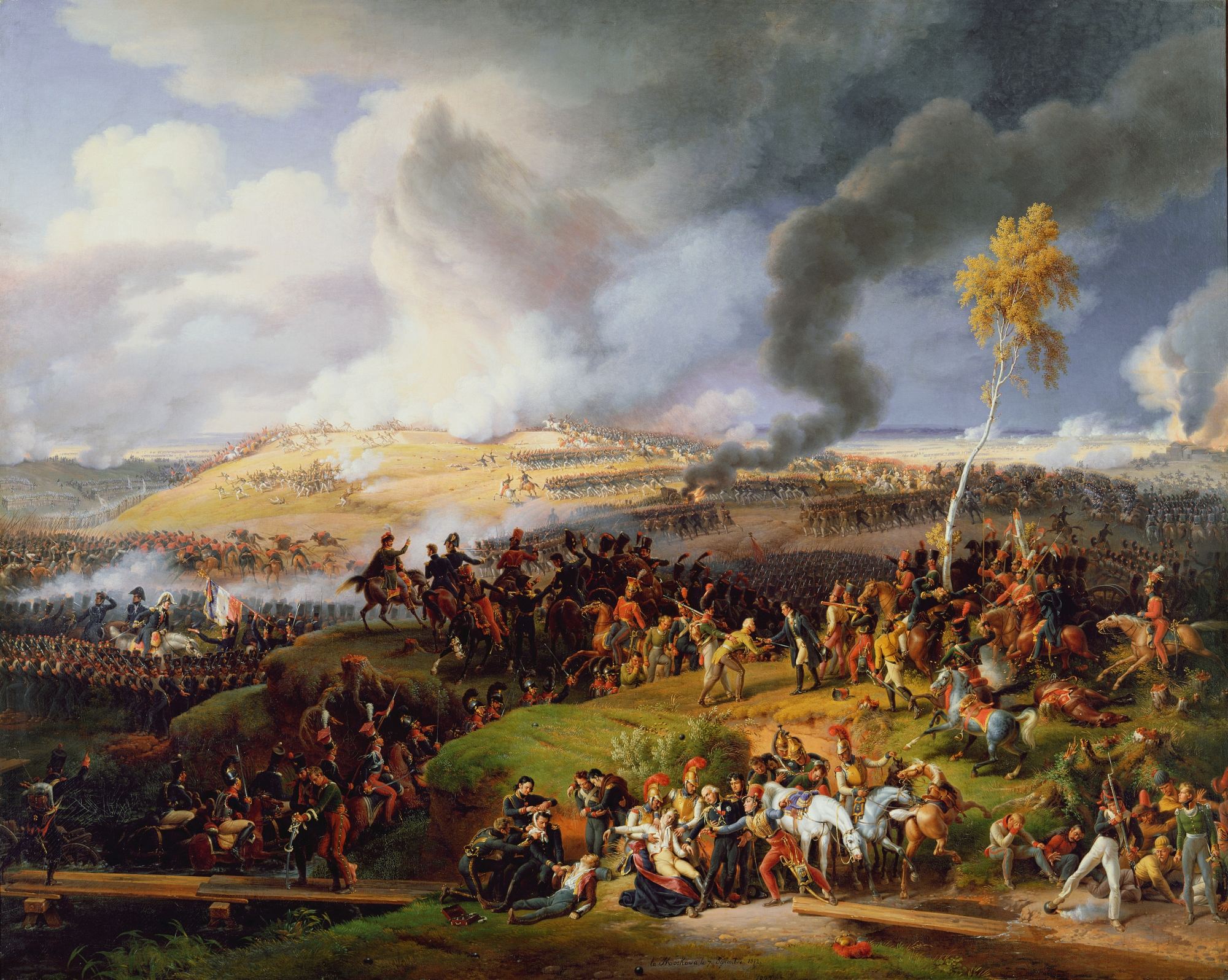
Battle of Borodino
BattleWikipedia
39
MENTIONS
21
EPISODES
19
PODCASTS
Search complete. 39 mentions across 21 episodes found for "Battle of Borodino".
Oct 16, 2026
Waiting #1219
C
0:59Chad SmithHOST
He was in his late sixties, heavy and half-blind from an old head wound.
C
1:03Chad SmithHOST
The court and the public wanted Moscow defended, so he gave them one fight at Borodino.
C
1:08Chad SmithHOST
It was one of the bloodiest days in history, and it settled nothing, and then he did what nobody could stand.
C
1:13Chad SmithHOST
He retreated and gave up Moscow.
History of Napoleon is so Perfectly Boring...You'll Fall Asleep
S
104:33Stephen DaltonHOST
And still Napoleon pushes forward.
S
104:39Stephen DaltonHOST
Eventually, in September, the Russians make a major stand at Borodino near Moscow.
S
104:49Stephen DaltonHOST
The battle is enormous and exceptionally bloody, so there is nothing amusing about the fighting itself.
S
104:59Stephen DaltonHOST
What matters for our story is that Napoleon wins the field, but he does not destroy the Russian army.
REPLAY: Why you feel busy all the time (even when you’re not), with Laura Vanderkam
A
22:25Amantha ImberHOST
[laughs]
L
22:25Laura VanderkamGUEST
Or the Battle of Borodino, like, you know, it goes on for a while.
A
22:28Amantha ImberHOST
[laughs]
L
22:28Laura VanderkamGUEST
The Battle of Borodino is with us for a bit.
A
22:30Amantha ImberHOST
[laughs]
L
22:30Laura VanderkamGUEST
So a lot of people have abandoned the pursuit in there.
Nobel Prize winner Anne Carson in conversation with Eleanor Wachtel
A
35:59Anne CarsonSOUNDBITE_SPEAKER
I complained to you often enough when they were here all night with the boards spread out and rugs and little lamps and cigarettes like Napoleon's tent, I suppose.
A
36:08Anne CarsonSOUNDBITE_SPEAKER
Who could sleep? All in all, my husband was a man who knew more about the Battle of Borodino than he did about his own wife's body, much more.
A
36:18Anne CarsonSOUNDBITE_SPEAKER
Tensions poured up the walls and along the ceiling.
A
36:22Anne CarsonSOUNDBITE_SPEAKER
Sometimes they played Friday night till Monday morning straight through, he and his pale, wrathful friends.
A
36:28Anne CarsonSOUNDBITE_SPEAKER
They sweated badly.
A
36:30Anne CarsonSOUNDBITE_SPEAKER
They ate meats of the countries in play.
A
36:33Anne CarsonSOUNDBITE_SPEAKER
Jealousy formed no small part of my relationship to the Battle of Borodino.
A
36:39Anne CarsonSOUNDBITE_SPEAKER
I hate it.
Tschaikovsky And His Orchestral Music-Louis Biancolli
D
21:29David WalesNARRATOR
But his friend Kashkin insisted the piece was requested for the ceremonies consecrating the Moscow Cathedral of the Saviour intended to symbolize Russia's part in the Napoleonic struggle.
D
21:41David WalesNARRATOR
The Overture accordingly pictured the great events beginning with the Battle of Borodino, September 7, 1812, and ending with Napoleon's flight from Moscow after the city was set aflame.
D
21:54David WalesNARRATOR
To make it more effective, the work was to be performed in the public square before the cathedral.
D
22:00David WalesNARRATOR
An electric connection on the conductor's desk would set off salvos of real artillery, and all Moscow would thrill with the thoughts of its heroic past.
Napoleon and his Marshals: Victory, Rivalry, Betrayal with Andrew Roberts
P
21:08Phil CraigHOST
Maybe like the Peninsular War, they could have done better.
P
21:10Phil CraigHOST
At Borodino, he had 10
A
21:11Andrew RobertsGUEST
marshals.
A
21:12Andrew RobertsGUEST
If he'd had 10 marshals at Waterloo, he could hardly have done worse, certainly, than when he only had two.
Napoleon’s nest of vipers
A
33:11Andrew RobertsGUEST
Um, and, uh, and so the... and he also, Davout, did come up with a much better, um, route back home, uh, which Napoleon didn't take.
A
33:22Andrew RobertsGUEST
Instead, he took, uh, the advice of some of his other marshals and, and wound up doing a huge dogleg via the battlefield of Borodino, which is when the, uh, snow started to descend.
P
33:34Paul LayHOST
Now, we can get to Waterloo.
P
33:37Paul LayHOST
We must get to Waterloo, of course.
A
37:27Andrew RobertsGUEST
No, it was a, it was a great, a great victory for, um, for the Duke of Wellington.
A
37:33Andrew RobertsGUEST
But I think had Napoleon had as many marshals on the battlefield of Waterloo, he only had two marshals, Ney and Soult, with him at Waterloo, um, whereas which out of the 26, or at least the 22 who were still alive by then, um, that, you know, that's not enough.
A
37:54Andrew RobertsGUEST
Um, at Borodino, he, he had 10, for example.
A
37:58Andrew RobertsGUEST
And so he, he re- the, the day he most required in order to save his empire to have the maximum amount of talent pool present, he only had two, and those two were in the wrong jobs.
3.06 The Assembled Man: Life and crimes of Igor 'Strelkov' Girkin
K
16:30Kristaps AndrejsonsHOST
He specialized, and the specialization tells you everything.
K
16:32Kristaps AndrejsonsHOST
Not the Great Patriotic War where his own grandfather had bled, not Borodino.
K
16:36Kristaps AndrejsonsHOST
No, no, no.
K
16:37Kristaps AndrejsonsHOST
He went to the White Movement, specifically the Volunteer Army and the Armed Forces of South Russia, 1918 to 1920, the losing side, the side that was beaten, scattered into exile, and erased from Soviet history.
P
Unknown podcast
War and Peace, Book 12 1812-Leo Tolstoy
Oct 3 · 3 Mentions
S
2:53speaker_4UNKNOWN
The Empress Elizabeth, however, when asked what instructions she would be pleased to give, with her characteristic Russian patriotism, had replied that she could give no directions about state institutions, for that was the affair of the sovereign, but as far as she personally was concerned, she would be the last to quit Petersburg.
S
3:11speaker_4UNKNOWN
At Anna Pavlovna's on the 26th of August, the very day of the Battle of Borodino, there was a soiree, the chief feature of which was to be the reading of the letter from his lordship the bishop, while sending the emperor an icon of the venerable Sergius.
S
3:25speaker_4UNKNOWN
It was regarded as a model of ecclesiastical patriotic eloquence.
S
3:29speaker_4UNKNOWN
Prince Vasily himself, famed for his elocution, was to read it.
54 MINS LATER
S
57:07speaker_9UNKNOWN
It made him afraid.
S
57:19speaker_9UNKNOWN
War and Peace, Book 12, Chapter 7, read for LibriVox.org by David Ream.
S
57:28speaker_9UNKNOWN
The dreadful news of the Battle of Borodino, of our losses in killed and wounded, and the still more terrible news of the loss of Moscow, reached Voronezh in the middle of September.
S
57:38speaker_9UNKNOWN
Princess Mary, having learned of her brother's wound only from the Gazette and having no definite news of him, prepared, so Nicholas heard, he had not seen her again himself, to set off in search of Prince Andrew.
P
Unknown podcast
War and Peace, Book 15 1812-1813-Leo Tolstoy
Oct 3 · 2 Mentions
S
38:21speaker_4UNKNOWN
Obviously, in spite of himself, in very diverse circumstances, he repeatedly expressed his real thoughts with the bitter conviction that he would not be understood.
S
38:31speaker_4UNKNOWN
Beginning with the Battle of Borodino, from which time his disagreement with those about him began, he alone said that the battle of borodino was a victory and repeated this both verbally and in his dispatches and reports up to the time of his death he alone said that the loss of moscow is not the loss of russia in reply to lauriston's proposal of peace he said there can be no peace for such is the people's will He alone, during the retreat of the French, said that all our manoeuvres are useless, everything is being accomplished of itself better than we could desire, that the enemy must be offered a golden bridge, that neither the Tarantino, the Viasma, nor the Krasnoe battles were necessary, that we must keep some force to reach the frontier with, and that he would not sacrifice a single Russian for ten Frenchmen.
S
39:26speaker_4UNKNOWN
and this courtier as he is described to us who lies to arkchev to please the emperor he alone incurring thereby the emperor's displeasure said in vilna that to carry the war beyond the frontier is useless and harmful Nor do words alone prove that only he understood the meaning of the events.
S
39:48speaker_4UNKNOWN
His actions, without the smallest deviation, were all directed to one and the same threefold end.
52 MINS LATER
S
91:57speaker_11UNKNOWN
chapter twelve as generally happens pierre did not feel the full effects of the physical privation and strain he had suffered as prisoner until after they were over after his liberation he reached orel and on the third day there when preparing to go to kiev he felt ill and was laid up for three months he had what the doctors termed bilious fever but despite the fact that the doctors treated him bled him and gave him medicines to drink he recovered scarcely any impression was left on pierre's mind by all that happened to him from the time of his rescue till his illness he remembered only the dull grey weather now rainy and now snowy internal physical distress and pains in his feet and side he remembered a general impression of the misfortunes and sufferings of people and of being worried by the curiosity of officers and generals who questioned him He also remembered his difficulty in procuring a conveyance in horses, and above all he remembered his inadequacy to think and feel all that time.
S
93:07speaker_11UNKNOWN
On the day of his rescue he had seen the body of Petya Rostov.
S
93:11speaker_11UNKNOWN
That same day he had learned that Prince Andrew, after surviving the Battle of Borodino for more than a month, had recently died in the Rostov's house at Yaroslavl, and Denisov, who told him this news, also mentioned Helene's death.
S
93:26speaker_11UNKNOWN
supposing that pierre had heard of it long before all this at the time seemed merely strange to pierre he felt he could not grasp its significance just then he was only anxious to get away as quickly as possible from places where people were killing one another to some peaceful refuge where he could recover himself rest and think over all the strange new facts he had learned but on reaching arrel he immediately fell ill when he came to himself after his illness he saw in attendance on him two of his servants tarenti and vasca who had come from moscow and also his cousin the eldest princess who had been living on his estate at elitz and hearing of his rescue and illness had come to look after him it was only gradually during his convalescence that pierre lost the impression he had become accustomed to during the last few months and got used to the idea that no one would oblige him to go anywhere to-morrow that no one would deprive him of his warm bed and that he would be sure to get his dinner tea and supper but for a long time in his dreams he still saw himself in the conditions of captivity in the same way little by little he came to understand the news he had been told after his rescue about the death of prince andrew the death of his wife and the destruction of the french a joyous feeling of freedom that complete inalienable freedom natural to man which he had first experienced at the first halt outside moscow filled pierre's soul during his convalescence he was surprised to find that this inner freedom which was independent of external conditions now had as it were an additional setting of external liberty he was alone in a strange town without acquaintances no one demanded anything of him or sent him anywhere he had all he wanted the thought of his wife which had been a continual torment to him was no longer there since she was no more oh how good how splendid said he to himself when a cleanly laid table was moved up to him with savoury beef-tea or when he lay down for a night on a soft clean bed or when he remembered that the french had gone and that his wife was no more oh how good how splendid and by old habit he asked himself the question well and what then what am i going to do and he immediately gave himself the answer well i shall live ah how splendid the very question that had formerly tormented him the thing he had continually sought to find the aim of life no longer existed for him now that search for the aim of life had not merely disappeared temporarily he felt that it no longer existed for him and could not present itself again and this very absence of an aim gave him the complete joyous sense of freedom which constituted his happiness at this time he could not see an aim for he now had faith not faith in any kind of rule or words or ideas but faith in an ever-living ever-manifest god formerly he had sought him in aims he set himself that search for an aim had been simply a search for god and suddenly in his captivity he had learned not by words or reasoning but by direct feeling what his nurse had told him long ago that god is here and everywhere in his captivity he had learned that in kerchev god was greater more infinite and unfathomable than in the architect of the universe recognized by the freemasons he felt like a man who after straining his eyes to see into the far distance finds what he sought at his very feet all his life he had looked over the heads of the men around him when he should have merely looked in front of him without straining his eyes in the past he had never been able to find that great inscrutable infinite something he had only felt that it must exist somewhere and had looked for it in everything near and comprehensible he had only what was limited petty commonplace and senseless he had equipped himself with a mental telescope and looked into remote space where petty worldliness hiding itself in misty distance had seemed to him great and infinite merely because it was not clearly seen and such had european life politics freemasonry philosophy and philanthropy seemed to him but even then at moments of weakness as he had accounted them his mind had penetrated to those distances and he had there seen the same pettiness worldliness and senselessness now however he had learned to see the great eternal and infinite in everything and therefore to see it and enjoy its contemplation he naturally threw away the telescope through which he had till now gazed over men's heads and gladly regarded the ever-changing eternally great unfathomable and infinite life around him and the closer he looked the more tranquil and happy he became that dreadful question what for which had formerly destroyed all his mental edifices no longer existed for him to that question what for a simple answer was now always ready in his soul because there is a god that god without whose will not one hair falls from a man's head chapter twelve this recording is in the public domain
11 more episodes mention Battle of Borodino.
Create an account to see the whole feed, search across every transcript, and follow the entities you care about.